

Where Did My Goldfinches Go?
By IdentifyThese Editorial · Reviewed · 3 min read
They did not leave. They changed colour, and the feeder they are on is yours.
The moult
American goldfinches are unusual among North American songbirds in moulting completely twice a year. In late summer the brilliant lemon-yellow body feathers are replaced with olive-buff, and the black cap goes entirely. By November a male looks like a different, much duller bird.
In spring they moult again and the yellow returns, which is why they seem to arrive in April.
Most other finches simply wear their bright feathers down over winter. Goldfinches replace theirs.
What stays the same
The black wings with two white wing bars. In every plumage, both sexes, all year. This is the character to look for.
Also constant:
- A short conical pale bill, orange in summer and duller in winter
- Deeply undulating flight, rising and falling in long bounces
- A flight call given on each bounce, often written po-ta-to-chip
- The habit of hanging upside down to feed
A small finch with black wings and white wing bars on a nyjer feeder in January is a goldfinch, whatever colour the body is.
What people mistake them for
| Winter goldfinch | Confused with | The difference |
|---|---|---|
| Olive-buff, black wings | Pine siskin | Siskins are heavily streaked with yellow flashes in the wing; goldfinches are unstreaked |
| Olive-buff, black wings | Female house finch | House finch is blurrily streaked below and has brown wings, not black |
| Olive-buff, black wings | Female purple finch | Bold white eyebrow and heavy streaking |
The streaking is the quick test. A winter goldfinch is plain below; the finches it is mistaken for are streaked.
Why they seem to leave and come back
Goldfinches are nomadic in winter, moving in flocks to wherever the seed is. A feeder can go from a dozen birds to none in a week and back again, and that is normal — they have found a better crop of thistle or birch seed somewhere and will be back.
They are also the latest-nesting songbird in North America, waiting until late June or July when thistle and milkweed down is available for the nest and seed for the young. If your goldfinches disappear in midsummer rather than winter, they are nesting.
Feeding them
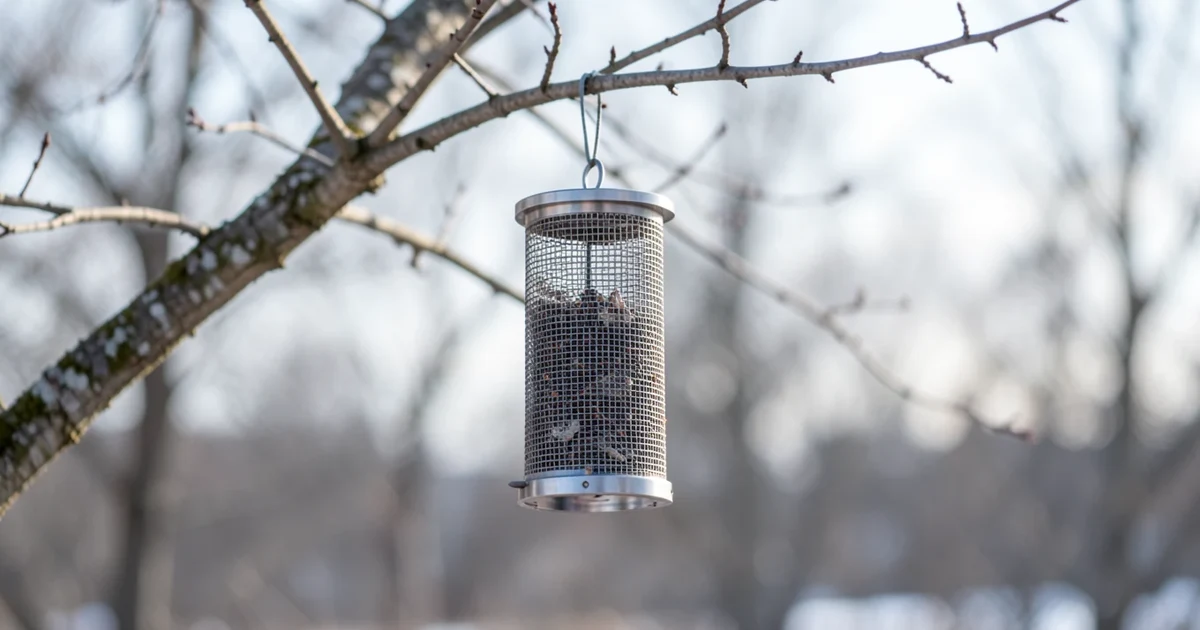
- Nyjer in a mesh or sock feeder. They will cling and feed upside down, which most competitors cannot.
- Hulled sunflower works as well and is cheaper.
- Keep nyjer dry. It goes rancid and moldy quickly, and birds will simply stop coming to a feeder of old seed. If it has been out more than three weeks in damp weather, replace it.
- They are strictly vegetarian, almost uniquely among songbirds — even the nestlings are fed seed rather than insects. This is why cowbird chicks laid in a goldfinch nest usually do not survive.
The general lesson
If a familiar bird seems to have vanished, consider the plumage before the migration. Several species do this and it produces the same question every autumn:
- European starlings go heavily white-spotted in winter and lose the yellow bill.
- American robins are still present through most winters — they move from lawns to fruiting trees and stop being conspicuous.
- Male scarlet tanagers moult to olive-green.
The features to trust are the ones that do not change, which is the argument for starting with bill shape rather than colour — and for a goldfinch, the black wings are that feature.
The one that catches people out in spring
The reverse question arrives in April: goldfinches that appear overnight in brilliant yellow, as though a new species had moved in.
Same birds, moulting back. The change takes a few weeks and males pass through a patchy stage where they look moth-eaten, which produces a second wave of concerned questions about sick birds at the feeder.
Species referenced
Keep reading
- The Small Brown Bird at My FeederFour species account for nearly every one. Look at the breast — plain, blurry or heavily streaked with a central spot — and the answer follows.
- Start With the Bill, Not the ColourColour is what everyone reaches for and the least reliable character a bird has. Bill shape follows diet, does not change, and eliminates far more of the list.
- There's a Hawk at My Bird FeederIt is almost certainly a Cooper's or sharp-shinned hawk, and it is hunting the birds rather than the seed. Here is what to do and what not to.