Free · No sign-up · Works offline once loaded
What rock is this? Work it out properly, in about five minutes.
Photographs are a bad way to identify minerals, because colour is the least reliable property a mineral has. This site asks what you can actually test — how hard it is, what colour it streaks, how it breaks — and narrows 49 common minerals down to a short list you can check by hand.

Rock Scanner: Stone Identifier — Free★ 4.2 · 67 ratings · iPhone & iPad
- 49 minerals
- Five field tests, no equipment to buy
- Nothing you enter leaves your browser
1.How hard is it?
optionalThe single most useful test. Try to scratch a fresh surface — not a weathered crust — and rub the powder away to check the mark is real.
2.What does the surface look like?
optionalJudge lustre on a freshly broken face in good light. Tarnish and weathering will mislead you.
3.What colour is the streak?
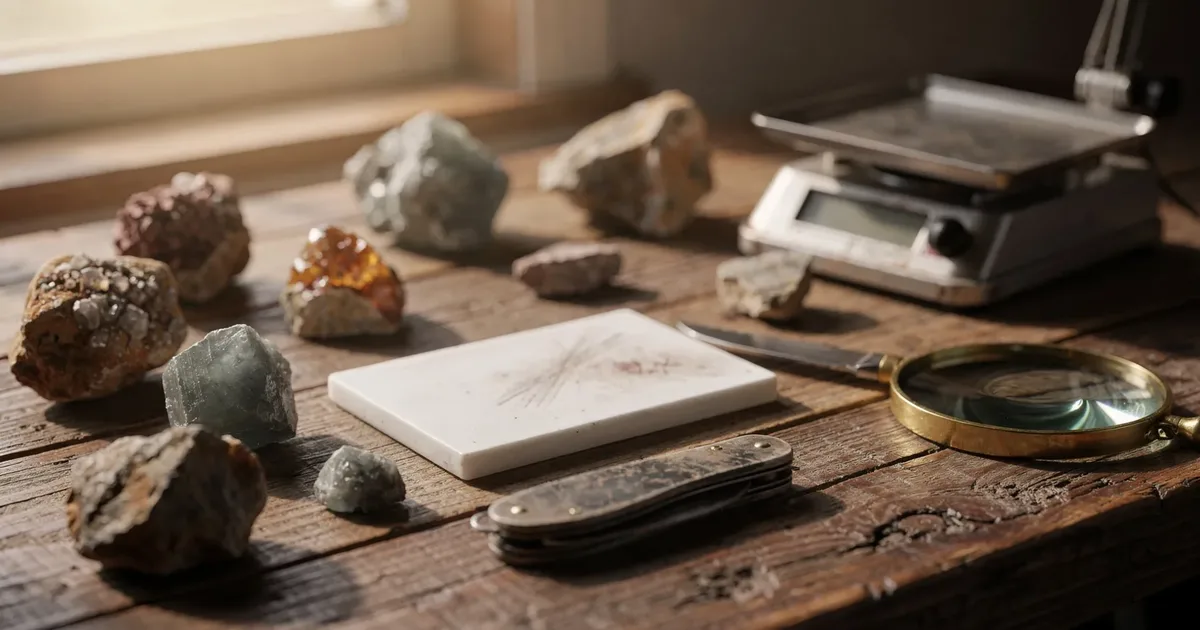
optionalDrag the specimen firmly across the unglazed back of a ceramic tile. The powder colour is often nothing like the specimen colour — that is exactly why this test is worth doing.
4.How does it break?
optionalLook at a broken edge under a bright light and turn it slowly. Flat faces that flash all at once are cleavage; curved shiny surfaces are fracture.
5.Any of these true?
optionalPick every one that applies. These are the shortcuts — a magnet sticking to a rock narrows the whole list down to one.
Safety: never taste a mineral you have not already narrowed to halite, never crush fibrous green material, and wash your hands after handling anything metallic and heavy.
6.What colour is it?
optionalDeliberately last, and it never rules anything out — it only reorders the list. Colour is the least reliable property in mineralogy.
- ApatiteH 5 · Often a distinctive sea-green or blue-green; also yellow and violet
- Augite (Pyroxene)H 5.5–6 · Dark green-black to brown-black; typically duller than hornblende
- AzuriteH 3.5–4 · A deep azure blue that darkens almost to black in massive material
- BariteH 3–3.5 · Usually white or pale; sand-included 'barite roses' are reddish brown
- Beryl (Emerald & Aquamarine)H 7.5–8 · Green beryl is emerald
- BiotiteH 2.5–3 · Dark brown to black
- CalciteH 3 · Usually white or colourless
- CassiteriteH 6–7 · Usually near black or dark reddish brown
- Chalcedony (Agate, Jasper, Chert)H 6.5–7 · Any colour
- ChalcopyriteH 3.5–4 · Deeper
- ChloriteH 2–2.5 · Almost always a distinct green
- ChromiteH 5.5 · Brownish black
- CopperH 2.5–3 · Fresh surfaces are bright copper-red; exposed surfaces tarnish brown
- Corundum (Ruby & Sapphire)H 9 · Red corundum is ruby; every other colour is sapphire
- DolomiteH 3.5–4 · Typically white to pale pink or buff
- EpidoteH 6–7 · A very particular yellow-green often described as pistachio green
- Feldspar (Orthoclase & Plagioclase)H 6–6.5 · Salmon pink and creamy white are the classic colours
- FluoriteH 4 · Famous for colour zoning — a single crystal can be purple at the corners and green in the middle
- GalenaH 2.5–2.75 · Bright silvery lead-gray when fresh
- GarnetH 6.5–7.5 · Deep brownish red is by far the most common
- GoethiteH 5–5.5 · Yellow-brown to near black
- GoldH 2.5–3 · Always a rich buttery yellow
- GraphiteH 1–2 · Steel gray to black with a slightly greasy sheen
- GypsumH 2 · Usually colourless or white; sand inclusions give desert roses their brown colour
The four mix-ups that account for most wrong answers
Browse the minerals
Every entry lists the tests that confirm it, the minerals it is confused with, and an honest note on what it is actually worth.
The hardness ladder, in objects you already own
Questions people ask
How do you identify a rock or mineral?
By testing properties rather than matching photographs. Hardness, streak, lustre, cleavage and a few quick checks like magnetism narrow the field faster than appearance does, because colour is the least reliable property a mineral has. Running the five tests in order usually takes a specimen down to a short list you can settle by hand.
Why can't I just identify a rock from a photo?
Because the properties that separate minerals mostly are not visible. Quartz and calcite can look identical and are told apart in seconds by a knife and a piece of tile. A photograph carries colour and shape, which are the two properties that mislead beginners most often. A photo is a good starting point and a poor finishing one.
Is my rock valuable?
Almost always no, and understanding why is more useful than a false yes. Value comes from crystal quality, genuine rarity, locality and provenance — not from a mineral being pretty or hard to name. The handful of finds worth pursuing seriously are gold, gem-quality transparent crystals, fossils, meteorites and specimens from closed localities.
Is there an app that identifies rocks from a photo?
Yes — Rock Scanner: Stone Identifier does exactly that, and this site is its free web companion. The difference is worth knowing before you rely on either: the app reads appearance from a photograph, while this site works from properties you test by hand. Appearance gets you a candidate quickly; the tests tell you whether the candidate is right.
Is this site free, and do I have to sign up?
Identifying a specimen, every mineral page and every guide are free, with no account and no email. Nothing you enter is sent anywhere — it runs in your browser. The app is a separate free download if you want photo identification, offline reference and a specimen log.
How accurate is photo identification of minerals?
Useful for narrowing, not for concluding. Photo identification does well on distinctive, well-formed specimens and poorly on the weathered, dull, mixed material most people actually pick up — which is the same limitation a geologist has looking at a photo. Treat any photo result as a hypothesis and confirm it with a hardness and streak test before you believe it.