

Calcite vs Quartz: How to Tell Them Apart Every Time
By IdentifyThese Editorial · Reviewed · 4 min read
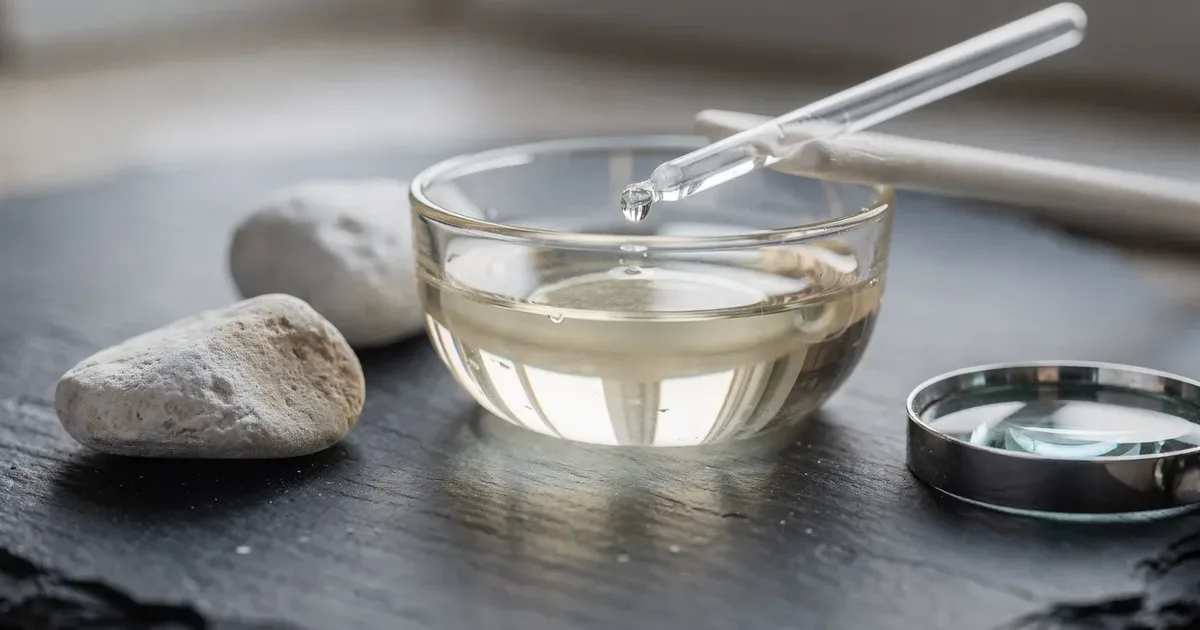
Calcite and quartz are both common, and both are frequently colourless. Both form good crystals in veins and cavities. And a great many white vein minerals get labelled "quartz" when they are actually calcite. Fortunately these two are separated by four tests that could hardly be more decisive.
The one-second version
Put a drop of vinegar on it. If it fizzes, it is calcite (or another carbonate). If nothing happens, it is not.
That is genuinely the whole answer in most cases. Everything below is for when you have no vinegar, or when the reaction is ambiguous.
Test 1: Hardness
This is the biggest practical difference between them, and it explains why the two minerals behave so differently in the world.
- Calcite is Mohs 3. A copper coin scratches it. So does a steel knife, effortlessly. It will not scratch glass.
- Quartz is Mohs 7. Nothing in your pocket scratches it. It scratches glass, steel, and calcite without difficulty.
Take the unknown and drag it across a piece of window glass, pressing firmly. If it cuts a real groove — check by wiping the powder away, since a soft mineral leaves a deposit that looks like a scratch — you have quartz. If it leaves nothing but a smear that rubs off, calcite.
Test 2: The acid test
Calcite is calcium carbonate. Carbonates release carbon dioxide when they meet acid, which you see as fizzing.
- Household white vinegar works, though slowly. Give it thirty seconds and look closely for small bubbles at the contact point.
- Dilute hydrochloric acid (sold as a masonry cleaner) reacts vigorously and instantly.
Quartz does not react at all, at any concentration, at room temperature.
One important caveat: dolomite also fizzes, but only reluctantly. If your sample fizzes weakly, scratch a small patch to powder with a knife and re-apply the acid. Dolomite fizzes readily on powder and barely at all on a solid face; calcite fizzes on both.
Test 3: Cleavage versus fracture
This is the test to use when the sample is dirty, weathered, or you have no acid.
Calcite has perfect cleavage in three directions, and none of them is at a right angle. Break a piece and it falls apart into leaning, lozenge-shaped blocks — rhombs. Every broken face is dead flat and mirror-bright, and if you turn the piece slowly under a lamp, whole faces light up at once.
Quartz has no cleavage whatsoever. It fractures conchoidally, meaning it breaks in smooth curved surfaces like a thick piece of glass. There are no flat faces from breakage, and turning it under a lamp produces a moving glint, not a flash.
Once you have seen a calcite rhomb next to a quartz fracture surface, you will never confuse the two again.
Test 4: Crystal shape
When crystals are well formed rather than broken:
- Quartz forms six-sided prisms that taper to a six-faced point at the end. The prism faces usually carry fine horizontal striations, running around the crystal rather than along it.
- Calcite is famously varied — over 800 crystal forms have been described. The most common are sharp "dogtooth" points and flat "nailhead" shapes. What calcite does not do is form quartz's clean hexagonal prism with a pointed cap.
The double refraction trick
If you have a clear, transparent, colourless piece, this is the most satisfying test in mineralogy.
Place the sample on a page of printed text. Calcite splits the light into two beams, so you see two overlapping copies of the text. Rotate the crystal and one image travels around the other. Quartz shows the text once.
This effect is strong enough in clear calcite — Iceland spar — that it was used in early polarising optical instruments.
Quick reference
| Calcite | Quartz | |
|---|---|---|
| Hardness | 3 | 7 |
| Scratched by a coin | Yes | No |
| Scratches glass | No | Yes |
| Vinegar | Fizzes | No reaction |
| Cleavage | Perfect, 3 directions, rhombs | None |
| Fracture | Rarely seen | Conchoidal, curved |
| Specific gravity | 2.71 | 2.65 |
| Double refraction | Yes, strong | No |
Why it matters
The distinction is not academic. Calcite dissolves in weakly acidic rainwater, which is why limestone country has caves, sinkholes and disappearing streams, and why a calcite specimen left outdoors slowly etches. Quartz survives essentially unchanged, which is why beach sand is quartz and not calcite almost everywhere outside the tropics.
If you are choosing a stone for a tumbler, calcite will round and dull while the quartz in the same barrel comes out polished. If you are identifying a rock, knowing which of the two you have tells you a great deal about where it came from.
Mineral pages referenced
Keep reading
- Is There Gold in This Quartz?Usually pyrite or mica, and both are easy to rule out in under a minute. The four tests that settle it, and what a genuine gold-bearing specimen looks like.
- What Is This Black Shiny Rock?Eight things account for nearly every shiny black rock. Streak colour, weight and how it breaks separate all of them in about two minutes.
- Is This a Meteorite? Almost Certainly NotSlag, magnetite and industrial waste account for nearly every suspected meteorite. Fusion crust, density, magnetism and the nickel test — and what rules one out instantly.