

Is There Gold in This Quartz?
By IdentifyThese Editorial · Reviewed · 3 min read
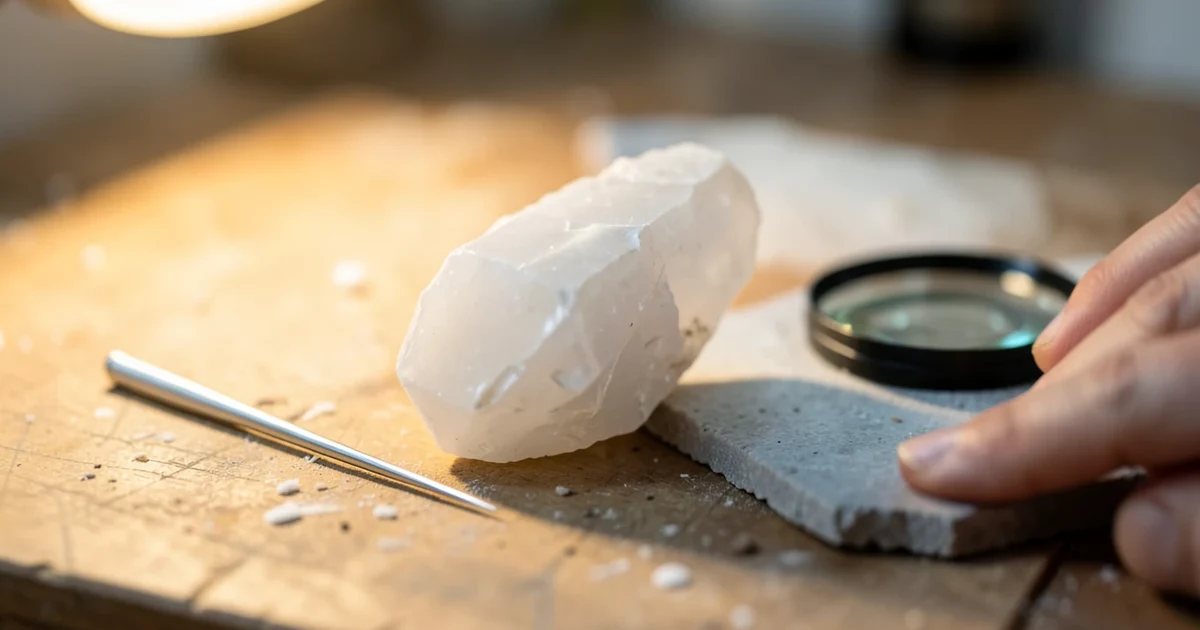
Quartz veins do carry gold, and gold in quartz is what most productive hard-rock gold mines actually look like. That is why the question is worth asking rather than dismissing.
It is also why almost every specimen brought in is pyrite or mica. The good news is that both are eliminated in under a minute with things already in the room.
The four tests
Run them in order. The first two settle the great majority of cases.
| Test | Gold | Pyrite | Mica |
|---|---|---|---|
| Streak on unglazed tile | Golden yellow | Greenish black | White to colourless |
| Steel needle pressed in | Dents, cuts, moves like metal | Shatters into powder | Peels into flakes |
| Shape under a lens | Irregular blobs, wires, ragged edges | Cubes, or radiating striations on flat faces | Flat sheets, book-like stacks |
| Weight in the hand | Startlingly heavy for its size | Heavy, but not startling | Light |
The streak test is the decisive one and takes five seconds. Drag the sample firmly across the unglazed back of a ceramic tile. Gold leaves a golden line because gold is gold all the way through. Pyrite leaves greenish black because its powder is a different colour from its surface — that mismatch is exactly what streak tests exploit.
Why colour alone always fails
Fresh pyrite in the right light is a convincing gold colour, and it occurs in quartz veins for the same geological reasons gold does. Weathered mica flashes gold-yellow in sunlight and sits in the same rocks.
Under a hand lens the differences are obvious. Gold in quartz appears as irregular specks, ragged blobs, or occasionally wires and dendritic sprays. It has no crystal faces to speak of. Pyrite forms cubes and has flat mirror-like faces, often with fine parallel striations. Mica is flat sheets you can lift with a fingernail.
What genuine gold in quartz looks like
Usually less impressive than people expect. Visible gold in a quartz specimen is typically fine specks along a fracture or seam rather than a nugget embedded in white stone.
The gold sits in the vein, and often along later cracks within it, so it tends to follow lines rather than sit in the middle of a clean block. Rusty iron staining in and around a quartz vein is a genuinely encouraging sign — it indicates sulphides have weathered out, and gold frequently travels with sulphides.
Testing without destroying the specimen
If the specimen is attractive and you would rather not scratch it, the streak test can be done on an inconspicuous edge, and the needle test on the same spot.
Specific gravity is the non-destructive option. Weigh the piece dry, then weigh it suspended in water, and divide the dry weight by the difference. Quartz alone comes out around 2.65. Anything substantially above that indicates something dense in there — pyrite is about 5, gold is 19.
If it passes everything
Golden streak, dents under a needle, irregular shapes under a lens, unusually heavy for its size — then it is worth a proper look rather than another web page.
Take it to a university geology department, a lapidary club, or a precious metals dealer. Assay labs will give you a number, and it costs less than most people assume.
Two practical notes. Gold recovered from public land is subject to local law — in many jurisdictions panning requires a permit and in some it is prohibited outright. And a specimen with visible gold in matrix is frequently worth more intact as a specimen than the gold in it is worth melted, so do not crush it before someone has looked at it.
For the full side-by-side including the hammer and weight tests, see gold vs pyrite in six tests. For what actually creates value in a specimen, an honest answer.
Keep reading
- Gold vs Pyrite: Six Tests That Settle It in Two MinutesSix field tests that separate real gold from pyrite, chalcopyrite and mica — using a knife, a ceramic tile and your hands. No chemicals required.
- Is My Rock Valuable? An Honest AnswerMost rocks are worth nothing, and that is fine. Here is what actually creates value in a specimen, the handful of finds worth pursuing, and how to get a real appraisal.
- Calcite vs Quartz: How to Tell Them Apart Every TimeCalcite and quartz look almost identical and behave completely differently. Four tests — hardness, acid, cleavage and crystal shape — separate them in under a minute.