

Hematite vs Magnetite: The Magnet and the Streak Plate
By IdentifyThese Editorial · Reviewed · 3 min read
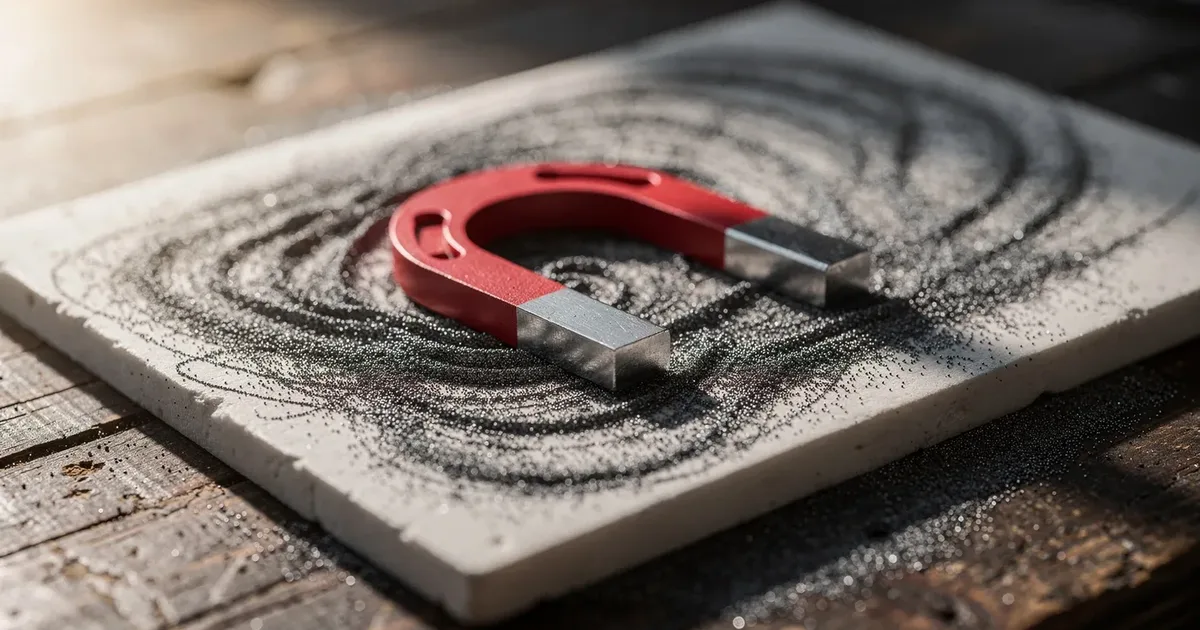
Hematite and magnetite are both iron oxides, both heavy, dark and metallic-looking. Both turn up in the same rocks. And they are separated by two tests that take about ten seconds combined.
Test 1: The magnet
Hold an ordinary refrigerator magnet against the specimen.
- Magnetite sticks. Firmly and unmistakably. Small pieces will leap to the magnet.
- Hematite does not. A powerful neodymium magnet may produce a faint tug on some specimens, but nothing that could be called sticking.
Magnetite is one of very few naturally strongly magnetic minerals, which makes this test nearly conclusive on its own. If a black rock grabs a magnet, magnetite is by far the most likely answer. (Pyrrhotite is weakly magnetic and much less common; meteorites are magnetic and much less common still.)
Test 2: The streak
Drag the specimen firmly across the unglazed back of a ceramic tile.
- Hematite leaves red-brown. Always. Even when the specimen is mirror-bright silver-black.
- Magnetite leaves black.
This surprises people, and it is worth understanding why it happens. Streak shows the colour of a mineral in powdered form. Bulk hematite looks metallic because light reflects off a smooth surface, but ground to a powder the same material is unambiguously red — this is the pigment in red ochre, red sandstone, and red soil worldwide. The metallic sheen is surface behaviour; the red is what hematite actually is.
Why one is magnetic and the other is not
Magnetite is Fe₃O₄, a mixture of iron in two different oxidation states. Their magnetic moments do not cancel, and the leftover produces a strong net magnetism (ferrimagnetism).
Hematite is Fe₂O₃, with iron in a single state. Its magnetic moments very nearly cancel, leaving only a trace (canted antiferromagnetism). That trace is real, which is why hematite records the Earth's ancient magnetic field and is useful in palaeomagnetism, but it is far too weak to hold a fridge magnet.
The confusing cases
Specular hematite is bright, silvery, and often sold under names like "specularite" or "iron rose". It looks far more like magnetite than like the dull red hematite people expect. Streak it: red-brown.
Martite is magnetite that has been chemically altered to hematite while keeping magnetite's octahedral crystal shape. It looks like magnetite, is shaped like magnetite, and streaks red like hematite. If shape and streak disagree, trust the streak.
Black sand in a gold pan is usually a mixture of both, plus chromite and garnet. A magnet dragged through it pulls out the magnetite fraction and leaves the rest, which is a practical prospecting technique rather than a curiosity.
Chromite is the third black mineral in this group. It is only weakly magnetic and its streak is dark brown rather than red or black. It appears almost exclusively near serpentinite and other ultramafic rock, so the surrounding geology is a strong hint.
Quick reference
| Hematite | Magnetite | Chromite | Goethite | |
|---|---|---|---|---|
| Streak | Red-brown | Black | Dark brown | Yellow-brown |
| Magnet | Weak or none | Strong | Weak | None |
| Hardness | 5–6.5 | 5.5–6.5 | 5.5 | 5–5.5 |
| Specific gravity | 5.3 | 5.2 | 4.5–4.8 | 3.3–4.3 |
| Typical habit | Botryoidal, platy, earthy | Octahedra, granular | Granular | Botryoidal, earthy |
A note on "magnetic hematite"
Polished black beads sold as magnetic hematite, hematine, or magnetic therapy jewellery are not hematite. They are a manufactured barium or strontium ferrite ceramic, magnetised during production. The giveaway is exactly the property being advertised: real hematite is not strongly magnetic, so anything sold because it is strongly magnetic is by definition not real hematite.
This matters if you are using a magnet as a test on tumbled or polished material of unknown origin. Test raw specimens where you can.
Mineral pages referenced
Keep reading
- What Is This Black Shiny Rock?Eight things account for nearly every shiny black rock. Streak colour, weight and how it breaks separate all of them in about two minutes.
- Gold vs Pyrite: Six Tests That Settle It in Two MinutesSix field tests that separate real gold from pyrite, chalcopyrite and mica — using a knife, a ceramic tile and your hands. No chemicals required.
- Calcite vs Quartz: How to Tell Them Apart Every TimeCalcite and quartz look almost identical and behave completely differently. Four tests — hardness, acid, cleavage and crystal shape — separate them in under a minute.