

What Is This Black Shiny Rock?
By IdentifyThese Editorial · Reviewed · 3 min read
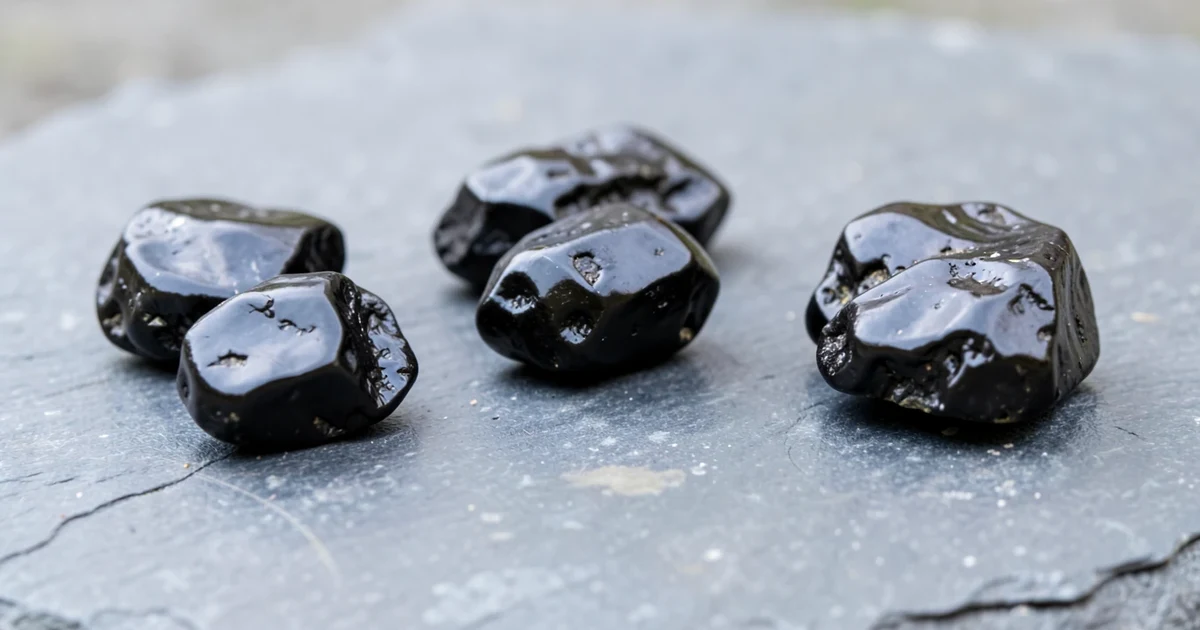
Shiny and black describes a lot of unrelated things, and the reason people get stuck is that colour is doing all the work. Three cheap tests separate essentially the whole group.
The three tests
Streak. Rub it on the unglazed back of a ceramic tile. The powder colour is far more consistent than the surface colour, and it is the single most useful test here — the full method is in the streak test.
Weight in the hand. Compare with an ordinary rock of similar size. Metallic minerals are dramatically heavier; glass and coal are noticeably lighter.
A magnet. A fridge magnet is enough for magnetite. A stronger one detects weak attraction.
The results
| Streak | Weight | Magnetic | Breaks | |
|---|---|---|---|---|
| Obsidian | White | Light | No | Curved glassy shells |
| Hematite | Red-brown | Heavy | Weakly, if at all | Irregular |
| Magnetite | Black | Heavy | Strongly | Irregular, octahedral crystals |
| Graphite | Grey-black, marks paper | Light | No | Flakes, greasy feel |
| Galena | Grey | Very heavy | No | Perfect cubes |
| Biotite mica | White | Light | No | Peels in elastic sheets |
| Molybdenite | Grey-green | Moderate | No | Flakes, greasy, softer than graphite |
| Coal | Brown-black | Very light | No | Blocky, dirties hands |
| Slag | Variable | Variable | Often | Glassy with bubbles |
The red-brown streak of hematite is the standout. A heavy black rock that leaves a rust-coloured mark is hematite, and no amount of surface metallic lustre changes that. It is the single most satisfying result in mineral identification and it is why hematite vs magnetite turns on the streak plate and the magnet together.
Working through it
Does it stick to a magnet?
Strongly — magnetite, or slag, or in rare cases a meteorite. Magnetite forms octahedral crystals and has a black streak. Slag is bubbly and glassy. Before getting excited about the third option, read is this a meteorite, because it almost never is.
Weakly — some hematite, some ilmenite.
Does it leave a red-brown streak? Hematite. Done.
Does it mark paper like a pencil and feel greasy? Graphite. It is soft enough to scratch with a fingernail. Molybdenite is similar but has a faint blue-grey tint and a greener streak.
Is it startlingly heavy, with cubic crystals and a grey streak? Galena — lead sulphide, and the density is unmistakable once you have held one. Wash your hands.
Does it break in curved, shell-like surfaces with razor edges? Obsidian. Hold a thin edge to the light: it is translucent brown or green rather than truly black. It feels light because it is glass, and it is not a mineral at all — it has no crystal structure, which is exactly the distinction in rock, mineral or neither.
Does it peel into thin flexible sheets? Biotite mica. The sheets bend and spring back.
Is it very light, sooty, and does it mark your hands? Coal. Anthracite is genuinely shiny and surprisingly clean; bituminous coal is duller and dirtier.
The ones that are not natural
Slag accounts for an enormous share of shiny black rocks brought in for identification. Look for rounded gas bubbles, a glassy fracture, unnatural colour flashes — blue, green, iridescent purple — and an association with old industrial sites, railway ballast or riverbanks downstream of a foundry.
Clinker from furnaces and steam locomotives: porous, light, sharp, often reddish inside.
Asphalt fragments worn by water, which round convincingly.
Manufactured glass, including the thick bases of old bottles.
None of these have a geological name, and it is worth reaching that conclusion early rather than working through a mineral key that cannot contain the answer.
Two that fool people
Sphalerite can look black and metallic, but its streak is pale yellow-brown and it often has resinous, almost gemmy patches on a fresh break. It is a major zinc ore.
Tourmaline (schorl) forms long black prisms with a distinctly triangular cross-section and striations running the length of the crystal. Hard, glassy, white streak. Where quartz veins carry black needles, this is usually the answer.
Once the streak plate and the magnet have narrowed it, hardness settles the remainder — the Mohs test with things you already own needs nothing more than a coin, a nail and a piece of glass.
Mineral pages referenced
Keep reading
- The Streak Test: The Most Underused Tool in IdentificationThe streak test takes five seconds and settles questions that colour cannot. How to do it properly, what each streak colour narrows to, and when it will not work.
- Hematite vs Magnetite: The Magnet and the Streak PlateTwo black iron minerals, two tests. A magnet and a ceramic tile separate hematite from magnetite reliably — here is why, and what to do about the confusing cases.
- Is This a Meteorite? Almost Certainly NotSlag, magnetite and industrial waste account for nearly every suspected meteorite. Fusion crust, density, magnetism and the nickel test — and what rules one out instantly.