

Is This a Meteorite? Almost Certainly Not
By IdentifyThese Editorial · Reviewed · 3 min read
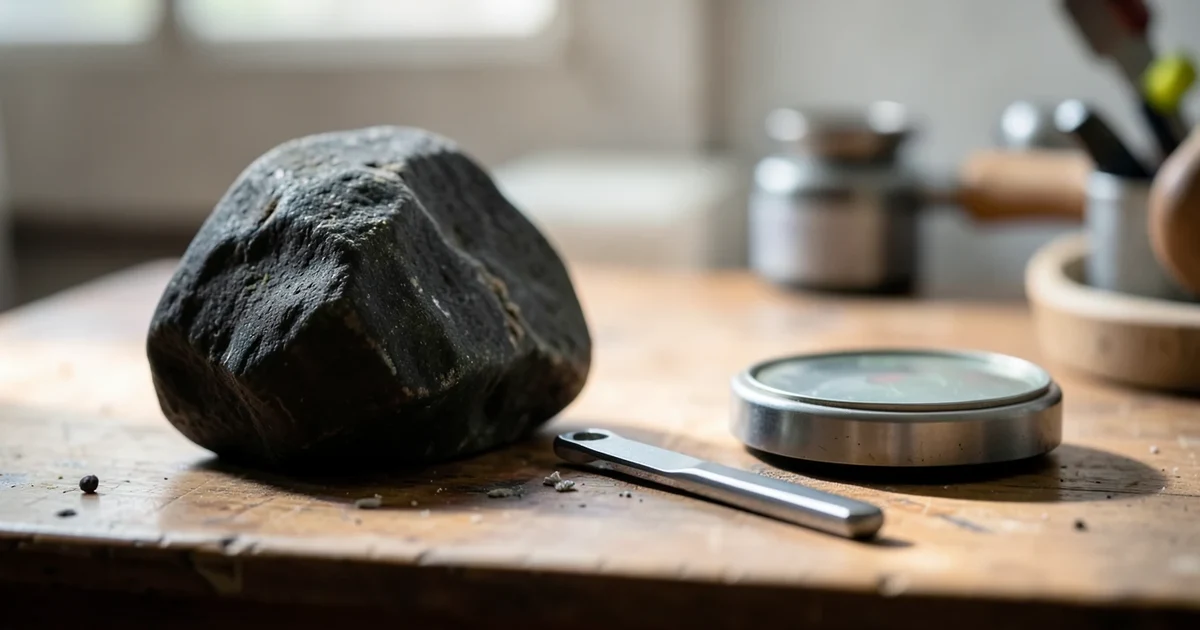
Meteorites are genuinely valuable and genuinely rare. Almost everything submitted as one is slag, magnetite, hematite, industrial furnace waste, or a piece of concrete with iron in it.
That is not a reason to skip the check. It is a reason to run the checks that rule things out first, because they are quick and they resolve nearly every case.
What rules one out immediately
Any of these and you can stop.
- Vesicles — bubbles or holes through the rock. Meteorites do not have them. Slag does, and this single feature eliminates the largest category of false finds.
- It is light for its size. Meteorites are dense. A rock that feels ordinary almost certainly is.
- Layers or banding. Meteorites are not sedimentary and do not have bedding.
- Visible quartz crystals. Quartz is essentially absent from meteorites.
- It rusted quickly after you found it, in a way that suggests manufactured steel.
- A perfectly rounded, water-worn shape. Meteorites break and ablate, they do not tumble smooth.
What actually points toward one
| Feature | What to look for |
|---|---|
| Fusion crust | A thin, dull black or brown rind, sometimes with fine flow lines. Fresh falls look shoe-polish black; old ones weather brown |
| Density | Noticeably heavier than a rock of the same size should be |
| Magnetism | Most stony and all iron meteorites attract a magnet strongly |
| Regmaglypts | Shallow thumbprint-like depressions in the surface, from ablation on the way down |
| No holes | A solid interior with no bubbles |
| Nickel | The chemical signature that actually confirms it |
The nickel test is the one that matters
Terrestrial iron-bearing rocks are common. Terrestrial rocks containing several percent nickel alloyed with iron are not.
That is the test that separates a meteorite from magnetite, hematite and slag, and it is why a laboratory answer is definitive where a visual one is not. A nickel test kit is inexpensive, and university geology departments will often check for free.
If the piece is an iron, cutting and etching a polished face with dilute nitric acid reveals Widmanstätten patterns — interlocking crystal bands that form over millions of years of very slow cooling and cannot be reproduced on Earth. Their presence is conclusive.
The magnet test, and its limit
A strong magnet sticking firmly is encouraging but proves nothing on its own. Magnetite is abundant, strongly magnetic, dense, and dark — it is the single most common thing mistaken for a meteorite.
Magnetite gives a black streak on an unglazed tile. Meteorites generally leave no streak at all, or a very faint grey one. That five-second test eliminates most magnetite immediately. How to run a streak test properly.
Where to get a real answer
University geology or planetary science departments frequently identify suspected meteorites at no charge. Many maintain a public page describing exactly what to send and what photographs to include.
Send clear photographs of the whole specimen, a close-up of the surface, and a broken or filed face showing the interior, along with the weight and where you found it. Do not clean it, do not polish it, and do not soak it — surface crust is diagnostic and removing it destroys the evidence.
If it turns out to be slag
Most do. Slag is a legitimate historical artefact in its own right, it tells you something about what was once done nearby, and it is not a wasted afternoon.
For what genuinely creates value in a specimen — and why most rocks are worth nothing, which is fine — see an honest answer.
Keep reading
- Is There Gold in This Quartz?Usually pyrite or mica, and both are easy to rule out in under a minute. The four tests that settle it, and what a genuine gold-bearing specimen looks like.
- Is My Rock Valuable? An Honest AnswerMost rocks are worth nothing, and that is fine. Here is what actually creates value in a specimen, the handful of finds worth pursuing, and how to get a real appraisal.
- What Is This Black Shiny Rock?Eight things account for nearly every shiny black rock. Streak colour, weight and how it breaks separate all of them in about two minutes.