
Rock, Mineral, or Neither?
By IdentifyThese Editorial · Reviewed · 3 min read
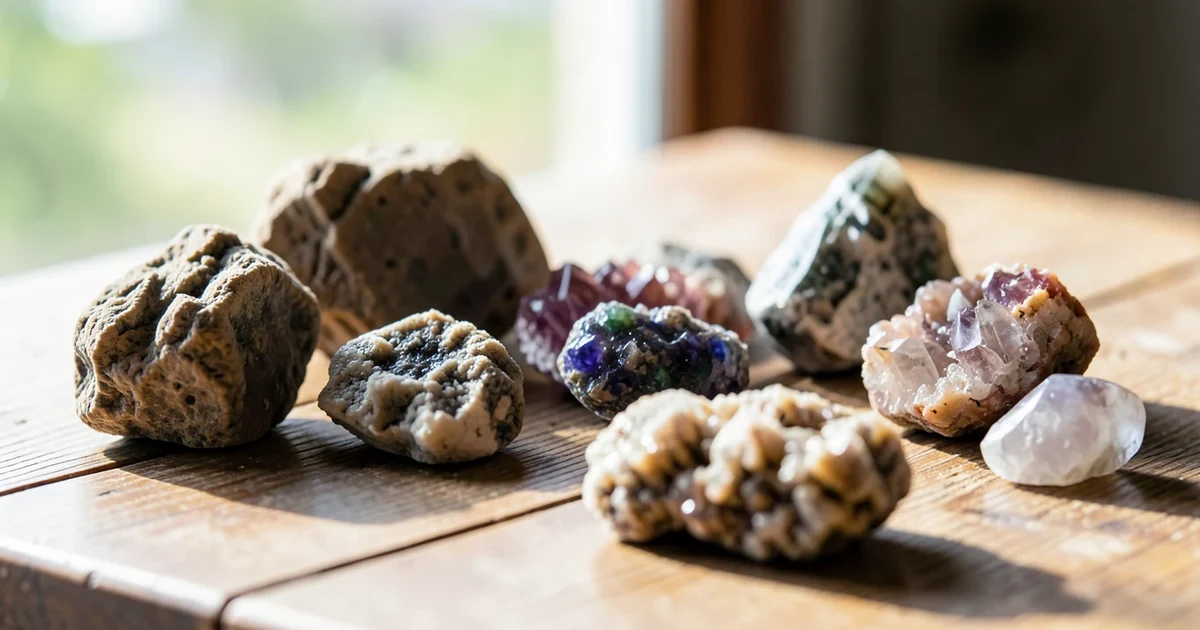
This distinction sounds academic and turns out to be the first useful step, because rocks and minerals are identified by different characters. Testing a rock as though it were a mineral produces confusion; the tests do not apply.
The definitions, and why each word is there
A mineral is:
- Naturally occurring
- Inorganic
- Solid
- Of a definite chemical composition
- With an ordered internal crystal structure
All five. Quartz is SiO₂ with silicon and oxygen atoms in a fixed repeating lattice — anywhere on Earth, the same composition and the same arrangement.
A rock is an aggregate of minerals. Granite is quartz plus feldspar plus mica, and the proportions vary between one outcrop and the next. There is no formula for granite.
Which tests apply to which
This is the practical consequence.
| Test | Mineral | Rock |
|---|---|---|
| Hardness | Meaningful — a fixed property | Meaningless — you are testing whichever grain you hit |
| Streak | Meaningful and diagnostic | Not meaningful |
| Cleavage | Diagnostic | Not applicable |
| Crystal form | Diagnostic | Not applicable |
| Texture and grain size | Not the point | The main character |
| Mineral composition | It is the mineral | The main character |
So if you have a rock, stop testing hardness and start asking what grains it is made of and how they are arranged. If you have a single crystal or a homogeneous mass, the mineral tests are the ones that work.
Telling them apart in the hand
Look at a broken surface with a hand lens.
- Uniform throughout, one colour and one texture, possibly with flat crystal faces or a consistent way of breaking — likely a mineral.
- Visibly made of different pieces — different colours, different lustres, distinguishable grains — a rock.
Some rocks are made almost entirely of one mineral, which blurs the line. Marble is nearly all calcite; quartzite is nearly all quartz. These are still rocks, because the defining thing is that they are an aggregate of interlocking grains rather than a single crystal.
The third category
A great deal of what gets brought in for identification is neither a rock nor a mineral, and recognising the group saves a lot of effort.
Slag. Industrial furnace waste. Glassy, often bubbly with rounded voids, frequently heavy, often metallic-looking, sometimes magnetic, and colours — blue, green, purple — that no natural rock produces. It is the single most common "meteorite", and is this a meteorite covers why.
Concrete and mortar. Angular aggregate set in a fine grey matrix. Weathered concrete rounded by water is convincing until you find a fragment with a flat cast surface.
Clinker and coal ash. From furnaces and old railway lines. Light, porous, dark, sharp.
Glass, worn. Beach glass, and the bases of old bottles frosted by sand.
Bone and fossilised bone. Porous internal structure, visible in cross section.
Concretions. Genuinely natural, genuinely confusing. Mineral cement forming around a nucleus in sediment, producing spheres, discs and shapes that look organic or manufactured. Frequently reported as fossil eggs, cannonballs or artefacts.
Rocks: the three families
Once you have established that it is a rock, the first split is how it formed.
- Igneous — cooled from melt. Interlocking crystals with no layering. Coarse if it cooled slowly underground (granite), fine or glassy if it cooled fast at the surface (basalt, obsidian). Often contains gas bubbles near the top of a flow.
- Sedimentary — deposited in layers. Visible bedding, rounded or angular grains cemented together, sometimes fossils. Usually softer and often reacts to acid if it is limestone.
- Metamorphic — altered by heat and pressure. Aligned minerals producing banding or a tendency to split in sheets. Slate, schist, gneiss.
Layers mean sedimentary or metamorphic. Interlocking crystals with no layering mean igneous. Sheets that split apart mean metamorphic.
What this changes
If someone asks what your rock is, the answerable version of the question depends on which of these it is. A mineral can be named specifically. A rock gets a type name and a description. And an object in the third category has no geological name at all, which is worth knowing before spending an afternoon on it — much as is my rock valuable is worth reading before spending money on it.
Mineral pages referenced
Keep reading
- Is My Rock Valuable? An Honest AnswerMost rocks are worth nothing, and that is fine. Here is what actually creates value in a specimen, the handful of finds worth pursuing, and how to get a real appraisal.
- The Streak Test: The Most Underused Tool in IdentificationThe streak test takes five seconds and settles questions that colour cannot. How to do it properly, what each streak colour narrows to, and when it will not work.
- A Rock With Crystals Inside: Geodes, Vugs and What They Are WorthA hollow lined with crystals is a geode; an irregular cavity in solid rock is a vug. Both form the same way, and neither is usually worth money.