

A Rock With Crystals Inside: Geodes, Vugs and What They Are Worth
By IdentifyThese Editorial · · 3 min read
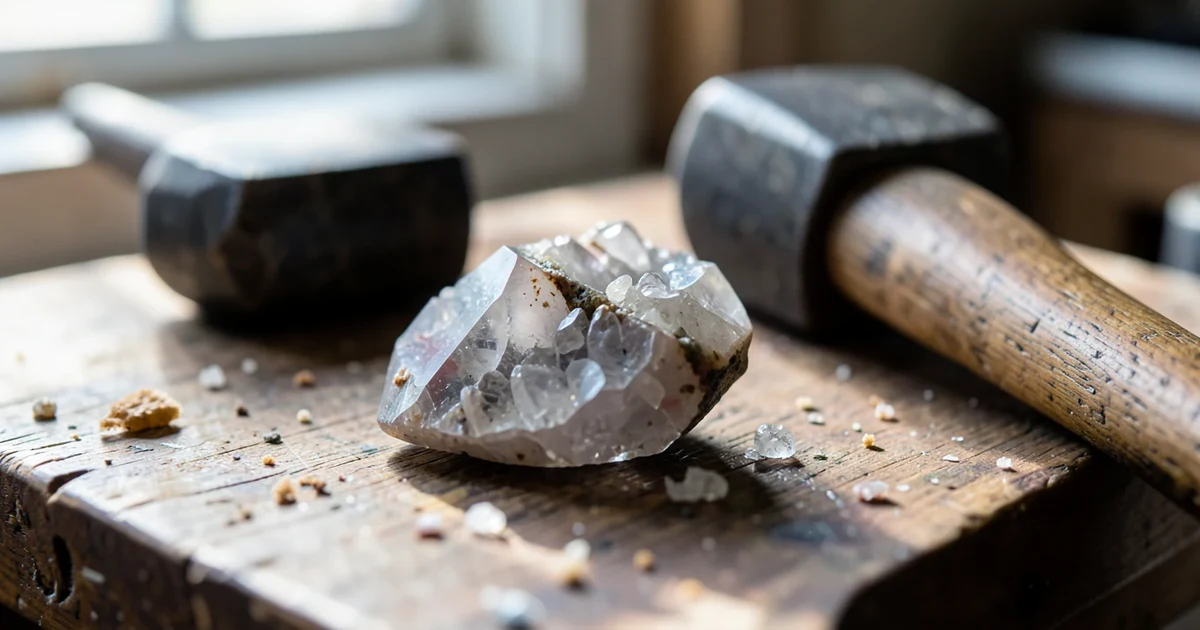
Both are cavities in rock that filled with crystals, and the distinction between them is mostly about shape.
- A geode is a roughly spherical hollow, lined inward with crystals, with a distinct outer shell that is tougher than the surrounding rock.
- A vug is an irregular cavity in solid rock, also crystal-lined, without the spherical form or the shell.
- A thunderegg is superficially like a geode but solid — filled with agate or chalcedony rather than hollow.
How they form
A void appears in rock. In volcanic rock it is usually a gas bubble trapped in cooling lava; in sedimentary rock it can be a dissolved nodule, a burrow, or a pocket left by a decayed organism.
Groundwater carrying dissolved silica, calcium carbonate or other minerals moves through the rock over a long period. Each pass deposits a little material on the cavity wall. Crystals grow inward from the walls toward the centre, which is why a geode's crystals all point inward and why the outer layers are typically fine-grained chalcedony while the inner ones are well-formed quartz.
If the process runs to completion, there is no hollow left and you have a thunderegg or a solid nodule. Most geodes stopped partway.
Finding one before you break it
- Weight. The most reliable clue. Pick up a suspect and a similar-sized ordinary rock. A geode is noticeably lighter.
- Shape. Roughly spherical or potato-shaped, often with a bumpy, cauliflower-like surface.
- Sound. Tapping sometimes gives a hollow note. Less reliable than the weight test.
- Where. Geodes come from specific formations — limestone and dolomite beds, and the vesicular zones of basalt flows. They are not scattered randomly, and a locality either produces them abundantly or not at all.
Keokuk in Iowa, the Warsaw Formation across Iowa, Illinois and Missouri, Kentucky and Indiana limestones, and the Brazilian and Uruguayan basalts that supply most amethyst geodes are the classics.
Opening one
Two approaches, and the choice is between speed and quality.
A rock saw gives a clean flat cut with a polished face. This is how the good ones are opened and it is what a lapidary club will have.
A chisel or a pipe cutter scores a line around the circumference and applies even pressure until it splits along that line. Slower, and it produces a natural break rather than a cut face.
Hitting it with a hammer works and frequently shatters the specimen. If you do, wear eye protection — the shell is brittle and fragments travel.
What is inside
Commonly, in rough order:
- Quartz — clear or milky, the default lining.
- Amethyst — purple quartz. The famous Brazilian and Uruguayan geodes.
- Calcite — often as scalenohedral "dogtooth" crystals; it fizzes in acid, which separates it from quartz instantly, as calcite vs quartz sets out.
- Chalcedony and agate — banded, fine-grained, forming the outer layers.
- Celestite, barite, fluorite, dolomite, pyrite, goethite — locality-specific, and where the interest usually is.
The Ohio celestite geodes, some of which are large enough to stand inside, are the best-known unusual case.
Value, honestly
Ordinary quartz-lined geodes are a bulk commodity, mined in quantity and sold cheaply. A common one is worth a few pounds regardless of how impressive it looks in your hand.
What raises value:
- Unusual mineral content — celestite, rare sulphates, well-formed fluorite
- Exceptional crystal quality: clarity, colour saturation, undamaged terminations
- Size, but only combined with quality
- A documented locality, particularly one no longer accessible
What does not raise value: being large, being heavy, being purple, or being found by you. Is my rock valuable covers the general shape of this, and geodes are one of the clearest cases — visually spectacular and commercially ordinary.
The confusions
Septarian nodules — cracked internally and filled with calcite, producing a yellow-brown web pattern. Solid, not hollow.
Concretions — mineral cement grown around a nucleus. Frequently spherical, sometimes hollow, often mistaken for eggs or artefacts. They are natural and they are not geodes.
Slag bubbles — industrial glass with rounded voids that can look crystal-lined. Bright unnatural colours and a glassy fracture give it away; the same material accounts for most suspected meteorites, as is this a meteorite explains.
Vesicular basalt — dark volcanic rock full of small gas bubbles, sometimes with crystals in them. That is a rock with vugs rather than a geode, and it is worth being clear which of those you have — rock, mineral or neither.
Mineral pages referenced
Keep reading
- Rock, Mineral, or Neither?A mineral is one substance with one composition. A rock is an aggregate of them. And a great deal of what gets brought in for identification is neither.
- Is My Rock Valuable? An Honest AnswerMost rocks are worth nothing, and that is fine. Here is what actually creates value in a specimen, the handful of finds worth pursuing, and how to get a real appraisal.
- Is There Gold in This Quartz?Usually pyrite or mica, and both are easy to rule out in under a minute. The four tests that settle it, and what a genuine gold-bearing specimen looks like.