
The Mohs Hardness Test With Things You Already Own
By IdentifyThese Editorial · · 3 min read · updated August 2026
The Mohs scale ranks minerals by what scratches what. It is not a measurement of anything absolute — it is an ordering — but it is the most useful single test available to an amateur, and you can run it with things already in your pocket.
The reference scale
| Mohs | Mineral | Everyday equivalent |
|---|---|---|
| 1 | Talc | Crumbles under a fingernail |
| 2 | Gypsum | Fingernail (≈2.5) |
| 3 | Calcite | Copper coin (≈3.5) |
| 4 | Fluorite | |
| 5 | Apatite | Steel knife, window glass (≈5.5) |
| 6 | Orthoclase feldspar | Steel file (≈6.5) |
| 7 | Quartz | Scratches all of the above |
| 8 | Topaz | |
| 9 | Corundum | |
| 10 | Diamond |
The gaps are not equal. Diamond is roughly four times harder than corundum in absolute terms, despite being one step above it. The scale tells you order, not distance.
Your test kit
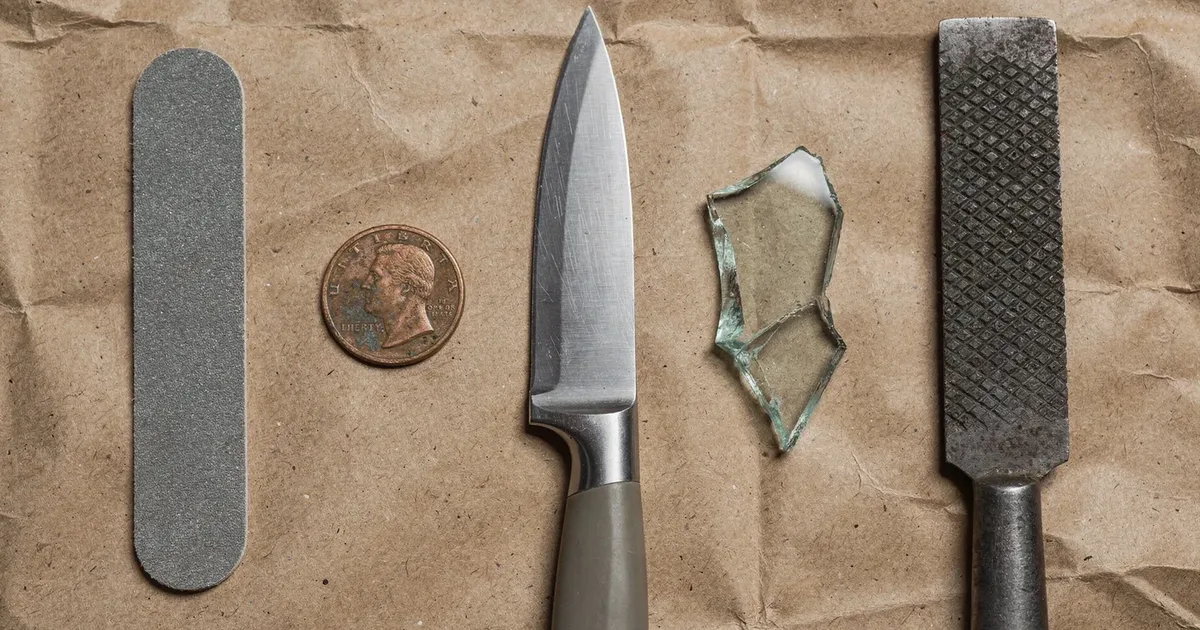
Fingernail — about 2.5. Free, always available.
Copper coin — about 3.5. With a caveat. Most modern coins are plated base metal, not solid copper. A US cent minted before 1982 is solid bronze and works. So does a scrap of copper pipe or a piece of household copper wire, which is more reliable and easier to grip.
Steel knife or nail — about 5.5. An ordinary pocket knife blade. Use the point or the spine, not the cutting edge, unless you enjoy sharpening.
Window glass — about 5.5. Useful as a target rather than a tool: try to scratch the glass with the mineral. Use a spare pane or a jar bottom, and mind the edges.
Steel file — about 6.5. A cheap flat file bridges the gap between glass and quartz.
A quartz crystal — exactly 7. A cheap clear point is the single most useful addition to the kit, because 7 is where a great many important distinctions sit.
How to run the test
- Find a fresh surface. Break a small corner off if you can. Weathered rock is much softer than the mineral inside it, and this causes more false readings than anything else.
- Press firmly and drag once, about a centimetre. Do not saw back and forth.
- Wipe the spot with your thumb, then look.
- Judge under good light, ideally with a hand lens.
The three mistakes
Mistaking a metal deposit for a scratch. When a steel knife slides across a harder mineral it leaves a grey metallic smear that looks exactly like a scratch. It wipes off. A real scratch does not. Always wipe before deciding — this single habit prevents most errors.
Testing a weathered or coated surface. A quartz pebble with a clay skin will appear soft. Iron staining, desert varnish, and weathering rinds all read softer than the underlying mineral.
Testing a fine-grained aggregate. Sandstone is made of quartz grains at hardness 7, but the rock crumbles under a fingernail because the cement between the grains is weak. You are testing the cement, not the mineral. Hardness testing applies to single mineral surfaces, not to porous rocks.
Directional hardness
One mineral breaks the rules, and it is worth knowing because it turns the exception into a diagnostic.
Kyanite is 4.5–5 when scratched along the length of its blades and 6.5–7 when scratched across them. A steel knife marks it in one direction and slides off in the other. Nothing else common behaves this way, so if you find a blue bladed mineral that is soft one way and hard the other, you have kyanite.
Reading the result
Once you have a hardness band, feed it into the identification key alongside streak and lustre. Hardness alone rarely names a mineral, but it eliminates most of the list — which is what a key is for.
A worked example. Suppose a white mineral is scratched by a knife but not by a coin. That places it between 3.5 and 5.5, which rules out quartz (7), feldspar (6), calcite (3) and gypsum (2) in a single step. Fluorite (4) and apatite (5) remain, and the difference between them is settled by cleavage: fluorite breaks its corners off as triangles, apatite does not.
Safety
Do not test with your teeth, do not press hard enough to snap a blade toward your hand, and wear eye protection if you are hammering rather than scratching. Fragments of hard minerals come off fast.
Mineral pages referenced
Keep reading
- Gold vs Pyrite: Six Tests That Settle It in Two MinutesSix field tests that separate real gold from pyrite, chalcopyrite and mica — using a knife, a ceramic tile and your hands. No chemicals required.
- Jade or Serpentine? What Most Green Stone Actually IsMost green stone sold as jade is serpentine. Four practical tests — the knife test, heft, sound and translucency — tell you which one you have.
- What Is This Black Shiny Rock?Eight things account for nearly every shiny black rock. Streak colour, weight and how it breaks separate all of them in about two minutes.