
Jade or Serpentine? What Most Green Stone Actually Is
By IdentifyThese Editorial · Reviewed · 3 min read
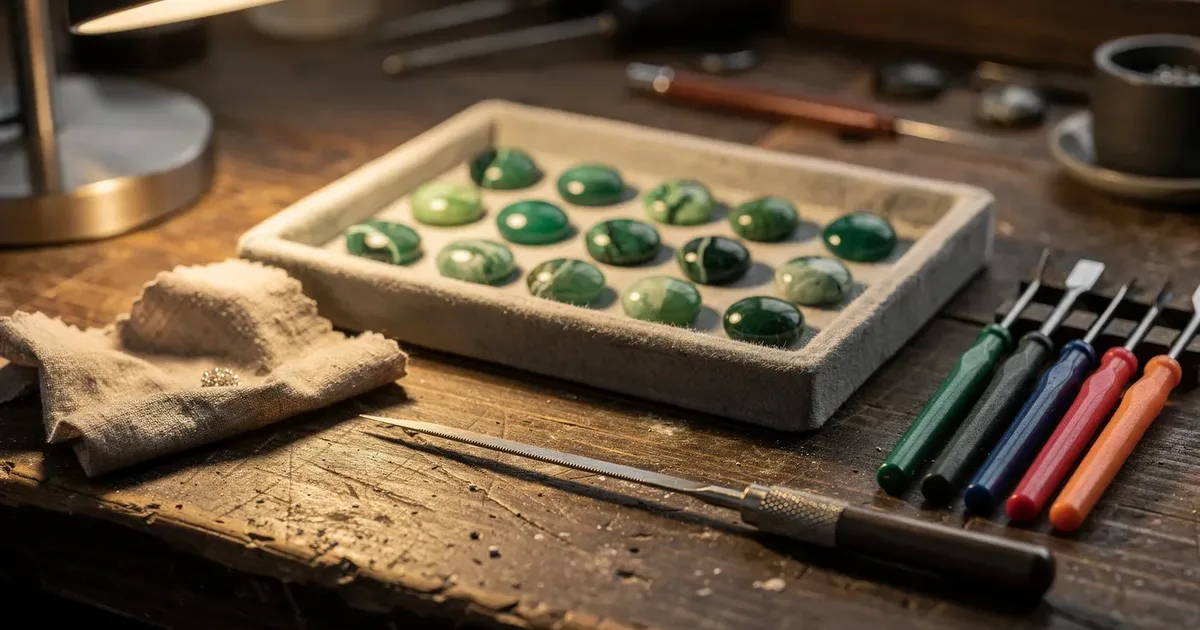
If you own a piece of green stone that was not expensive, it is probably serpentine rather than jade. This is not a scam so much as an industry convention: serpentine has been sold under jade-flavoured trade names for a very long time, and "new jade", "Korean jade", "Suzhou jade" and "olive jade" all mean serpentine.
Telling them apart is straightforward, and one test does most of the work.
The knife test
This is the decisive one.
Find an inconspicuous spot — the base of a carving, the back of a pendant — and press a steel knife point firmly into it, then drag.
- Jade (nephrite or jadeite) is Mohs 6–7. A steel knife is about 5.5. It will not mark jade. The blade slides and may leave a grey metal smear, which wipes off.
- Serpentine is Mohs 3–5. The knife bites immediately and leaves a real groove.
Wipe the spot before judging. Steel deposited on a harder stone looks exactly like a scratch until you rub it.
Toughness versus hardness
Jade's reputation rests on a property that is not hardness at all.
Hardness is resistance to scratching. Toughness is resistance to breaking. Jade is only moderately hard, but it is among the toughest natural materials known, because it is built from countless fibrous crystals interlocked like felt. A blow that would shatter a quartz crystal is absorbed and distributed.
This is why Neolithic cultures across China, New Zealand and Central America made axes and adzes from jade rather than from harder stones. A jade blade survives use; an obsidian blade is sharper and snaps.
Serpentine is neither hard nor especially tough. A dropped serpentine carving chips; a dropped jade carving usually does not.
The other tests
Heft. Jadeite has a specific gravity around 3.3 and nephrite around 3.0. Serpentine is about 2.5. Hold a piece in each hand and the difference is noticeable — jade feels dense in a way serpentine does not.
Sound. Suspend the piece on a thread and tap it with another piece of the same material. Jade produces a clear, ringing, slightly musical tone that sustains. Serpentine gives a duller, shorter click. This is a traditional test in the Chinese jade trade and it works surprisingly well on larger pieces.
Temperature. Jade is a good conductor and feels distinctly cold when first picked up, warming slowly. Serpentine warms faster. Glass imitations warm fastest of all.
Surface texture. Under a loupe, jade shows a fine fibrous or granular interlocking texture. Serpentine often shows a smoother, waxier, more homogeneous surface with occasional darker mottling.
Nephrite and jadeite are both jade
"Jade" covers two unrelated minerals, which were only distinguished in 1863.
Nephrite is an amphibole. It is the historic jade of China and New Zealand, comes in creamy white through spinach green to black, and has a slightly greasy, waxy lustre.
Jadeite is a pyroxene. It is harder, denser, and takes a glassier polish. Burmese jadeite is the source of "imperial jade", the intense emerald-green translucent material that reaches extraordinary prices.
Both are genuinely jade. Neither is a fake of the other, though jadeite is generally more valuable.
The treatments to know about
Jadeite is graded A, B and C in the trade:
- Type A is untreated apart from a traditional wax coating.
- Type B has been acid-bleached to remove brown staining and then impregnated with polymer resin. It looks good initially and degrades over years.
- Type C has been dyed.
B and C material is worth a small fraction of Type A, and the difference is not reliably visible to the naked eye. For anything expensive, insist on a certificate from a recognised gemmological laboratory. This is one of the areas in the stone trade where documentation genuinely matters.
Quick reference
| Nephrite jade | Jadeite jade | Serpentine | |
|---|---|---|---|
| Hardness | 6–6.5 | 6.5–7 | 3–5 |
| Knife test | Resists | Resists | Scratches easily |
| Specific gravity | 2.9–3.0 | 3.3–3.4 | 2.5–2.6 |
| Lustre | Greasy, waxy | Vitreous, glassy | Greasy, waxy |
| Sound when tapped | Ringing | Ringing | Dull |
A safety note
Fibrous serpentine — chrysotile — is a form of asbestos. Massive serpentine carvings are safe to handle, but do not saw, grind or sand serpentine dry, and do not cut fibrous material at all without proper equipment and extraction.
Mineral pages referenced
Keep reading
- The Mohs Hardness Test With Things You Already OwnHow to run a reliable hardness test using a fingernail, a copper coin, a steel knife and a piece of glass — including the three mistakes that give false readings.
- The Streak Test: The Most Underused Tool in IdentificationThe streak test takes five seconds and settles questions that colour cannot. How to do it properly, what each streak colour narrows to, and when it will not work.
- What to Do Before You Ask Anyone to Identify a RockA wash, a fresh break and four photographs turn an unanswerable question into an answerable one. Most identification requests fail on the photograph alone.