
How to Identify an Unknown Stamp
By IdentifyThese Editorial · Reviewed · 3 min read
There is an order to this, and doing it out of order wastes an afternoon.
1. Country
Catalogues are organised by country. Until you have it, nothing can be looked up.
No country name at all, with a monarch's silhouette — Great Britain. It issued the first postage stamp in 1840 and by convention is the only country that omits its name.
Another script — work from what it says:
| Text | Country |
|---|---|
| ПОЧТА, CCCP | Russia / Soviet Union |
| MAGYAR | Hungary |
| SUOMI | Finland |
| SVERIGE / NORGE / DANMARK | Sweden / Norway / Denmark |
| HELVETIA | Switzerland |
| ÖSTERREICH | Austria |
| ESPAÑA | Spain |
| NIPPON | Japan |
| ELLAS | Greece |
Currency helps too. "ORE", "PARA", "CENTAVOS", "ANNA", "PFENNIG" each narrow the field sharply even without a country name.
There is more on this, including the harder cases, in stamps with no country name.
2. Printing method
Run a fingertip across the design.
Raised ink you can feel — intaglio, engraved. Sharp lines that vary in thickness. The classic method for early and high-value issues.
A slight impression on the back — typography, printed from a raised surface.
Completely flat — lithography. Even line width, no texture either side.
A fine dot screen under a lens — photogravure, twentieth century.
This separates issues that look alike, and it catches forgeries: a lithographed copy of a stamp that should be engraved is a forgery, and that single check settles a great many classic fakes.
3. Perforation
Count the holes per two centimetres with a perforation gauge, which is a printed card costing very little and the first tool worth buying.
This is where the money is. The same design issued perf 12 and perf 14 is two catalogue entries, and they can differ by three orders of magnitude in value.
Compound perforations differ on the horizontal and vertical edges and are written as two numbers. More in perforation varieties.
4. Watermark
Invisible until you look for it, and frequently decisive.
Hold to a strong light first. If nothing shows, lay the stamp face down in a black tray with a few drops of watermark fluid and the design appears as a darker outline.
Never use water on a mint stamp with gum, or on a used stamp with a coloured cancel. Both cause damage. Watermarks covers the method and the orientations, which are themselves separate varieties.
5. Then the catalogue
With country, printing, perforation and watermark you can find the entry. Without them you are guessing between entries that look identical.
Stanley Gibbons for British and Commonwealth, Scott for the US, Michel for Europe, Yvert for France. Most libraries hold at least one.
What it is probably worth
Very little, and it is better to know that early.
Stamps were printed in the hundreds of millions. An inherited album of twentieth-century material is usually worth a modest sum, and the value that exists concentrates in early issues, specific varieties, errors and above all condition.
Two things worth knowing before you do anything:
- Do not soak stamps off old envelopes. The cover — the envelope with its postmarks and routing — is frequently worth more than the stamp on it.
- Do not clean or repair anything. It reduces value and it is detectable.
The tools
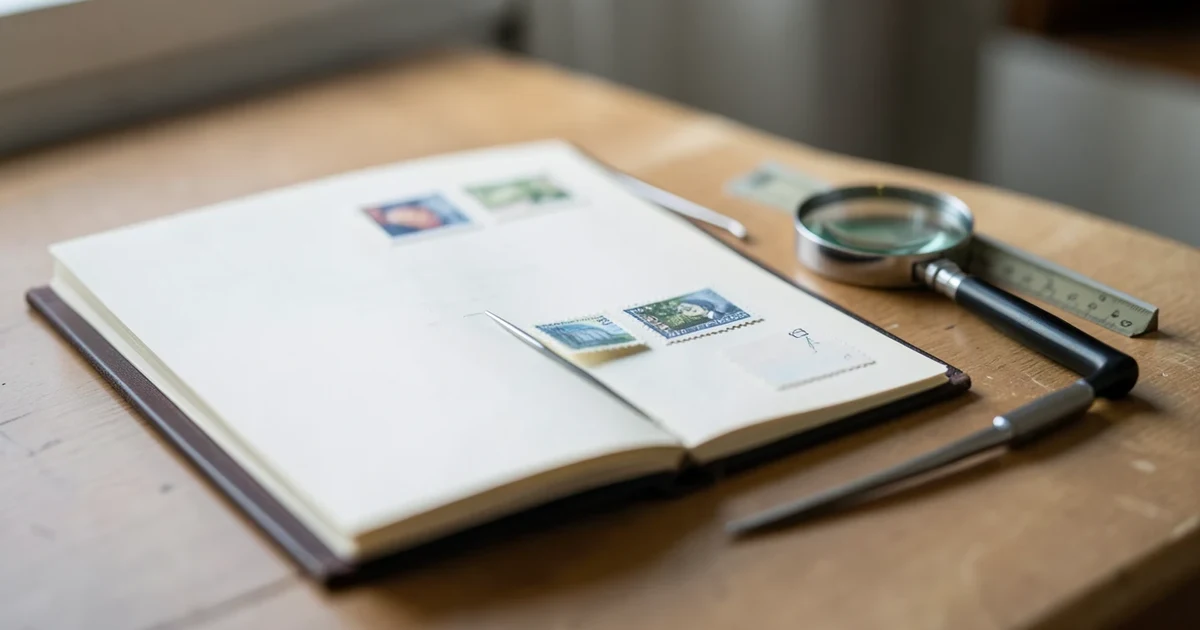
A perforation gauge, a watermark tray and fluid, tweezers, and a lens. Under thirty pounds together, and they answer the questions that a photograph cannot.
Where to ask
A local philatelic society will identify something in minutes that would take an evening alone, and membership costs very little.
Online, the specialist forums are patient with beginners provided you post a clear scan of both sides at high resolution, state the size in millimetres, and say what you have already checked. A photograph taken at an angle in poor light is the commonest reason a request goes unanswered.
Topics referenced
Keep reading
- Where the Value Hides in Identical-Looking StampsTwo stamps from the same design can differ by three orders of magnitude. The difference is almost never visible in the design.
- Starting a Collection Without Wasting MoneyBuy tools before stamps, pick a narrow subject, and ignore the packets of a thousand worldwide — which is where most beginners' money goes.
- Forgeries, Fakes and Why Certificates ExistPrinting method catches most classic forgeries. Overprints, regumming and repairs need an expert, and any expensive stamp should carry a certificate.