
Where the Value Hides in Identical-Looking Stamps
By IdentifyThese Editorial · Reviewed · 3 min read
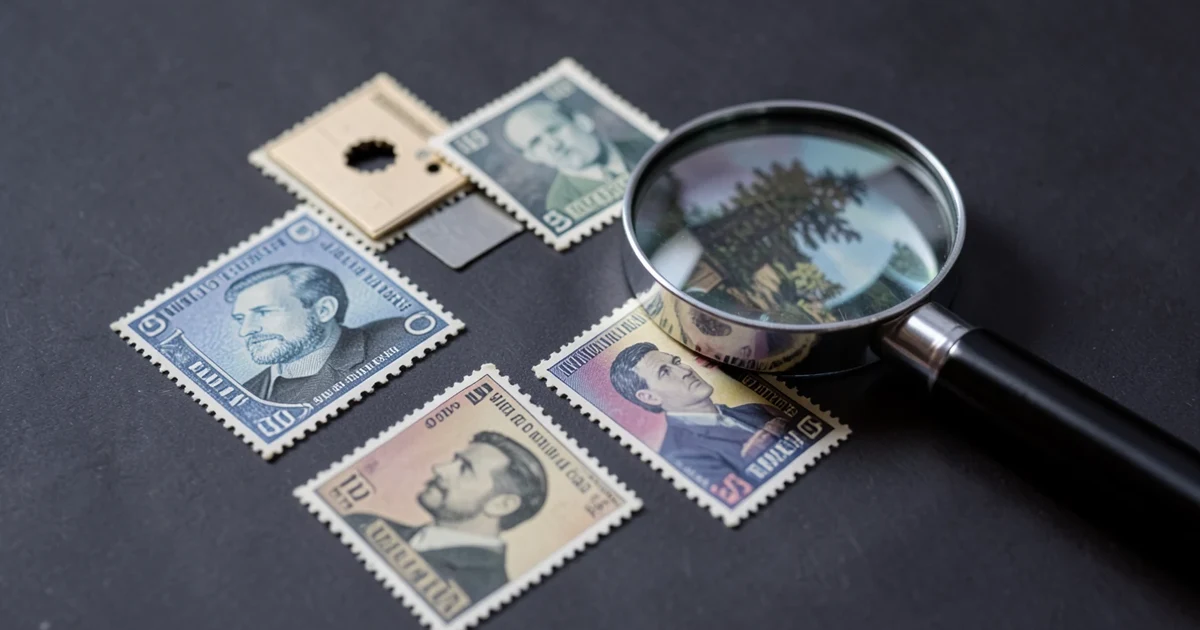
The design is the least informative thing about a stamp's value. It is what everyone looks at and it is usually shared across every variety.
Perforation
The same design issued perf 12 in one printing and perf 14 in another produces two catalogue entries. One may have been printed in millions and the other in thousands.
Measuring takes seconds with a gauge — a printed card with graduated rows of dots, laid under the stamp until they align. The result is holes per two centimetres, usually between 10 and 15.
Compound perforations differ between the horizontal and vertical edges — "perf 12 x 11½" — and are separate again.
This is the single most valuable habit in the hobby, and the reason a gauge is the first purchase. More in perforation varieties.
Watermark
Invisible in normal handling, and it separates issues that are otherwise identical in every respect.
The same design on watermarked and unwatermarked paper is two entries. So is the same watermark inverted, reversed or sideways, and those orientations are frequently the scarcer ones.
Checking takes a black tray and a few drops of fluid. Never water, on a gummed mint stamp or a coloured cancel. Detail in watermarks.
Printing method
Separates issues, and catches forgeries.
A stamp that should be engraved — raised ink you can feel — and is instead flat and even was lithographed, and lithography was the forger's method of choice for classic issues. That single fingertip check has exposed a very large number of fakes.
Paper
Chalk-surfaced, ordinary, thick, thin, ribbed, granite. Catalogue entries distinguish them, and telling them apart is a matter of feel and of how they respond under a lens.
Shades
Recognised in the catalogues and genuinely difficult. Colour varies with the printing, with age and with light exposure, so shade identification needs reference examples rather than description.
Approach with caution: many claimed rare shades are ordinary stamps that faded.
Condition, which overrides everything
Two examples of the same scarce variety, one superbly centred and sound and the other off-centre with a thin, are not close in price.
What is judged:
- Centring — how evenly the design sits within the perforations
- Gum — never hinged, lightly hinged, heavily hinged, regummed
- Faults — thins, creases, tears, short or pulled perforations, pinholes
- Cancellation — light and clear is preferred to a heavy smudge
- Colour — fading is permanent
Condition and centring covers the grades.
The practical consequence
Sorting a collection by what the stamps look like sorts it by the least informative characteristic.
The stamps worth the most in an ordinary accumulation are usually indistinguishable from their common neighbours until someone measures them. That is a reason to have a gauge before selling, and a reason not to bulk anything out on appearance.
It is also why an inherited collection is worth a proper look even when the headline answer is that most of it is common — the value is not where the eye goes.
Plate flaws and constant varieties
One more place value hides, and the most specialised.
Printing plates develop damage — a scratch, a broken letter, a worn area — and every stamp printed from that position on the plate carries the same flaw. Those are constant varieties, and they are catalogued separately for the well-studied issues.
They are distinguished from one-off freaks by being repeatable: the same mark, in the same place, on every example from that plate position. Plating a sheet — working out which position each stamp came from — is a serious specialism and it is where a good deal of the deep value in classic issues sits.
Where to check all of this
A specialised catalogue rather than a general one. The general catalogues list the major varieties; the specialised ones list the plate flaws, the shades and the printings, and they are what a serious collector works from.
Topics referenced
Keep reading
- Is My Stamp Collection Worth Anything?Usually a modest sum. Stamps were printed in the hundreds of millions, catalogue values are not selling prices, and condition decides most of what remains.
- How to Identify an Unknown StampCountry first, because catalogues are organised by it. Then printing, perforation and watermark, which is where the value actually hides.
- Measuring Perforations, and Why It Settles ArgumentsTwo stamps that look identical can differ only in perforation gauge, and the difference can be a hundredfold in value. Measuring takes seconds.