

Dating Furniture in Five Checks
By IdentifyThese Editorial · Reviewed · 3 min read
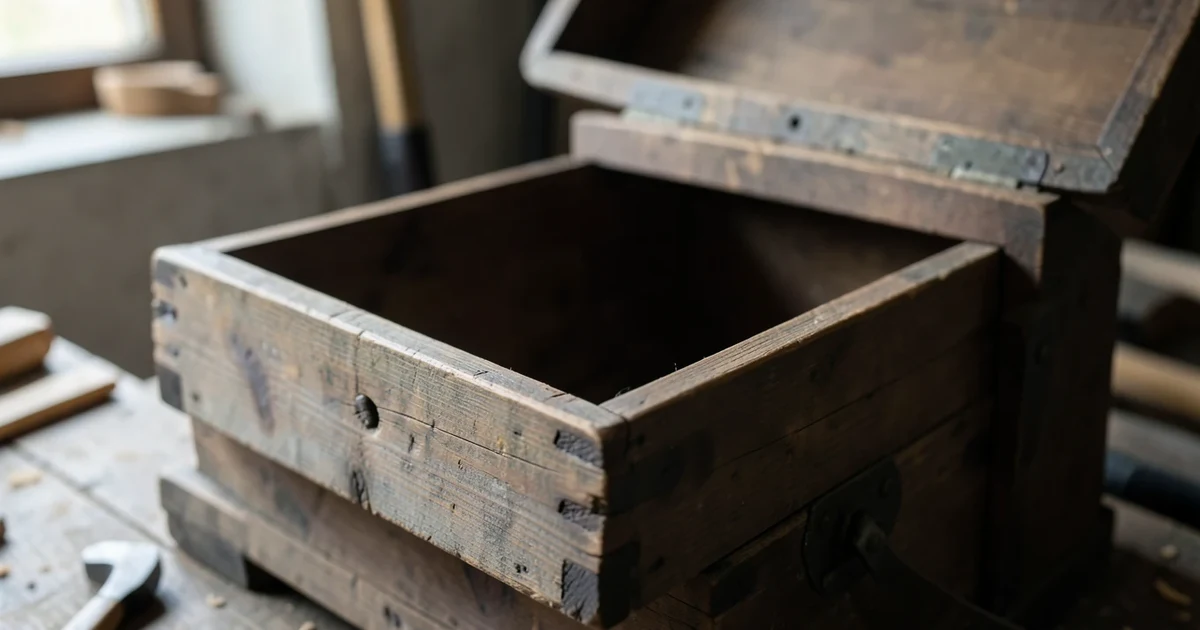
Style is copied continuously — every generation reproduces the one before it, and reproduction Georgian furniture has been made for two centuries. How a thing was built is much harder to fake, because it follows from the tools that existed.
Five checks, in order, and none takes more than a minute.
1. Pull out a drawer
Look at the corner joints on the side of the drawer.
Hand-cut dovetails — few of them, irregular in width and spacing, with faint scribe lines where the maker marked out the cut. The pins are usually narrow.
Machine-cut dovetails — many, perfectly uniform, evenly spaced, with rounded bottoms from a router bit. Machine dovetailing spreads from the 1860s.
A Knapp joint — an unmistakable half-moon and pin pattern — dates to roughly 1870 to 1900 in American furniture and nothing else.
No dovetails at all, with staples or dowels: twentieth century.
2. Look at an unfinished surface
The back of a case, the underside of a top, the bottom of a drawer — surfaces nobody bothered to finish, which is where the tool marks survive.
- Straight, irregular marks — a pit saw, worked by hand. Before roughly 1800.
- Straight, very regular marks — a sash or gang mill. Roughly 1790 to 1860.
- Curved arcs — a circular saw. Not in general use before about 1830, common from the 1860s.
- No marks anywhere — machine-planed. Modern.
The arcs are the useful one because they give a hard floor: a piece with circular saw marks cannot be Georgian, whatever the style claims.
3. Check a screw
Take one out from somewhere inconspicuous.
Hand-made — an off-centre slot, an irregular thread, a blunt tip, and a shank that tapers unevenly. Before roughly 1850.
Machine-made — consistent thread, centred slot, and from the 1840s a gimlet point that can drive itself.
A piece with modern Phillips-head screws has been repaired, which is not a fault but is information.
4. Look for shrinkage
Wood shrinks across the grain and barely at all along it, over decades.
- A round table top that has gone slightly oval.
- Panels that have pulled back from their grooves, showing an unstained line at the edge.
- Drawer bottoms that have shrunk and left a gap.
A perfectly circular top on a piece claimed as two hundred years old is worth a second look.
5. Test the finish
An inconspicuous dab of denatured alcohol.
Goes tacky — shellac, which dominates before roughly 1920. Softens with lacquer thinner instead — lacquer, standard in factory furniture from the 1920s. Resists both — polyurethane, and therefore a modern finish or a refinish.
That last result matters more than it sounds. Original surface is one of the strongest value drivers in period furniture, and a stripped and refinished good piece can lose most of its worth. The finishes page goes into what to do instead.
What the checks cannot tell you
Whether it is worth anything. Age contributes far less to value than condition, originality of surface, maker, form and demand. A great deal of nineteenth-century furniture was made in enormous quantities and is worth less than the cost of moving it.
Whether it is a marriage. Pieces get assembled from parts of others — a good top on a lesser base. Check that the wear, the colour and the construction agree throughout.
Whether the hardware is original. Handles and locks are replaced routinely. Look behind a handle for filled holes in a different position.
The order matters
Drawer joints first, because they are quick and decisive. Then saw marks, because they give a hard date floor. Then the details.
If the joints and the saw marks disagree with the style, believe the joints — that is the whole argument.
Categories referenced
Keep reading
- Dating Ceramics by the Foot and the GlazeTurn the piece over. The unglazed foot rim records how it was made and fired, and that changes by period in ways a decorated surface does not.
- Dating Glass by the Seam and the BaseThe seam records how a bottle was made, and manufacturing method has a known chronology. Follow it up from the base and the date follows.
- What Not to CleanPolishing silver, stripping furniture and scrubbing coins all remove value permanently. The safe rule is stabilise, do not restore.