

How Reproductions Give Themselves Away
By IdentifyThese Editorial · Reviewed · 3 min read
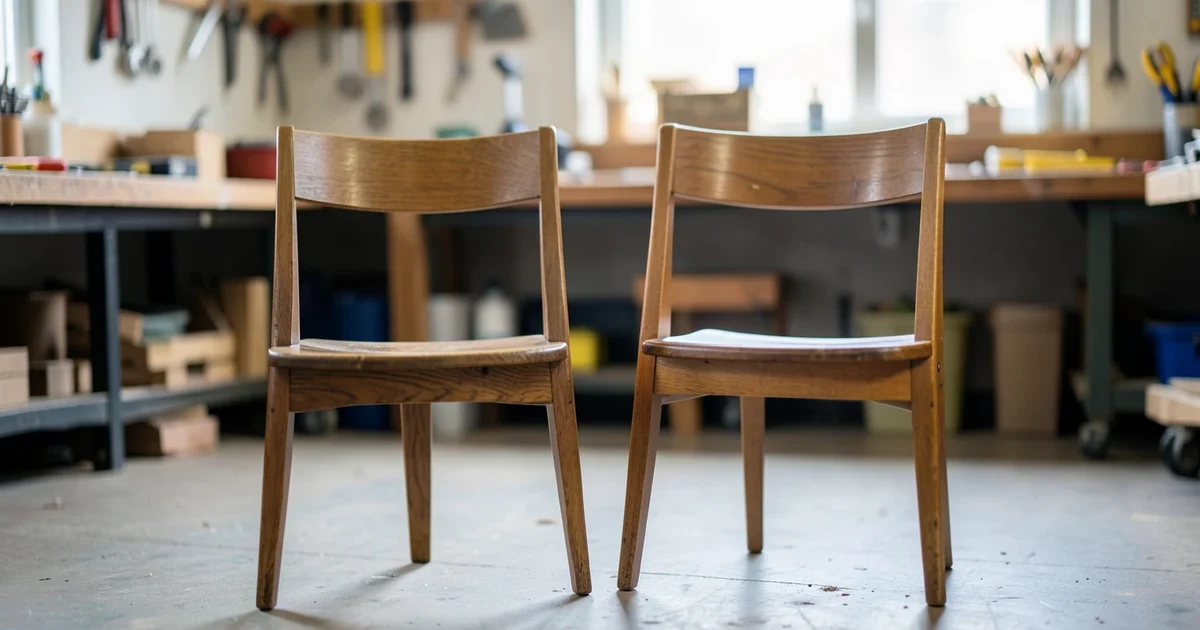
Very few reproductions are made to deceive. Most are made to be sold as reproductions and become problems later, when they have aged twenty years and changed hands three times.
Either way, they give themselves away in the same places.
Wear in the wrong places
This is the most reliable tell in the field.
Real wear is concentrated. It happens where hands, feet, floors and cloth actually touch:
- The front edge of a drawer, where fingers pull it
- Chair arms at the front, and stretchers where feet rest
- The bottom of legs, worn unevenly depending on the floor
- Around a keyhole
- The high points of carving, not the recesses
- Table tops in the middle, not the edges
Artificial distressing is even. It is applied across a surface because it is a decorative effect rather than a history. Dents in places nothing would strike, wear on a surface nobody touches, and uniform scratching across a whole panel are all wrong.
Also: real wear on wood has rounded, polished edges from decades of contact. Fresh distressing has sharp edges under a fingernail, however dark the stain.
Uniformity where there should be variation
Hand work varies. Machines do not.
- Dovetails cut by hand differ in width and spacing. Machine ones are identical.
- Hand-blown glass varies in thickness and has small bubbles and asymmetry.
- Hand-painted decoration varies between pieces from the same workshop.
- Turned legs on a period chair are close but not identical to each other.
A set of four chairs whose turnings are indistinguishable was made on a copying lathe.
Look at the back
Fakers spend effort where buyers look. The back of a case, the underside of a top, the inside of a drawer, the base of a bottle — these are where the real evidence sits and where the effort was not spent.
Specifically:
- Saw marks. Circular arcs on a piece claimed as Georgian settle it. Nothing else needs checking.
- Timber. Plywood, MDF or a modern manufactured board anywhere is conclusive.
- Modern fixings. Phillips screws, staples, modern glue lines.
- Consistency of colour. An interior that has aged should be a different colour from an exterior that has been polished. Uniform colour throughout suggests the whole thing was finished at once.
Materials that did not exist yet
A hard chronological floor, and the most conclusive kind of evidence there is.
- Plywood in furniture: significant use from the later nineteenth century, widespread in the twentieth.
- Modern screw types: Phillips heads from the 1930s.
- Certain glass colours: some bright purples, teals and opaque colours depend on twentieth-century chemistry.
- Synthetic dyes in textiles: aniline dyes from the 1850s onward.
- Modern plastics: Bakelite from 1907, and anything lighter and smell-free is later still.
The specific tells by material
Glass — follow the seam. On a bottle it dates the manufacturing method directly, and a seam running over the lip means machine-made, 1905 onward. Detail in old bottles.
Ceramics — look at the printing under a lens. Genuine transfer printing has engraved lines and visible tissue join marks. Modern decal printing has a dot screen.
Metal — cast fakes reproduce marks softly. A struck punch has crisp edges; a cast copy of one does not.
Plastic — the hot water and rub tests. Bakelite smells of phenol; modern resin does not.
The married piece
Not a fake exactly, and very common: a genuine period object assembled from parts of several.
A good top on a lesser base, a period movement in a later case, an original lamp fount with a replacement burner. Look for:
- Wear that does not agree between parts
- Colour that does not match on hidden surfaces
- Screw holes that do not line up, or filled holes in the wrong place
- Proportions that look slightly wrong
Marriages are worth substantially less than the sum of the good parts, and they are far more common than outright fakes.
The one that catches everyone
A convincing style with modern construction. Reproduction furniture has been made continuously for two hundred years, often to a high standard and in period timbers.
Which is why the argument in dating furniture in five checks holds: when the style and the construction disagree, believe the construction.
Categories referenced
Keep reading
- The Marks That Date an Object ExactlyMost marks give a rough period. Four kinds give a precise year, and they are worth learning because they end the argument.
- Dating Furniture in Five ChecksPull out a drawer, look at the back, check the screws. Construction evidence dates a piece; style does not, because style is copied continuously.
- Silver or Plate? Four Tests Before the HallmarkPlate wears through at the edges and sterling does not. Weight, wear, sound and a magnet separate them before you look for a mark.