
What Not to Clean
By IdentifyThese Editorial · Reviewed · 3 min read
The instinct to make something look better before selling it is the most expensive instinct in this subject.
Furniture: do not strip
Original surface is one of the strongest value drivers in period furniture. Stripping and refinishing a good piece routinely removes most of its worth, and it cannot be undone.
Safe: dusting, and a wax polish sparingly once or twice a year.
Not safe: chemical strippers, sanding, modern varnish or polyurethane, silicone sprays — which penetrate and make any later proper restoration far harder.
If a finish is dirty rather than damaged, a barely-damp cloth and a mild soap will often lift a surprising amount without touching the finish underneath. The finishes page covers how to tell what you are dealing with first.
Silver: gentle only
Every polish removes a microscopic layer of metal. Repeated over decades it softens engraving, wears through plating and eventually erases the hallmarks — which are the object's identity.
Safe: a proprietary silver cloth, or a mild silver dip used briefly and rinsed thoroughly.
Not safe: abrasive pastes, wire wool, repeated machine polishing, and any attempt to remove tarnish from the recesses of decoration. Tarnish in the low points is what gives chased and engraved work its depth, and buffing it out flattens the design.
Never polish a piece where the hallmarks are already faint.
Coins and medals: never clean at all
This one is close to absolute. Cleaning a coin can remove most of its value in seconds, and collectors detect it immediately — cleaned surfaces have a characteristic hairline pattern and an unnatural brightness.
Toning on a coin is desirable. A brilliantly clean old coin is a damaged one.
Cast iron: rust yes, seasoning no
Safe: removing rust, and re-seasoning.
Not safe: electrolysis or lye tanks on a rare or marked piece without knowing what you have, and any abrasive that removes the smooth machined cooking surface, which is a dating feature as well as the reason old pans cook well.
Paper and photographs: almost nothing
Safe: storing flat, in the dark, in acid-free materials, away from damp.
Not safe: tape of any kind, lamination, adhesive photo albums, erasing pencil marks, trimming edges, or attempting to remove foxing. Every one of these is irreversible.
Old photographs in particular are chemically fragile and cannot be cleaned by anyone who is not a conservator.
Textiles: stabilise, do not wash
Safe: careful vacuuming through a screen, flat storage, keeping out of light.
Not safe: washing anything with early dyes, which bleed. Dry cleaning, which is harsh on old fibres. Any bleaching agent.
A stained quilt is worth more than a washed one that has lost its colours.
Ceramics: water and patience
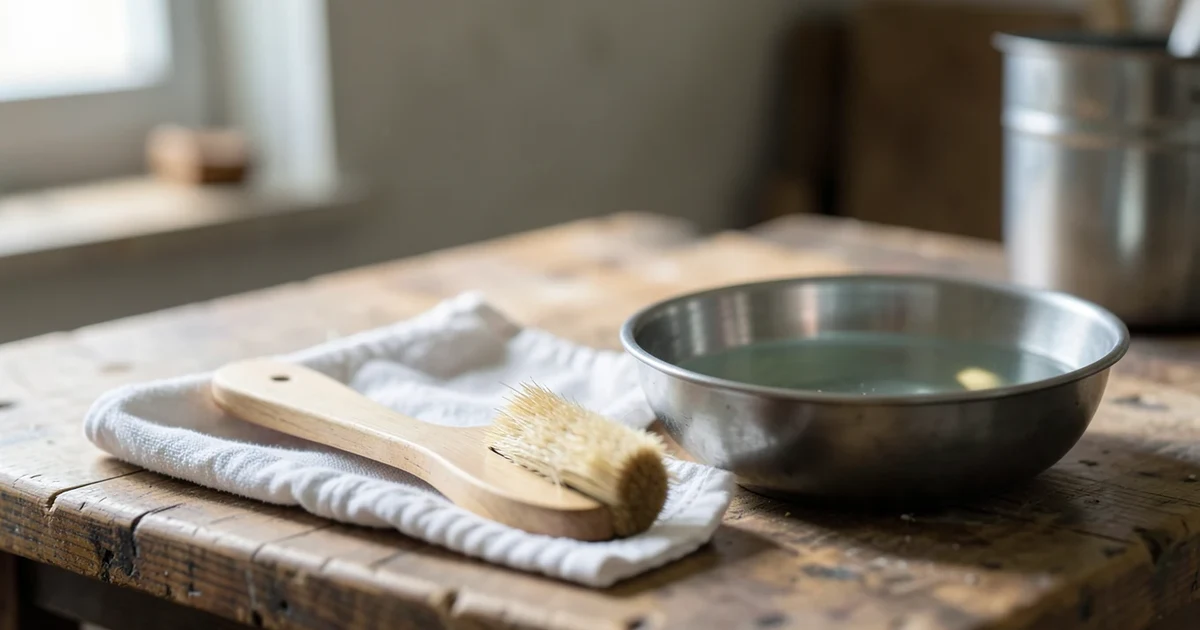
Safe: warm water and a soft brush.
Not safe: dishwashers, bleach soaking to remove crazing stains — which can leave residue that migrates back out for years — and any adhesive repair using modern superglue, which yellows and is difficult for a conservator to reverse.
The general rule
Stabilise, do not restore. Remove active damage — damp, insects, acidic materials, direct sunlight — and stop there.
If something genuinely needs work and is worth the cost, that is a conservator's job, and the first thing a good one will tell you is what not to do to it. Establishing whether it is worth the cost comes before the work rather than after.
The one universal exception: remove anything actively destroying the object — a rusting fixing, a damp environment, tape, acidic paper, an insect infestation. That is stabilisation, and it is always right.
The short version
| Material | Safe | Not safe |
|---|---|---|
| Furniture | Dusting, occasional wax | Stripping, sanding, polyurethane, silicone |
| Silver | Silver cloth, brief dip | Abrasive paste, wire wool, buffing recesses |
| Coins | Nothing | Everything |
| Cast iron | De-rusting, re-seasoning | Abrasives on the cooking surface |
| Paper | Acid-free storage | Tape, lamination, erasing, trimming |
| Textiles | Vacuum through a screen | Washing, bleaching, dry cleaning |
| Ceramics | Warm water, soft brush | Dishwasher, bleach soaking, superglue |
Categories referenced
Keep reading
- How Reproductions Give Themselves AwayWear in the wrong places, uniformity where there should be variation, and materials that did not exist yet. Fakers concentrate on the front.
- Is My Antique Valuable? Probably Less Than You HopeAge contributes very little. Condition, originality, maker and demand do almost all of it, and most nineteenth-century objects were made in enormous numbers.
- Dating Furniture in Five ChecksPull out a drawer, look at the back, check the screws. Construction evidence dates a piece; style does not, because style is copied continuously.