

Hummingbird Feeders: Four Parts Water, One Part Sugar, No Dye
By IdentifyThese Editorial · Reviewed · 3 min read
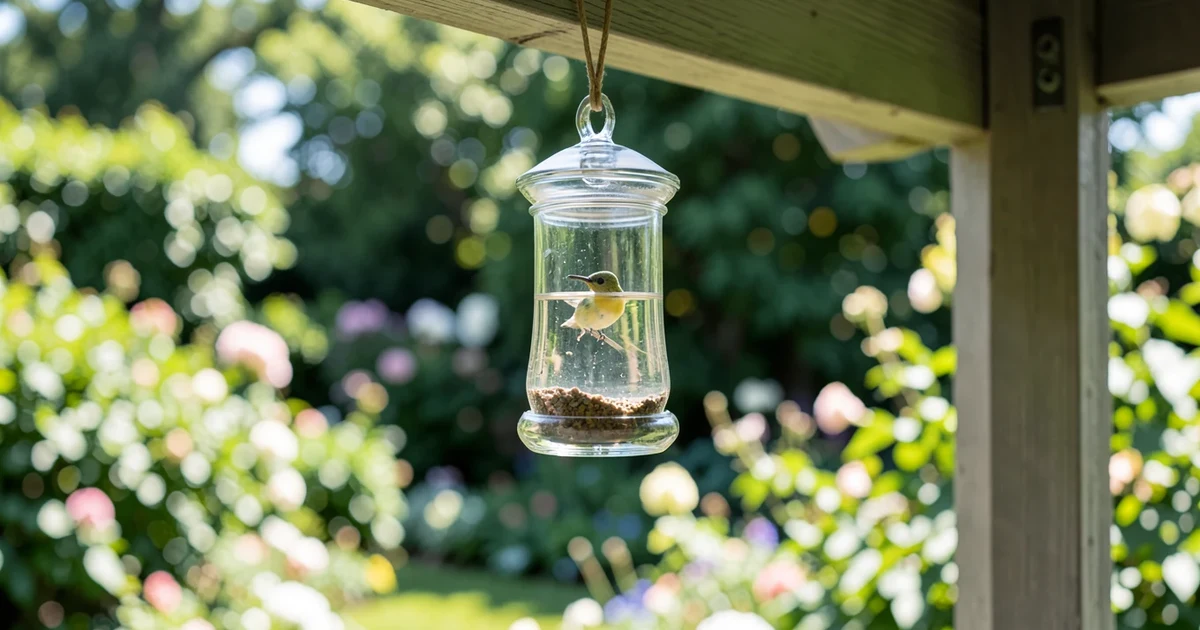
The recipe is four parts water to one part plain white sugar. Everything else people add makes it worse.
The recipe
- One part white granulated sugar to four parts water.
- Heat enough to dissolve — it does not need boiling, though boiling extends how long it keeps.
- Cool completely before filling. Warm nectar ferments faster.
- Store the surplus in the fridge for up to a fortnight.
That ratio approximates the sucrose concentration of the flowers hummingbirds feed on. Stronger is not better; it is harder for them to process and can dehydrate them.
What not to add
Red dye. Unnecessary and unstudied at the volumes a hummingbird consumes. Feeders are made with red parts precisely so the liquid does not need colouring, and hummingbirds find them by sight of the feeder, not the fluid. There is no benefit to weigh against an unknown, so do not.
Honey. Ferments rapidly and grows a fungus implicated in a fatal tongue infection. This one matters.
Brown sugar, raw sugar, turbinado. They contain iron and molasses. Hummingbirds process very little iron and it accumulates.
Artificial sweetener. Nectar is fuel. A sweetener with no calories is a bird starving on a full crop.
Changing it — the part people get wrong
Nectar spoils, and warm nectar spoils fast.
| Temperature | Change every |
|---|---|
| Above 32 °C | Daily |
| 27–32 °C | 2 days |
| 21–27 °C | 3 days |
| Below 21 °C | 4–5 days |
Cloudy fluid, black specks, or a film inside the reservoir means it is already too late. Empty it, scrub it, refill.
Clean with hot water and a bottle brush, getting right into the ports where mold forms. A weak vinegar solution for stubborn deposits, rinsed thoroughly. Avoid soap residue.
If you cannot commit to changing it in hot weather, put out less at a time. A half-full feeder changed on schedule is far better than a full one left a week.
Ants and bees
Ants — an ant moat, which is a small water cup above the feeder. Nothing else works reliably. Do not use oil or grease on the hanger; it gets on feathers.
Bees and wasps — choose a feeder where the ports sit above the fluid level, so a hummingbird's tongue reaches and an insect's mouthparts do not. Avoid yellow parts, which attract wasps. Do not use bee guards that block the ports for the birds too.
When to put it out and take it in
Out: about two weeks before the first birds are expected in spring. Early arrivals hit bad weather and a feeder can matter.
In: two weeks after the last sighting in autumn.
Leaving a feeder up does not stop hummingbirds migrating. Migration is triggered by day length, not food supply. This is a persistent myth and it causes people to take feeders down too early, which is the opposite of helpful — late feeders support stragglers and injured birds.
In the east, a hummingbird at a feeder in November is worth reporting. Western vagrants — rufous especially — turn up most autumns and some winter successfully.
The birds
East of the Great Plains, essentially every hummingbird is a ruby-throated, which makes identification unusually simple. The male's throat is iridescent rather than pigmented, so it looks black from most angles and flashes ruby only when the light is right — this is why so many people report a black-throated hummingbird.
West of there, several species overlap and it becomes a real identification problem.
Beyond the feeder
Nectar is fuel; hummingbirds get protein from small insects, and they take a great many of them. A garden with flowering plants and without insecticide supports them better than any feeder — bee balm, cardinal flower, trumpet vine, salvia, columbine.
Species referenced
Keep reading
- What to Put in a Bird FeederBlack oil sunflower feeds nearly everything. Most mixed seed is filler that gets kicked to the ground, and the cheap bag is not the cheap option.
- A Bird Hit My Window. What Now?Most stunned birds recover if left alone in a dark, quiet box. And the fix for the window is on the outside of the glass, which is why most products fail.
- Feeding Birds in Winter: What ChangesFat matters more than seed once it is cold, water matters more than either, and the birds at the feeder are a different set from the summer ones.