

Mold After a Flood: The First 48 Hours Decide It
By IdentifyThese Editorial · · 3 min read
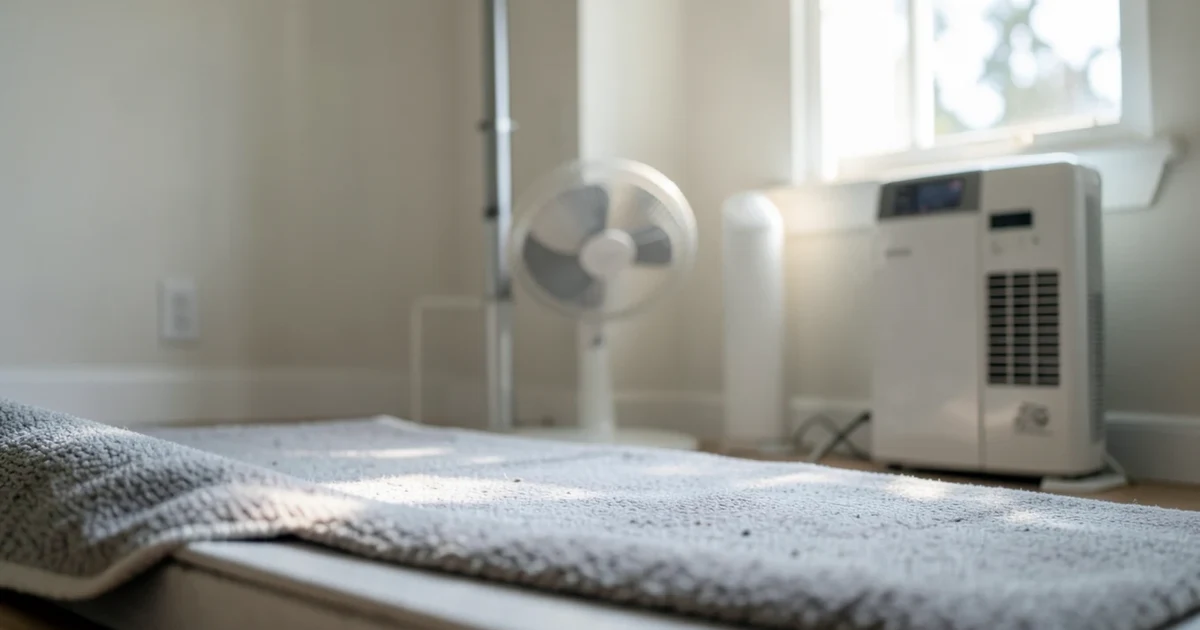
Mold begins colonising wet porous materials within 24 to 48 hours at ordinary room temperatures.
That is the entire framing. Everything about the outcome is decided by how fast the building dries, and almost nothing by what you clean it with afterwards.
Before anything: what kind of water
The category determines whether material can be dried or must be removed, and it is not negotiable.
| Category | Source | Response |
|---|---|---|
| 1 — clean | Supply pipe, tank overflow, rainwater | Dry in place if you act fast |
| 2 — grey | Washing machine, dishwasher, shower waste | Porous materials out; hard surfaces cleaned |
| 3 — black | Sewage, river or ground flooding, standing water over 48 hours | All porous materials out. No exceptions |
Category 1 becomes Category 2 after about 48 hours, and Category 2 becomes Category 3. A clean-water leak left for three days is not a clean-water leak any more.
Anything involving sewage or floodwater from outside is Category 3 from the start, and that means carpet, underlay, insulation and saturated drywall are removed rather than dried.
The first 48 hours
1. Safety. Power off at the consumer unit if water is near sockets or appliances. Do not enter standing water with live power. Category 3 water needs gloves, boots and eye protection.
2. Stop the source. Isolate the supply, or wait for external water to recede.
3. Get the water out. Pump, wet vacuum, mop. Standing water first.
4. Remove wet contents. Furniture off wet floors, carpets and underlay up, anything soaked outside. Underlay holds water long after carpet feels dry and is a reliable later smell source.
5. Open the structure. This is the step most people skip and the one that matters. Remove skirting boards. Drill or cut ventilation holes at the base of walls so cavities can dry. Water trapped inside a wall does not dry from the outside.
6. Move air and remove moisture. Fans for air movement, dehumidifiers for water removal — both, not one. Open windows only if outdoor air is drier than indoor; on a humid day this makes it worse.
7. Keep it warm. Drying is faster at 20–25 °C. Cold rooms dry slowly.
What has to come out
- Carpet underlay — always, when saturated. Carpet itself may be salvageable in Category 1 if professionally cleaned and dried within 48 hours.
- Drywall — cut at least 30 cm above the visible waterline. It wicks upward well past where it appears wet.
- Fibrous insulation — mineral wool and fibreglass hold water and lose their function. Closed-cell foam may survive.
- Chipboard and MDF — swell irreversibly. Not recoverable.
- Upholstered furniture and mattresses — in Category 2 or 3, out.
Solid wood, plaster on masonry, tile and concrete can usually be dried and saved.
Measuring, not guessing
"It feels dry" is not drying. Surfaces dry long before the material behind them does, and this is where slow failures come from.
A moisture meter, checked daily against an unaffected area of the same material, is the only way to know. Target readings back at the baseline for that material, and expect structural timber and masonry to take considerably longer than surfaces.
Professional restoration firms document daily readings for exactly this reason.
When to call someone
- Category 3 water of any volume
- More than about 10 square metres affected
- Water in wall cavities, under floors, or in a crawlspace
- Anything not dry within 72 hours
- An insurance claim, where documentation matters
Photograph everything before you move it. Insurers ask, and a claim is far easier with a record made at the time.
Afterwards
Watch for the smell. MVOCs from growth inside a cavity appear before anything visible, and a musty note weeks after a flood means somewhere did not dry — the search order for that applies directly.
Clothes and soft furnishings that were wet need dealing with separately, and the drying step is where they get lost — mold on clothes and fabric.
The thing not to do
Do not seal or paint over anything until it is measurably dry. Encapsulating damp material traps the moisture and gives you a slower, hidden version of the same problem — and by the time it reappears, the material behind it has been wet for months.
Types referenced
The species matters less than you think
- Public health guidance is to remove all indoor mold regardless of type. The CDC and EPA do not recommend routine species testing for ordinary households, because the response does not change: find the water, stop it, remove the growth.
- “Toxic black mold” is a marketing phrase, not a category. Stachybotrys is real and does need soaked material to grow, so finding it tells you something useful about your building. But the health effects that are well established — allergy, asthma aggravation, irritation — are not specific to it.
- Mold without water does not persist. Cleaning growth while leaving the moisture source is why it comes back. The leak, the condensation or the ventilation is the actual problem.
Call a professional for areas larger than about 10 square feet, for anything in HVAC ductwork, after sewage or flood water, or if anyone in the household is immunocompromised or has a lung condition.
Keep reading
- A Musty Smell With No Visible MoldThe smell is real and it means active growth somewhere. Here is the search order, and the six places hidden mold is usually found.
- Mold on Clothes and FabricMost fabric mold washes out if you get to it early. Mildew stains set with heat, so the drying step is where garments are usually lost.
- Black Mold Around Windows: It Is CondensationMold on a window reveal is the coldest surface in the room collecting the room's moisture. Cleaning it treats the symptom; three changes treat the cause.