

Mold on Cheese: When to Cut It Off and When to Bin It
By IdentifyThese Editorial · · 3 min read
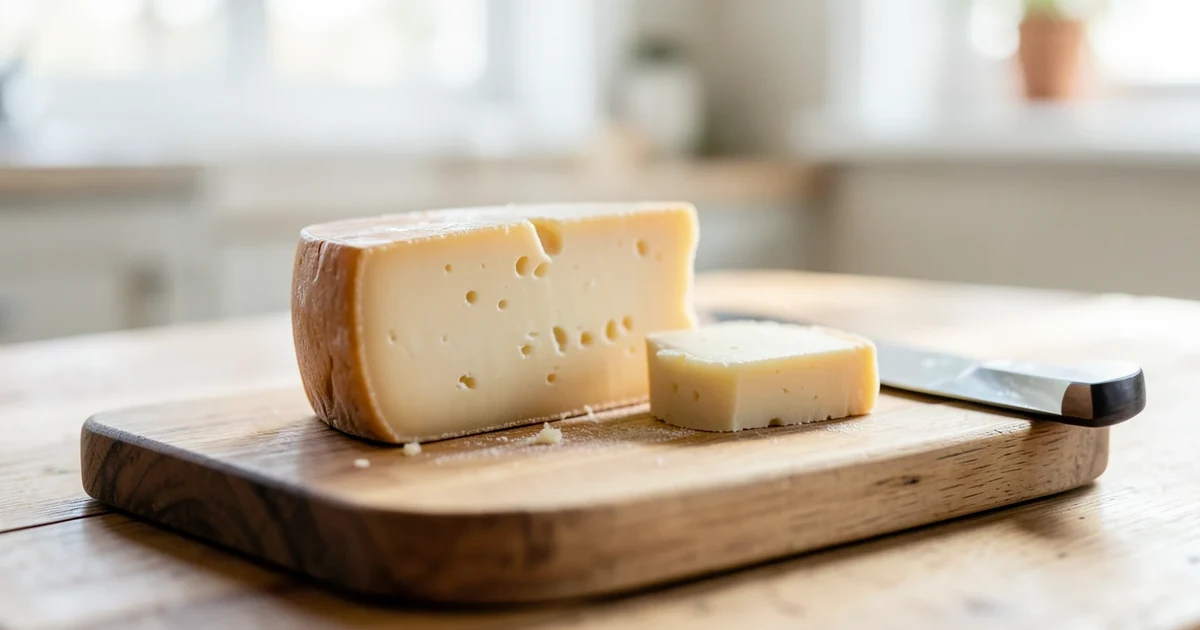
The answer depends almost entirely on how much water is in the cheese, because water is what lets mold grow through rather than sit on top.
Hard and semi-hard cheese — cut it off
Cheddar, gruyère, parmesan, gouda, swiss, colby, and anything else firm.
Their density and low moisture stop mold filaments penetrating far. The visible spot is close to the whole of it.
Cut at least 2.5 cm around and below the mold. Keep the knife out of the mold itself so you do not carry spores into the cut face, and rewrap in fresh material rather than the old wrapper.
The rest is fine.
Soft cheese — throw it away
Cream cheese, cottage cheese, ricotta, chèvre, brie, camembert, and any soft cheese showing unwanted mold.
High moisture lets a mold colony extend far beyond what is visible, and the surface spot is the fruiting body of something already distributed through the mass. Cutting around it removes the part you can see and leaves the rest.
Same for shredded, crumbled and sliced cheese of any hardness — the processing has created surface area and distributed contamination through the bag. A moldy shred means the bag goes.
The molds that are supposed to be there
Several cheeses are made with mold, and it is not a defect.
| Cheese | Culture | Looks like |
|---|---|---|
| Brie, camembert | Penicillium camemberti | Soft, even white bloom over the whole rind |
| Roquefort, stilton, gorgonzola | Penicillium roqueforti | Blue-green veins through the paste |
| Tomme, some alpine cheeses | Mixed natural rind | Grey, brown, mottled rind, deliberate |
Unwanted mold on these is distinguishable because it looks different from the intended one — patches of a different colour on a white bloom, black or pink spots, fuzzy growth on the cut face rather than the rind.
Blue cheese showing a fuzz that is not the usual blue veining, particularly on a cut surface, is a soft cheese with an unwanted mold, and it goes.
What colour tells you
Not much, and less than people expect.
Blue-green is usually a Penicillium species and typically produces no significant toxin, which is why the cut-around rule works on hard cheese. Black spotting is often Cladosporium. Fuzzy white can be several things, including the beginnings of something else.
The reason colour is not the deciding factor is that the water content of the cheese determines whether cutting works, not the species of mold. A safe-looking blue on cream cheese is still a bin decision.
Aflatoxin-producing Aspergillus species are the genuine concern, and they are not distinguishable by eye — which is the argument for the margin rather than for identifying the mold.
Storage that prevents it
- Wrap hard cheese in cheese paper or waxed paper, then loosely in foil. Plastic film traps moisture against the surface and is the main reason cheese molds early.
- Change the wrapping each time you cut.
- Keep it in the warmest part of the fridge — a drawer — rather than the coldest, which dries and cracks the surface.
- Freeze hard cheese if you will not finish it. Texture suffers; safety does not.
The wider food question
Cheese is one case in a general rule about food molds, and the rule tracks moisture and density. Firm, dry, low-moisture foods can be salvaged with a wide margin. Soft, wet or porous ones cannot, because the visible growth is a small fraction of the colony.
That is the same reasoning that applies to bread, and bread is a more common question — it is worth knowing why a loaf is not a wheel of cheddar.
When it is not mold at all
- Calcium lactate crystals on aged cheddar and gouda — white, gritty, crunchy, entirely harmless and a sign of good ageing. Frequently mistaken for mold, and the texture gives it away: crystals are hard, mold is soft.
- Surface drying producing a darker, harder rind.
- Pink or orange smear on washed-rind cheeses like taleggio and époisses, which is Brevibacterium linens and is deliberate.
Distinguishing a deposit from a growth is the same question that comes up on walls and in bathrooms, where efflorescence and mineral staining get treated as mold for years — is it even mold covers the four commonest impostors, and the crystals here belong to the same family of mistake.
Types referenced
The species matters less than you think
- Public health guidance is to remove all indoor mold regardless of type. The CDC and EPA do not recommend routine species testing for ordinary households, because the response does not change: find the water, stop it, remove the growth.
- “Toxic black mold” is a marketing phrase, not a category. Stachybotrys is real and does need soaked material to grow, so finding it tells you something useful about your building. But the health effects that are well established — allergy, asthma aggravation, irritation — are not specific to it.
- Mold without water does not persist. Cleaning growth while leaving the moisture source is why it comes back. The leak, the condensation or the ventilation is the actual problem.
Call a professional for areas larger than about 10 square feet, for anything in HVAC ductwork, after sewage or flood water, or if anyone in the household is immunocompromised or has a lung condition.
Keep reading
- Is It Even Mold? Four Things That Aren'tWhite crust on basement walls, pink slime in the shower, black lines on the ceiling — three of the most common mold reports are not mold. Each has a ten-second test.
- Removing Mold: What Works, and Why Bleach Usually Isn't ItCleaning the growth without fixing the moisture is why mold comes back. What to use on which surface, what to throw away, and where the DIY limit sits.
- Mold on Bread: Is the Rest of the Loaf Safe?No, and bread is the clearest case of all. Why cutting the moldy part off works for hard cheese and not for bread, and what the fuzz you can see is hiding.