

Mold on Bread: Is the Rest of the Loaf Safe?
By IdentifyThese Editorial · Reviewed · 3 min read
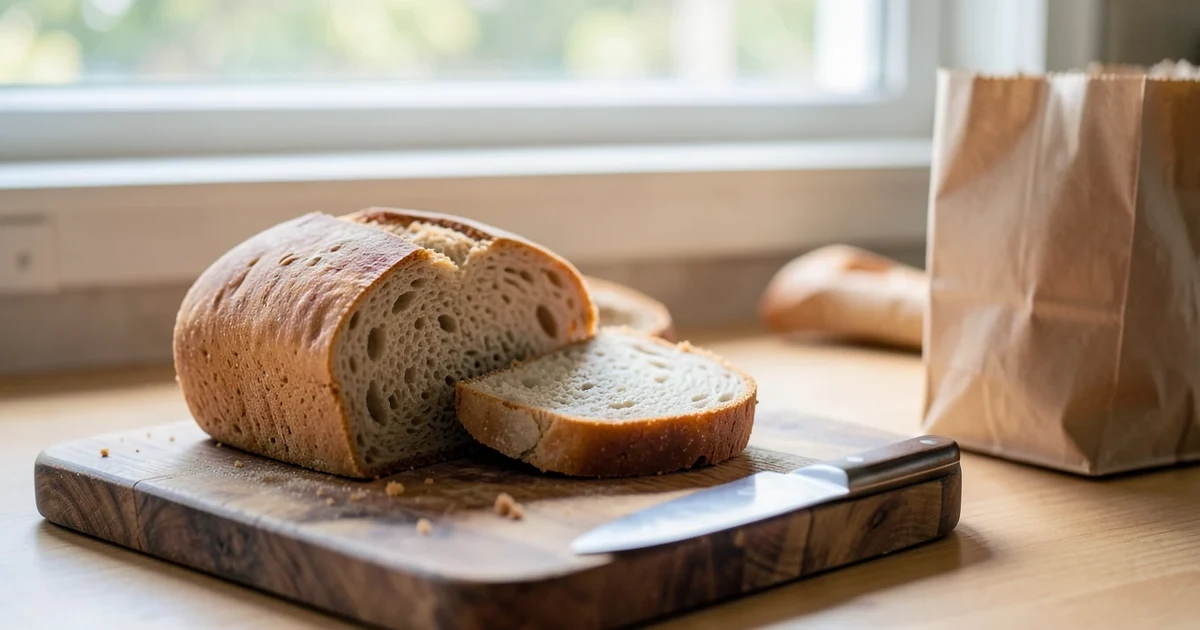
Throw the loaf away. Bread is the one food where the answer is genuinely simple, and the reason is structural rather than a matter of caution.
Why bread is different from cheese
The visible fuzz is the fruiting body. The organism is a network of hyphae threading through the food, and how far it reaches depends entirely on how dense the food is.
| Food | Structure | What that means |
|---|---|---|
| Bread | Porous, full of air pockets | Hyphae travel freely through the crumb, far beyond the visible spot |
| Hard cheese | Dense, low moisture | Growth stays near the surface — cut 2.5 cm around and below, and the rest is fine |
| Soft cheese, yoghurt | High moisture, no structure to resist | Discard |
| Firm vegetables (carrot, cabbage) | Dense, low moisture | Cut generously around; the rest is usually fine |
| Soft fruit, jam, bread, cooked leftovers | Porous or moist | Discard |
A slice of bread is mostly air. The mold you can see on one corner has almost certainly been through the loaf, and the parts you cannot see are the majority.
What about just toasting it
Toasting kills the living mold. It does not remove mycotoxins, which are heat-stable chemical compounds rather than organisms — that is the whole point of them being a food-safety concern. Cooking does not fix moldy food for the same reason boiling does not fix a chemical contaminant.
Do not sniff it
The standard instinct is to lean in and smell the loaf. Do not. Disturbing moldy bread releases a large quantity of spores directly into the space in front of your face, and inhaling them is the one genuine hazard here for most people — particularly anyone asthmatic or allergic.
Put the whole loaf in a bag, seal it, and bin it outside.
And then clean the bin
If bread has gone moldy in a bread bin or a cupboard, the spores are now in that space. Wipe it out with hot soapy water and dry it thoroughly before putting new bread in, or the next loaf will go the same way faster.
Why it went moldy
Bread molds are everywhere and always have been; the question is only how fast conditions let them grow.
- Warmth and moisture accelerate it enormously. A loaf on a sunny counter in summer has days; the same loaf in the fridge has considerably longer.
- Sealed plastic traps moisture from the bread itself and speeds it up. Paper breathes.
- Slicing exposes surface area, which is why sliced loaves go faster than whole ones.
- Bread with fewer preservatives goes faster, which is a straightforward trade rather than a problem.
Freezing is the genuinely effective answer for bread you will not finish. It stops growth rather than slowing it, and bread freezes and toasts from frozen well.
The moldy-bread-is-penicillin argument
It comes up every time, and it is wrong in a specific way worth naming. Penicillin came from Penicillium notatum, one species among hundreds in the genus, and the drug is a purified compound extracted and refined from a controlled culture.
What grows on a forgotten loaf is whichever airborne spore landed first — commonly Rhizopus, Aspergillus, Cladosporium or a Penicillium that produces nothing medicinal. You have no way of knowing which, the colour does not tell you, and some of the candidates produce mycotoxins.
If someone has eaten some
A mouthful of moldy bread is very unlikely to cause harm to a healthy adult, and the usual result is nothing at all or a brief upset stomach. It is worth watching rather than worrying about.
The people for whom it matters more are those who are pregnant, immunocompromised, or having treatment that suppresses immunity — and for them the sensible course is to ask a doctor rather than to reason about it from a table.
The wider point
Several things people find and call mold are not mold at all, and the reverse is also true — some food that looks fine is well past the point where the organism has spread. On bread the visible spot is the least of it, which is exactly why the whole loaf goes.
For household surfaces rather than food, the equivalent question is whether it is mold in the first place: four things that are not.
The species matters less than you think
- Public health guidance is to remove all indoor mold regardless of type. The CDC and EPA do not recommend routine species testing for ordinary households, because the response does not change: find the water, stop it, remove the growth.
- “Toxic black mold” is a marketing phrase, not a category. Stachybotrys is real and does need soaked material to grow, so finding it tells you something useful about your building. But the health effects that are well established — allergy, asthma aggravation, irritation — are not specific to it.
- Mold without water does not persist. Cleaning growth while leaving the moisture source is why it comes back. The leak, the condensation or the ventilation is the actual problem.
Call a professional for areas larger than about 10 square feet, for anything in HVAC ductwork, after sewage or flood water, or if anyone in the household is immunocompromised or has a lung condition.
Keep reading
- Is It Even Mold? Four Things That Aren'tWhite crust on basement walls, pink slime in the shower, black lines on the ceiling — three of the most common mold reports are not mold. Each has a ten-second test.
- Mold on a Sourdough Starter, or Just Kahm and Hooch?Fuzzy and coloured means throw it out. Flat white film, grey liquid, or an acetone smell are normal and fixable — and most starters are discarded unnecessarily.
- Mold on Cheese: When to Cut It Off and When to Bin ItHard cheese can be salvaged by cutting well clear of the mold. Soft cheese cannot, because the mold has already grown through it.