

Mold on a Sourdough Starter, or Just Kahm and Hooch?
By IdentifyThese Editorial · Reviewed · 3 min read
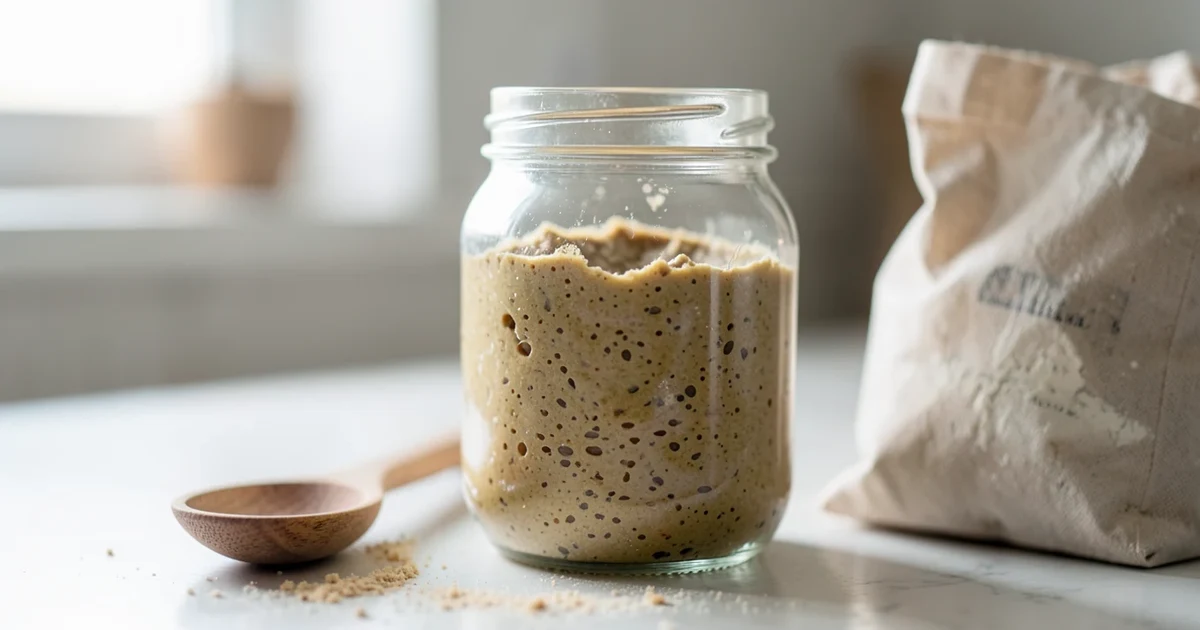
Most sourdough starters thrown away for mold did not have mold. They had kahm yeast, hooch, or a strong smell — all three of which are normal and none of which mean the starter is finished.
The distinction is worth getting right in both directions. Real mold on a starter means it goes; the three impostors do not.
The three things that are not mold
| What you see or smell | What it is | What to do |
|---|---|---|
| Flat white film, no texture, sometimes wrinkled | Kahm yeast — harmless, a sign of a slow or neglected starter | Scrape off, discard down to clean starter, feed |
| Grey or brown liquid on top or in a layer | Hooch — alcohol from a hungry starter | Pour off or stir in, then feed more often |
| Sharp acetone or nail-polish smell | Underfed starter producing acetic acid and ethanol | Feed on a shorter cycle, or use more flour per feed |
| Grey-ish colour through the starter | Normal for a rye or wholemeal starter | Nothing |
None of these are fuzzy. That is the whole test.
What real mold looks like
Mold on a starter is raised and fuzzy, and it is coloured — pink, orange, green, black, or white with visible texture. It appears as distinct spots that spread outward rather than an even film across the surface.
If you see that, the starter goes. So does the jar, or at least the jar goes through a dishwasher on hot before anything else lives in it.
The reason for the firm line is the same as with bread: a starter is a wet, porous medium, and hyphae travel through it far beyond the visible spot. Scraping the top off a genuinely moldy starter leaves the network behind.
Pink or orange is a particular warning. It usually indicates bacterial contamination rather than mold, and it is the one appearance where nobody sensible recommends salvage.
Why starters get moldy
Almost always one of four things:
- Neglect. A starter left unfed for weeks runs out of acidity and loses the chemical defence that normally keeps mold out.
- Dried residue on the jar walls above the starter line. That crust is the usual starting point, because it is exposed and not protected by the acidic mass below.
- A contaminated utensil — a spoon that touched something else, a lid put down on a counter.
- Too little flour relative to water, giving a slack starter with a wet surface and a weak acid environment.
Wiping the jar walls clean after each feed removes the most common cause outright.
Bringing a neglected one back
A starter that smells sharp, has separated, and has a grey layer is usually recoverable.
Pour off the hooch. Take a spoonful from the middle — not the top, not the crust on the sides — into a clean jar. Feed it at 1:5:5 by weight, meaning one part starter to five parts flour and five parts water. Repeat every twelve hours somewhere warm.
Give it three days before deciding. A starter that has been dormant takes a while to rebuild population, and most that look dead on day one are active by day three.
When to stop trying
Fuzzy growth of any colour. Pink or orange anything. A smell that is genuinely putrid rather than sharp — sour and acetone-ish is fine, rotten is not.
Starting again costs flour and a week. That is a smaller loss than it feels like at the time.
The same question on other food
Bread is the clearest case in the other direction — the visible spot is the least of it, and the loaf goes whole. Why bread is different from hard cheese explains which foods can be salvaged by cutting around the growth and which cannot.
And for household surfaces rather than food, the first question is usually whether it is mold at all: four things that are not.
The species matters less than you think
- Public health guidance is to remove all indoor mold regardless of type. The CDC and EPA do not recommend routine species testing for ordinary households, because the response does not change: find the water, stop it, remove the growth.
- “Toxic black mold” is a marketing phrase, not a category. Stachybotrys is real and does need soaked material to grow, so finding it tells you something useful about your building. But the health effects that are well established — allergy, asthma aggravation, irritation — are not specific to it.
- Mold without water does not persist. Cleaning growth while leaving the moisture source is why it comes back. The leak, the condensation or the ventilation is the actual problem.
Call a professional for areas larger than about 10 square feet, for anything in HVAC ductwork, after sewage or flood water, or if anyone in the household is immunocompromised or has a lung condition.
Keep reading
- Mold on Bread: Is the Rest of the Loaf Safe?No, and bread is the clearest case of all. Why cutting the moldy part off works for hard cheese and not for bread, and what the fuzz you can see is hiding.
- A Musty Smell With No Visible MoldThe smell is real and it means active growth somewhere. Here is the search order, and the six places hidden mold is usually found.
- Is It Even Mold? Four Things That Aren'tWhite crust on basement walls, pink slime in the shower, black lines on the ceiling — three of the most common mold reports are not mold. Each has a ten-second test.