

Black Mold Around Windows: It Is Condensation
By IdentifyThese Editorial · Reviewed · 4 min read
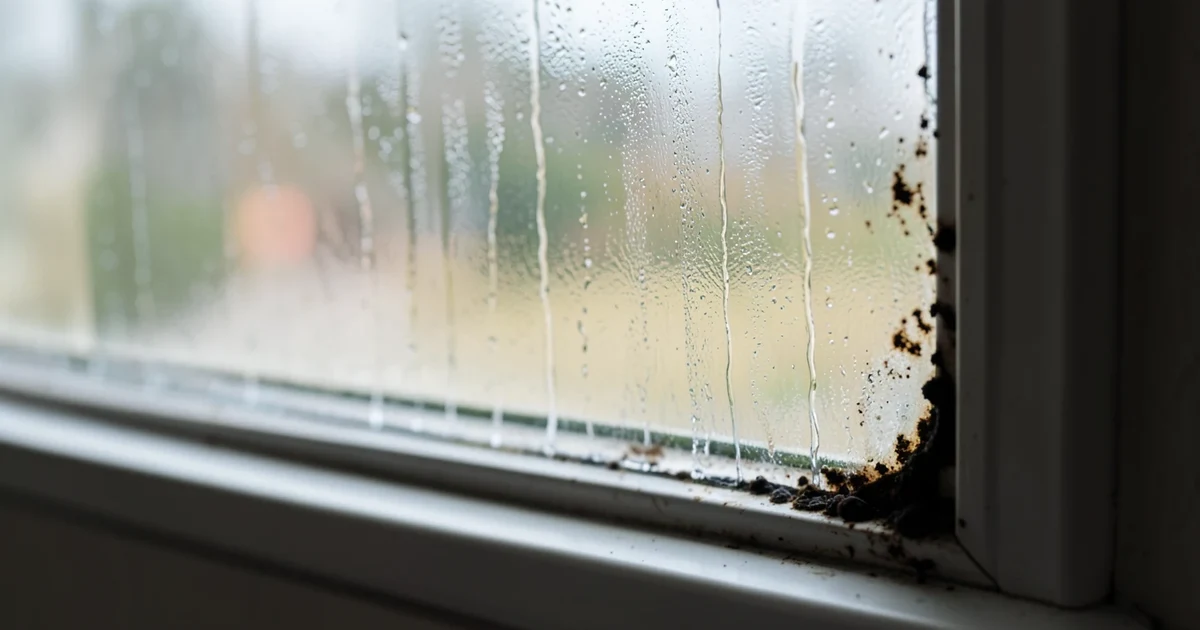
Mold in a window reveal is not a window problem. It is a room problem showing up at the coldest surface.
Warm air holds more water vapour than cold air. When indoor air meets glass or a frame that is several degrees colder, it cools past the point where it can hold that water, and the surplus condenses. That water sits in the reveal, in the corner of the frame, on the sill, and mold grows in it.
The window is the messenger.
Where the moisture comes from
A household produces a surprising volume of water vapour daily.
| Source | Roughly |
|---|---|
| Breathing and perspiration, four people | 4–6 litres/day |
| Cooking | 2–3 litres/day |
| Showers and baths | 1–2 litres/day |
| Drying laundry indoors | 2–5 litres per load |
| Unvented tumble dryer | 2–3 litres per load |
| Houseplants | Small but not nothing |
Drying laundry indoors is the item people miss and it is frequently the largest single contributor. A single load put on an airer in a bedroom releases several litres into that room over a day.
The three fixes, in order
1. Ventilate. The single most effective action.
- Extractor fans in the kitchen and bathroom, running during and for twenty minutes after use. A timer switch makes this happen without anyone remembering.
- Trickle vents open. They exist for exactly this and are routinely closed.
- Ten minutes of proper cross-ventilation each morning — windows open on opposite sides. Brief and vigorous beats a window on the latch all day, because it exchanges the air without cooling the structure.
- A dehumidifier where ventilation is not practical.
2. Reduce production.
- Dry laundry outside, or in a vented dryer, or in one closed room with a dehumidifier.
- Lids on pans; extractor on when cooking.
- Close the bathroom door while showering rather than letting the moisture reach the rest of the house.
3. Warm the cold surfaces.
- Steady low background heat beats intermittent bursts. A house that cools right down and is then heated hard produces more condensation, because the surfaces stay cold while the air warms.
- Do not block radiators under windows — they are there to warm the cold surface.
- Keep furniture and heavy curtains off the reveal so air can move across it.
- Longer term: insulation, and thermally broken or double-glazed frames. Old aluminium frames without a thermal break are the worst offenders and will run with water regardless of what else you do.
Condensation, penetrating damp or rising damp
Worth separating, because two of the three are building faults.
| Condensation | Penetrating damp | Rising damp | |
|---|---|---|---|
| Where | Cold surfaces, corners, behind furniture, window reveals | A defined patch, often around a specific defect | Base of walls, up to about a metre |
| Pattern | Worse in winter, worse in the morning | Worse after rain | Fairly constant |
| Tide mark | No | Sometimes | Yes — a distinct horizontal line, often salty |
| Mold | Usually | Sometimes | Rarely — salts inhibit it |
If the damp is a defined patch that worsens after rain, look for a defect above it — a blocked gutter, cracked render, failed pointing, a slipped tile. That is repair rather than ventilation.
The white crystalline deposit at the base of a wall is efflorescence — salts left behind as water evaporates — and is regularly reported as mold. It is one of the impostors in is it even mold, and it brushes off dry rather than smearing.
Cleaning it
Once the cause is addressed:
- Ventilate the room and wear a mask.
- Wipe with detergent solution rather than dry brushing, which throws spores into the air.
- For painted reveals, a hydrogen peroxide or dilute vinegar solution, then dry thoroughly.
- Silicone seals with growth inside them need cutting out and replacing — no cleaner reaches inside silicone, as shower mold covers.
- Repaint with a fungicidal paint if it is a recurring spot. It buys time; it is not a fix.
The measurement worth making
A hygrometer costs very little and settles the argument. Below 50% relative humidity, mold does not establish. Above 60%, it does, and above 70% it does so readily.
If your bedroom reads 70% on a winter morning, no amount of cleaning the window will keep the mold away, and no test kit will tell you anything you do not already know — which is what those mostly do.
Types referenced
The species matters less than you think
- Public health guidance is to remove all indoor mold regardless of type. The CDC and EPA do not recommend routine species testing for ordinary households, because the response does not change: find the water, stop it, remove the growth.
- “Toxic black mold” is a marketing phrase, not a category. Stachybotrys is real and does need soaked material to grow, so finding it tells you something useful about your building. But the health effects that are well established — allergy, asthma aggravation, irritation — are not specific to it.
- Mold without water does not persist. Cleaning growth while leaving the moisture source is why it comes back. The leak, the condensation or the ventilation is the actual problem.
Call a professional for areas larger than about 10 square feet, for anything in HVAC ductwork, after sewage or flood water, or if anyone in the household is immunocompromised or has a lung condition.
Keep reading
- Are Mold Testing Kits Worth It? Mostly NotA petri dish will grow mold in any house on Earth, because spores are everywhere. A positive result is not evidence of a problem.
- Removing Shower Mold Without BleachBleach whitens the surface of grout and silicone without killing what is underneath. Hydrogen peroxide and detergent reach further and last longer.
- Removing Mold: What Works, and Why Bleach Usually Isn't ItCleaning the growth without fixing the moisture is why mold comes back. What to use on which surface, what to throw away, and where the DIY limit sits.