

Mold on Wood Furniture
By IdentifyThese Editorial · Reviewed · 4 min read
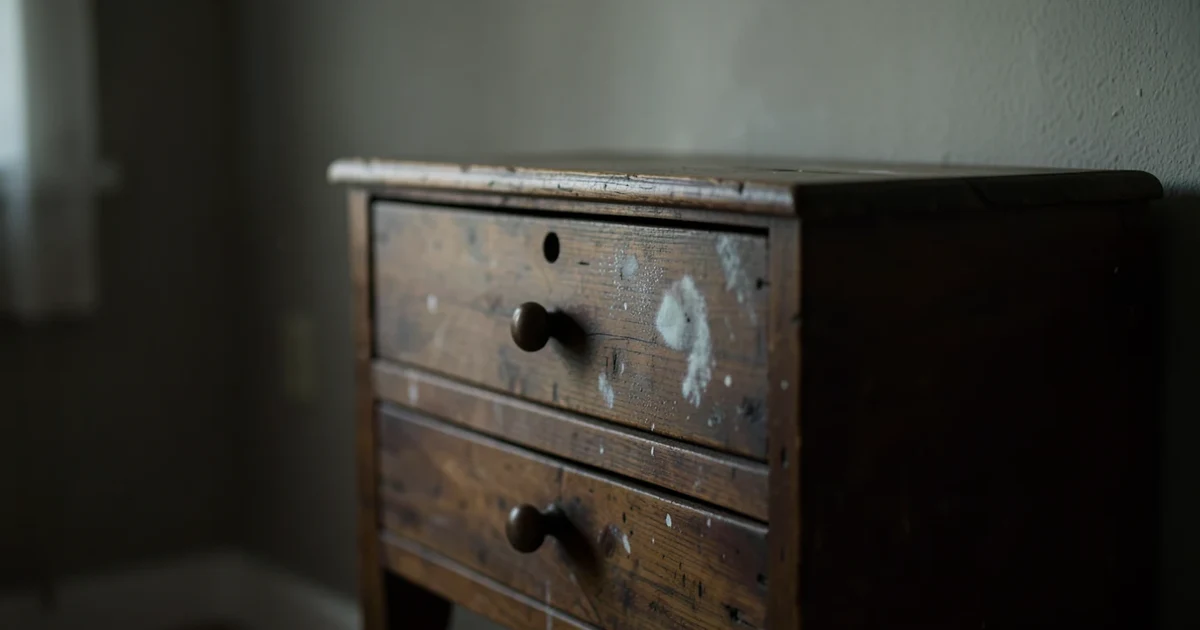
The first question is whether the wood is finished, because it determines whether the mold is on the piece or in it.
Finished wood — varnish, lacquer, shellac, paint, wax. The finish is a barrier and the mold is growing on the surface film, on dust and skin oils, not on the wood. It wipes off, and the wood underneath is usually untouched.
Bare or unfinished wood — the undersides of drawers, backs of cabinets, raw pine, the inside of a chest. Cellulose is food, the grain is porous, and hyphae go in. Wiping removes the visible growth and not the colony.
Look at the back and the underside, not the front. That is where furniture is unfinished and where it faces a wall.
Before touching it
Take it outside. Cleaning mold indoors disperses spores into the room and turns one problem into several. A garden, a garage with the door open, a driveway — anywhere with air movement.
Wear an N95 or better, gloves, and eye protection. A cloth dust mask does nothing for spores.
If it cannot be moved, seal the room off, open a window, and use a fan blowing outward rather than circulating.
Finished surfaces
- Vacuum first, with a HEPA filter and a brush attachment, holding the nozzle slightly off the surface. This removes loose spores before you smear them.
- Wipe with a cloth dampened in warm water with a little washing-up liquid. Damp, not wet.
- For stubborn areas, distilled white vinegar or a 1:1 rubbing alcohol and water mix. Test on a hidden area — alcohol softens shellac and some lacquers.
- Dry immediately and thoroughly. Leave it in moving air for a day.
- Re-wax or re-oil once fully dry, to restore the barrier.
Avoid soaking, avoid bleach — it damages the finish, raises the grain, and does not reach anything a detergent has not already reached — and avoid ammonia on shellac.
Bare wood
More work, and it is genuine removal rather than cleaning.
- Vacuum with HEPA.
- Sand the affected area with 120 grit, then 220. This is the actual removal step: you are taking away the wood the mold is in.
- Vacuum again, then wipe with a cloth dampened in vinegar or a dilute borax solution — borax leaves a residue that inhibits regrowth, which is why it suits unfinished surfaces.
- Dry completely. Days, not hours, if the piece was damp.
- Seal it. A shellac, oil or varnish barrier is what stops it recurring on wood that has already proved it will host mold.
Sand outdoors, with a respirator. Sanding mold indoors is one of the more effective ways to distribute it through a house.
Upholstery and inside drawers
Fabric is a different problem. Removable covers can be washed hot; fixed upholstery with significant mold growth generally is not worth saving, because the growth is inside the foam.
Drawer interiors, being bare wood in a closed box, are where the problem usually starts and where it usually returns.
When the piece is not the problem
Furniture molds because the room does. If a piece has grown mold, look at:
- The wall behind it. Furniture against an exterior wall creates a cold, still pocket where condensation forms. Pulling it 5 cm off the wall frequently resolves it permanently.
- Room humidity. Above 60% relative humidity, mold grows on whatever is available. A cheap hygrometer answers this and is the single most useful thing to own if you have recurring mold.
- Basement or garage storage. Both run humid, and both are where stored furniture molds.
- A leak. Persistent growth in one spot means water arriving.
Cleaning the furniture without changing any of that returns you to the same position in a season.
Dry rot, which is not this
Worth ruling out on structural or antique wood. Dry rot — Serpula lacrymans — is a wood-destroying fungus, not a surface mold. Signs: the wood is cracked into cubes, crumbles under a screwdriver, smells strongly mushroomy, and there may be white or grey strands spreading across surfaces.
That is a building problem rather than a cleaning problem and needs a surveyor. The distinction between something growing on a surface and something consuming the material is the same one that runs through is it even mold.
When to let it go
If the piece is inexpensive, was stored damp for a long time, is upholstered and heavily affected, or is chipboard or MDF that has swollen — the work exceeds the value. MDF in particular disintegrates once wet and cannot be sanded back to sound material.
Removing mold covers the same judgement for building materials, where the threshold for calling someone in is lower than most people assume.
Types referenced
The species matters less than you think
- Public health guidance is to remove all indoor mold regardless of type. The CDC and EPA do not recommend routine species testing for ordinary households, because the response does not change: find the water, stop it, remove the growth.
- “Toxic black mold” is a marketing phrase, not a category. Stachybotrys is real and does need soaked material to grow, so finding it tells you something useful about your building. But the health effects that are well established — allergy, asthma aggravation, irritation — are not specific to it.
- Mold without water does not persist. Cleaning growth while leaving the moisture source is why it comes back. The leak, the condensation or the ventilation is the actual problem.
Call a professional for areas larger than about 10 square feet, for anything in HVAC ductwork, after sewage or flood water, or if anyone in the household is immunocompromised or has a lung condition.
Keep reading
- Removing Mold: What Works, and Why Bleach Usually Isn't ItCleaning the growth without fixing the moisture is why mold comes back. What to use on which surface, what to throw away, and where the DIY limit sits.
- Removing Shower Mold Without BleachBleach whitens the surface of grout and silicone without killing what is underneath. Hydrogen peroxide and detergent reach further and last longer.
- Black Rings in the Toilet Tank and BowlThe black or pink ring in a toilet is normally bacterial biofilm or manganese, not mold. Which changes what removes it and whether it keeps returning.