

Fairy Rings, and What They Are Telling You
By IdentifyThese Editorial · · 4 min read
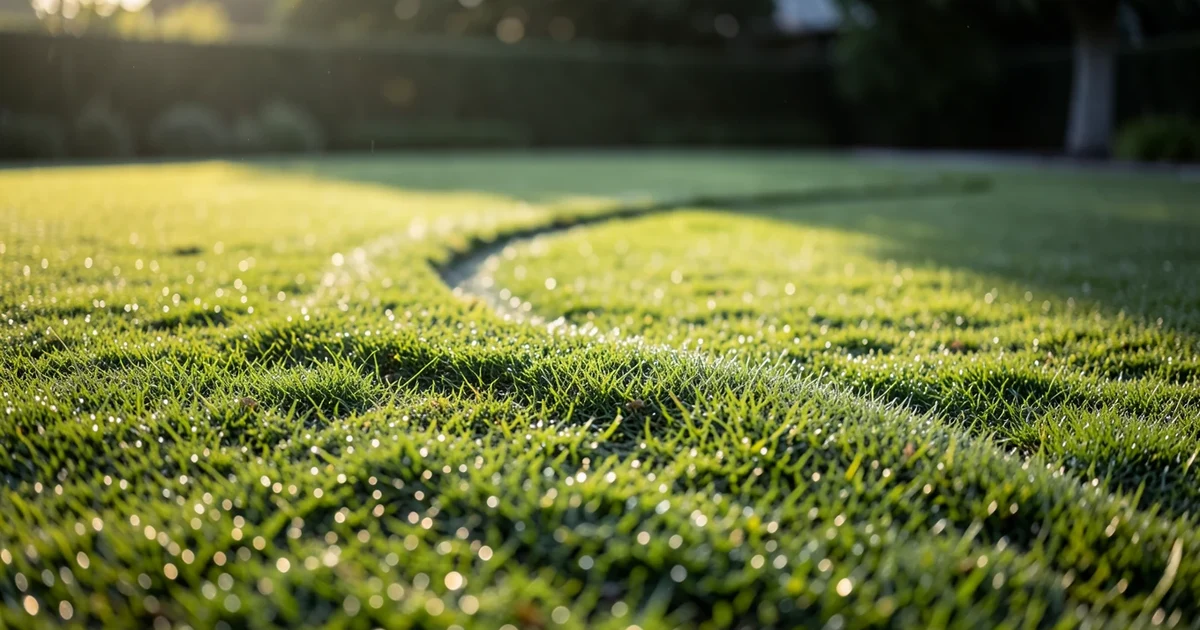
A ring of mushrooms is one organism, not many.
A spore lands, germinates, and the mycelium grows outward from that point in every direction at a roughly constant rate. The oldest part in the middle exhausts its food and dies, so what remains is an expanding ring of living mycelium — and the mushrooms appear at its leading edge.
Which means the ring is a map of the colony, and its diameter is a rough measure of its age.
The age
Rings expand by something like 10 to 35 cm a year depending on species and soil.
So a five-metre ring has been growing for decades. Some documented rings in European grassland are several hundred metres across and estimated at several hundred years old, which makes them among the oldest living organisms in the area by a wide margin.
If a ring crosses a lawn that has been there thirty years, it predates the lawn.
The three types
Turf managers classify them by what they do to the grass, and the type tells you what is worth doing.
Type 1 — the damaging one. A ring of dead or dying grass, often with darker green on one or both sides. The mycelium forms a dense mat that becomes hydrophobic, so water cannot penetrate and the grass above it dries out.
Type 2 — the green one. A ring of stimulated, darker green grass with no dieback. The fungus is breaking down organic matter and releasing nitrogen, and the grass is responding. This is the common kind and it is a fertiliser effect, visible chiefly because the rest of the lawn is comparatively underfed.
Type 3 — mushrooms only. A ring of fruiting bodies with no visible effect on the grass at all.
Type 2 and Type 3 need nothing. Type 1 is the one that damages turf.
Dealing with Type 1
The mycelium can extend 30 cm or more into the soil, and fungicides very rarely reach it. Elimination is not usually a realistic target.
What works:
- Aerate deeply through the ring, breaking up the hydrophobic layer.
- Water heavily immediately after aerating, ideally with a wetting agent or a drop of washing-up liquid in the water to break the surface tension.
- Feed the whole lawn, which reduces the visual contrast by bringing the rest up to the ring.
- Repeat over several seasons. This is management, not a cure.
The nuclear option — excavating the soil to 60 cm and a metre beyond the ring on each side, and replacing it — works and is rarely proportionate.
The mushrooms in it
Several species make rings. The common ones in lawns:
- Fairy ring champignon (Marasmius oreades) — small, tan, with a low central bump, widely spaced tough gills, and a stem that is remarkably tough and will not snap. The classic ring-former.
- Shaggy ink cap — tall, white, shaggy, dissolving into black ink from the edge upward.
- Puffballs, in arcs.
- Green-spored parasol (Chlorophyllum molybdites) — large, in lawns, often in rings, and one of the most frequent causes of severe gastrointestinal poisoning in North America. The spore print is green, which is the identifying feature and which develops only as the mushroom matures.
That last one is the reason a ring of large white mushrooms in a lawn is worth identifying rather than admiring. It is regularly mistaken for the edible parasol.
If there are children or dogs
The ring itself is not the issue; what is in it is. Any lawn producing mushrooms in quantity is worth walking before children play, particularly after rain in late summer and autumn.
The response to an ingestion is a call to Poison Control and a properly collected specimen, dug up with the base intact — a child ate a mushroom covers what to collect and why the base matters.
Why the ring is there at all
The underlying answer is almost always buried organic matter: old tree roots, a removed stump, construction debris, or a long history of thatch.
Which is the same answer as for most lawn mushrooms. The fungus is decomposing something, and it stops when it runs out — the ring finds an obstacle, a path or a driveway, and dies back along that edge, which is why so many old rings are arcs rather than circles.
The folklore
Rings appear in European folklore as the dancing grounds of fairies, with the usual penalties for stepping inside. There are parallel traditions elsewhere — witches' rings, dragon paths, and in several accounts lightning strikes.
The explanations are more interesting than the phenomenon they were invented for, which is a fungus that grows outward at a steady rate and eventually runs out of food in the middle.
Species referenced
Read this before anything else
- Never eat a wild mushroom identified by a website or an app.That includes this one. These tools narrow possibilities; they cannot see your mushroom, its base, its smell or its habitat, and the difference between a meal and a liver transplant is sometimes a feature buried in the soil.
- Get it confirmed in person by an experienced local forager or a mycological society. Most regions have one, most run free identification sessions, and they will look at the actual specimen.
- Dig, do not pull. The cup at the base of a death cap is often underground. Pulling the mushroom leaves the most important feature in the soil.
- If someone has eaten a wild mushroom and feels unwell, call poison control now — in the US, 1-800-222-1222. Do not wait for symptoms to worsen. Amatoxin poisoning has a false recovery phase, and delayed treatment is what makes it fatal. Save any uneaten pieces for identification.
Keep reading
- A Child Ate a Mushroom From the GardenCall Poison Control now, and collect the mushroom before it is trampled. Most garden mushrooms are harmless — and identification is what establishes that.
- Oyster Mushrooms and the Three Things That Look Like ThemDecurrent gills, an off-centre stem or none, and growth in shelving clusters on wood. Two lookalikes are poisonous and one is merely disappointing.
- Mushrooms Growing on My Tree: What That MeansA fruiting body on a living trunk means the fungus has been inside the wood for years. The position on the tree tells you which part is affected.