

A Child Ate a Mushroom From the Garden
By IdentifyThese Editorial · · 3 min read
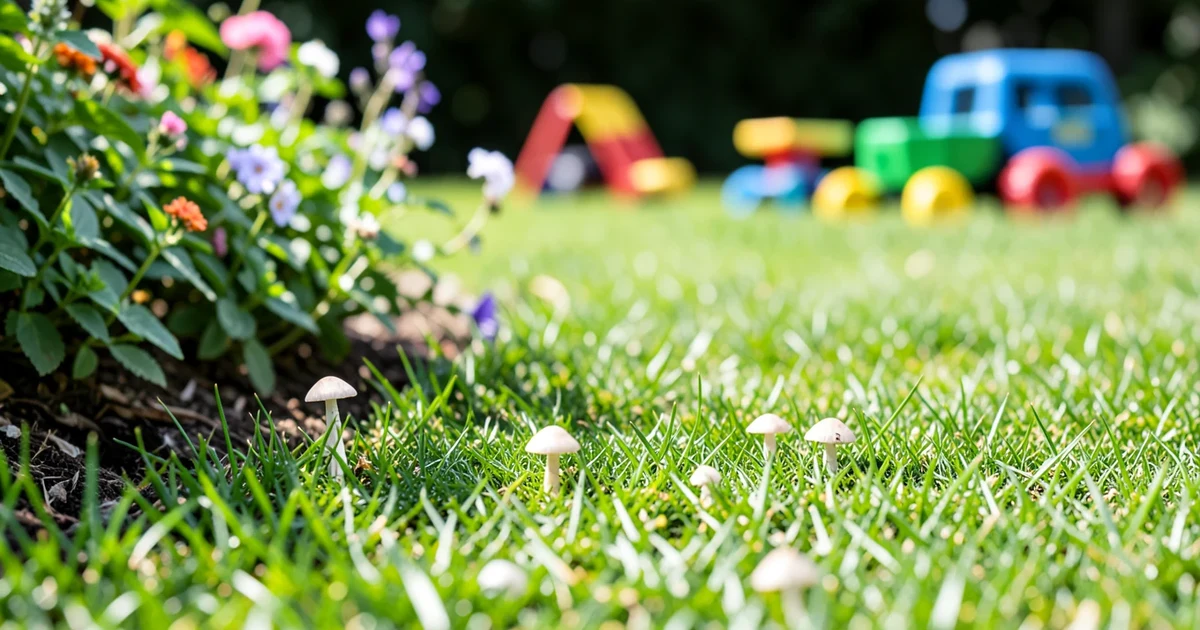
Call Poison Control. In the United States that is 1-800-222-1222, free, 24 hours, staffed by toxicologists. Elsewhere, the national poisons service or emergency number.
Then collect the mushroom. Both of those before anything else, and both before symptoms.
Collect a specimen properly
This is the part that gets lost, and it is what decides whether anyone can tell you it is fine.
- Find the same kind of mushroom from the same spot. Ideally an intact one.
- Dig it up with a trowel or a spoon. Do not pull. The cup at the stem base is the single most important feature and it is usually buried — the Amanita check explains why.
- Wrap it in paper, not plastic. Plastic turns a specimen into mush within hours.
- Refrigerate it.
- Photograph the spot: what it was growing on or near, and which trees are close by.
- If any of the mushroom is still in the child's mouth, remove it and keep that too.
A whole specimen with the base intact can be identified. A photograph of a trodden cap frequently cannot.
What Poison Control will ask
- Roughly how much was eaten, and when
- The child's age and weight
- Whether there are symptoms yet
- Whether you have a specimen
- Where it was growing — soil, wood, mulch, near what trees
They may connect you with a mycologist. Many poison centres have arrangements with local mycological societies precisely for this.
Do not
- Do not induce vomiting unless instructed.
- Do not wait for symptoms. With the dangerous species, the absence of symptoms in the first hours is expected and is exactly when treatment matters — why the delay matters.
- Do not give anything by mouth — milk, charcoal, water — unless instructed.
- Do not identify it from an app and act on that. Photo identification is unreliable on precisely the lookalike pairs that matter.
What is usually growing in a garden
Most lawn and garden fungi are saprophytes breaking down organic matter, and most ingestions produce nothing at all. The common ones:
- Fairy ring champignon and other small brown lawn mushrooms
- Puffballs, which are harmless while pure white inside — and dangerous only through one specific confusion
- Inky caps on lawns and mulch
- Yellow houseplant mushrooms in pots and mulch
- Field mushrooms and their relatives
The ones that matter, and are found in gardens and parks:
- Deadly Amanitas — near trees, especially oaks, including in suburban gardens and street plantings. The species and its signature are in the death cap.
- Deadly galerina — small, brown, on rotting wood and bark mulch, containing the same toxins as a death cap in a mushroom the size of a thumbnail.
- Green-spored parasol — large, in lawns, and one of the most frequent causes of severe gastrointestinal poisoning in North America.
The galerina is the one worth knowing about for gardens specifically. It is small, unremarkable, and it grows on wood chips.
Afterwards
Once the immediate question is resolved, the useful work is on the garden.
- Walk the lawn before children play, especially after rain in late summer and autumn. Pick and bin what is there.
- Mushrooms mean buried wood — old roots, stumps, construction debris, bark mulch. Removing the wood removes the fruiting.
- Bark and wood-chip mulch is the main substrate for the small brown ones. Consider a different mulch in play areas.
- Mowing spreads spores and does not touch the mycelium, so it does not reduce the crop.
The proportion to keep
Most mushroom ingestions by children result in no illness at all. The reason to act quickly is not that the odds are bad; it is that the small number of genuinely dangerous species are not distinguishable at a glance by someone under pressure, and the treatable window for the worst of them closes before symptoms begin.
Call, collect, and let someone who does this identify it.
Species referenced
Read this before anything else
- Never eat a wild mushroom identified by a website or an app.That includes this one. These tools narrow possibilities; they cannot see your mushroom, its base, its smell or its habitat, and the difference between a meal and a liver transplant is sometimes a feature buried in the soil.
- Get it confirmed in person by an experienced local forager or a mycological society. Most regions have one, most run free identification sessions, and they will look at the actual specimen.
- Dig, do not pull. The cup at the base of a death cap is often underground. Pulling the mushroom leaves the most important feature in the soil.
- If someone has eaten a wild mushroom and feels unwell, call poison control now — in the US, 1-800-222-1222. Do not wait for symptoms to worsen. Amatoxin poisoning has a false recovery phase, and delayed treatment is what makes it fatal. Save any uneaten pieces for identification.
Keep reading
- Mushroom Poisoning: Why the Delay Matters More Than the SymptomsHow long before symptoms start is the most informative single fact. Under six hours is usually the milder group; after six hours is the dangerous one.
- Puffball or a Young Amanita? Cut It in HalfA young deadly Amanita in its egg stage looks exactly like a puffball from outside. One cut, lengthwise, settles it — and there is no substitute.
- Mushrooms in Bark Mulch and Garden BedsMulch is wood, and wood-decaying fungi eat wood. Most are harmless, one is not, and two of them are strange enough to be worth recognising.