

Puffball or a Young Amanita? Cut It in Half
By IdentifyThese Editorial · Reviewed · 3 min read
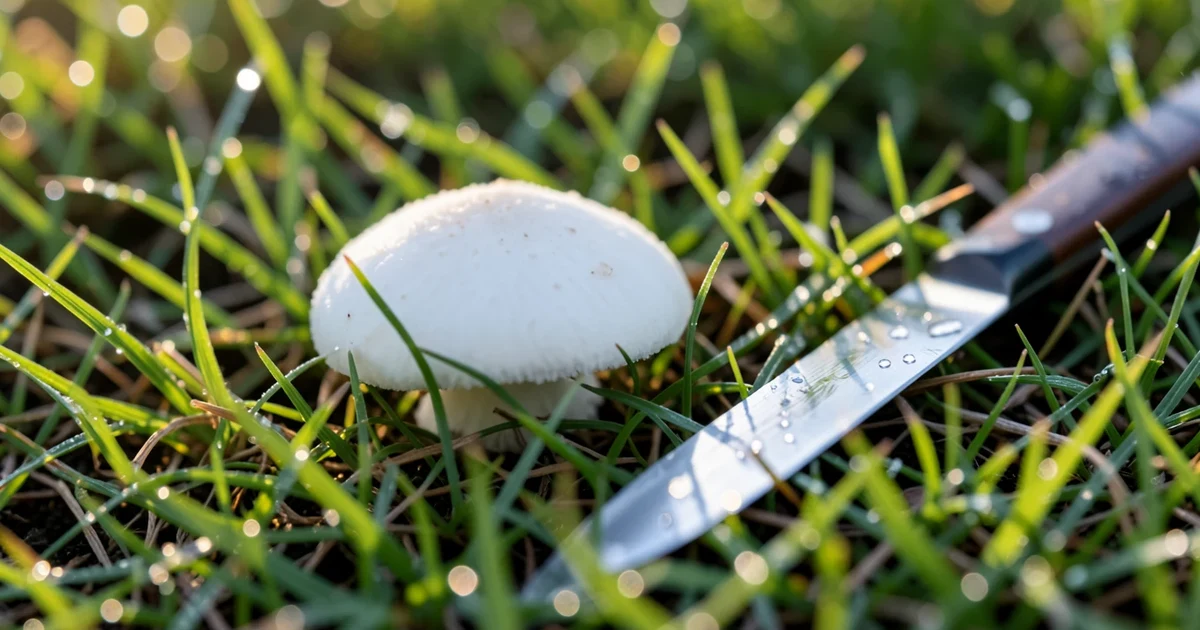
A deadly Amanita begins life as a white egg, entirely enclosed by the universal veil, sitting in the soil. From outside, that egg looks like a puffball.
There is one way to tell them apart and it takes three seconds.
The cut
Cut it in half from top to bottom. Not across — lengthwise, through the whole thing.
A true puffball is pure white and completely uniform inside, like a marshmallow. No structure, no lines, no shapes. Homogeneous throughout.
A young Amanita shows the outline of a mushroom developing inside: a cap, gills, and a stem, in silhouette. Once you have seen one, it is unmistakable — but you have to cut it to see it.
An earthball (Scleroderma) has a firm, dark purple-black interior with a marbled or granular texture, and a thick rind. Earthballs are poisonous, cause serious gastric illness, and are common. They are also frequently sold or given away as puffballs.
Cut every single one, individually. Not a sample from the patch.
What else disqualifies a puffball
Even when the cut face is uniform:
- Any yellow or brown discolouration — it is maturing and the spores are developing. Not eaten at this stage.
- A firm dark rind — earthball.
- A stem or a stalk below the ball — stalked puffballs are a different group.
- A soft or powdery interior — it has matured and the inside is now spore mass.
The white-throughout requirement is not about flavour. It is the condition under which the identification holds.
Recognising the good ones
Giant puffball (Calvatia gigantea) — can reach the size of a football or larger, in meadows, pastures and grassy woodland edges. Its size makes confusion with an Amanita egg implausible above a certain point, but small ones still need the cut.
Common puffball (Lycoperdon perlatum) — pear-shaped, with small spines that rub off leaving a pattern, on soil and woodland debris.
Pear-shaped puffball (Apioperdon pyriforme) — clustered on rotting wood, which is unusual for the group.
Earthball (Scleroderma citrinum) — the one to know as a negative. Yellow-brown, warty, firm, and dark inside. Poisonous.
Why this one specific mistake matters
Most mushroom safety advice is about not eating things you cannot identify. This case is different, because the mistake is made by people who believe they have identified it — puffballs are widely described as a beginner's mushroom with no dangerous lookalikes.
That description is true only with the cut. Without it, a puffball has one dangerous lookalike and it is among the most lethal fungi in the world. The signature to be avoiding is set out in the death cap, and the habit that prevents it — digging so the base is visible, then cutting — in the Amanita check.
Where they grow
Puffballs are saprophytic, feeding on dead organic matter, so they grow from soil, grass and rotting wood without any tree association.
Amanitas are mycorrhizal and grow from soil near trees. So a white ball in an open meadow far from trees is less likely to be an Amanita egg — which is context, not a test, and it does not replace the cut.
Both turn up in lawns, which is where most people meet them and where the two overlap.
Puffballs on a lawn
Common, harmless to the grass, and a sign of organic matter in the soil rather than a problem.
Mature ones release clouds of spores when disturbed, which is where the name comes from. The spores are not toxic, though inhaling a large quantity has caused respiratory irritation in a small number of documented cases — a reason not to stamp on one deliberately at close range.
If there are children or dogs in the garden, the relevant question is not what the puffball is but what else is coming up alongside it. A lawn producing fungi is producing all of them, and the Amanita signature is what to be scanning for.
Species referenced
Read this before anything else
- Never eat a wild mushroom identified by a website or an app.That includes this one. These tools narrow possibilities; they cannot see your mushroom, its base, its smell or its habitat, and the difference between a meal and a liver transplant is sometimes a feature buried in the soil.
- Get it confirmed in person by an experienced local forager or a mycological society. Most regions have one, most run free identification sessions, and they will look at the actual specimen.
- Dig, do not pull. The cup at the base of a death cap is often underground. Pulling the mushroom leaves the most important feature in the soil.
- If someone has eaten a wild mushroom and feels unwell, call poison control now — in the US, 1-800-222-1222. Do not wait for symptoms to worsen. Amatoxin poisoning has a false recovery phase, and delayed treatment is what makes it fatal. Save any uneaten pieces for identification.
Keep reading
- The Death Cap: The One Worth Learning FirstOne species accounts for most fatal mushroom poisonings worldwide. It is unremarkable to look at, and that is the problem.
- The Parts of a Mushroom You Have to CheckSix features carry nearly all identification, and two of them are commonly destroyed by the way people pick. Here is what each one is and why it matters.
- How to Take a Spore Print — and Why It Matters So MuchA spore print costs nothing, takes a few hours, and separates several deadly mushrooms from the edible species they resemble. Here is how, and what each colour rules out.