

The Amanita Check: Dig It Up, Every Time
By IdentifyThese Editorial · Reviewed · 3 min read
The overwhelming majority of fatal mushroom poisonings worldwide come from one genus: Amanita — the death cap and the destroying angel. Learning to recognise it is worth more than learning any number of edible species, because you only have to be right about this once.
The two features
A ring on the stem. A skirt or collar hanging near the top, left by the partial veil that covered the gills when the mushroom was young.
A cup at the base. A membranous sac — the volva — left by the universal veil that enclosed the entire young mushroom like an egg.
Both together, on a mushroom with white gills, means stop. That combination covers the death cap and the destroying angels, which between them cause most mushroom deaths.
Why you must dig
The volva is usually below ground level.
If you pull a mushroom, the stem snaps above the base and the volva stays in the soil. You are then holding a white mushroom with a ring and apparently no cup — which looks considerably more reassuring than what you actually have.
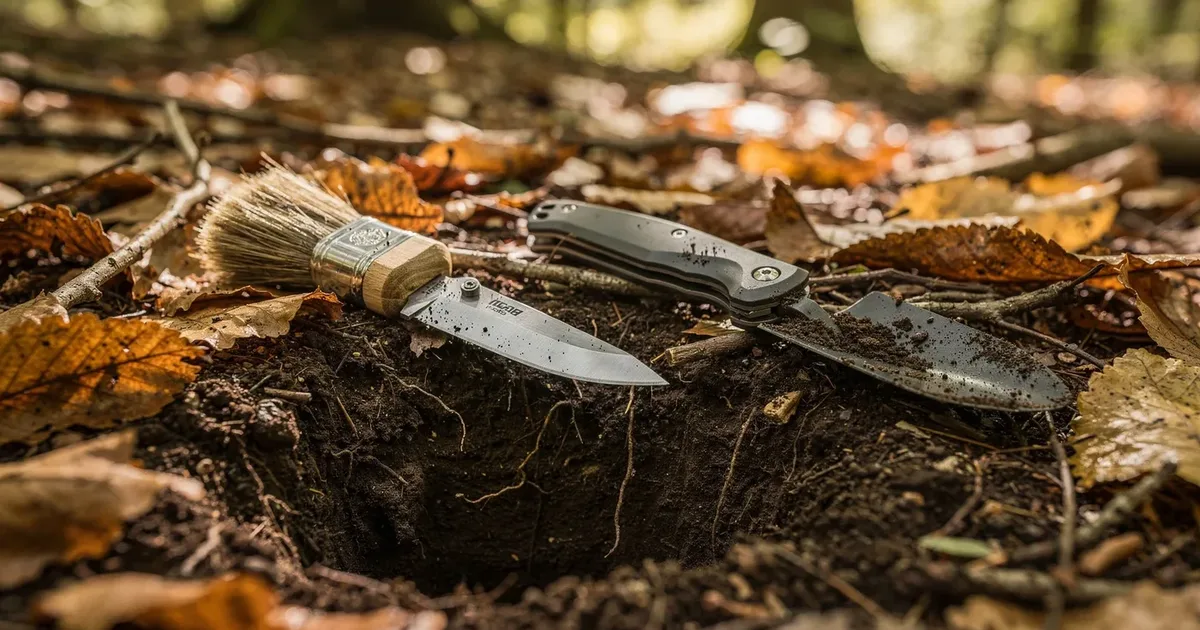
So: push a knife or trowel into the soil beside the stem and lever the whole thing out, base included. Brush the soil off carefully and look at what you have. This takes ten seconds and it is the single most important habit in mushroom foraging.
The same applies to any mushroom you are considering. If you did not see the base, you did not identify it.
The full Amanita check
Run this on any pale mushroom growing from the ground:
- Are the gills white, and do they stay white? Amanita gills are white and remain so. Field mushroom gills go pink then chocolate brown.
- Take a spore print. White is consistent with Amanita. Brown rules it out.
- Is there a ring?
- Dig it up. Is there a cup, a sac, or a bulbous base with scaly rings?
- Is it growing from soil rather than wood? Amanitas are mycorrhizal — they partner with tree roots and grow from the ground, never on wood.
White gills, white print, ring, cup, growing from soil: that is a death cap description, and no amount of matching it against photographs changes that.
The button-stage trap
This one catches people who are not even foraging for Amanitas.
A young Amanita is still enclosed in its universal veil and looks like a small white ball — very much like a puffball, which is widely eaten and generally considered beginner-friendly.
Cut every white ball in half, from top to bottom.
- A puffball is uniformly white, firm and featureless inside, like a marshmallow.
- An Amanita egg shows the silhouette of a developing mushroom — a faint outline of cap, gills and stem.
That cut takes two seconds and it is not optional. Every single one, every time.
What does not help
"It grew in my own garden." Death caps are common in parks and gardens, particularly under oaks, and they have spread widely with planted trees. Familiarity with the location is not knowledge of the mushroom.
"Animals were eating it." Squirrels, slugs and deer eat mushrooms that are lethal to humans. This idea has killed people.
"It didn't taste bad." Death caps are widely reported as pleasant-tasting. Amatoxins have no taste and produce no immediate warning.
"It's been cooked." Amatoxins are heat-stable. Cooking, drying, freezing and boiling do not destroy them.
Rules of thumb generally. No universal rule distinguishes edible from poisonous mushrooms — not colour, not peeling, not silver spoons, not insects. Every such rule has a lethal counterexample.
If someone has eaten one
Call poison control immediately — in the US, 1-800-222-1222 — even if nobody feels unwell.
Amatoxin poisoning follows a specific and dangerous pattern: severe gastrointestinal symptoms after six to twelve hours, then an apparent recovery lasting a day or so while liver damage continues silently, then liver failure.
That false recovery is what makes it fatal. People go home from hospital feeling better. Treatment started early works far better than treatment started once jaundice appears.
Save any uneaten pieces, and any vomit, in a bag for identification. Do not induce vomiting unless told to.
Species referenced
Read this before anything else
- Never eat a wild mushroom identified by a website or an app.That includes this one. These tools narrow possibilities; they cannot see your mushroom, its base, its smell or its habitat, and the difference between a meal and a liver transplant is sometimes a feature buried in the soil.
- Get it confirmed in person by an experienced local forager or a mycological society. Most regions have one, most run free identification sessions, and they will look at the actual specimen.
- Dig, do not pull. The cup at the base of a death cap is often underground. Pulling the mushroom leaves the most important feature in the soil.
- If someone has eaten a wild mushroom and feels unwell, call poison control now — in the US, 1-800-222-1222. Do not wait for symptoms to worsen. Amatoxin poisoning has a false recovery phase, and delayed treatment is what makes it fatal. Save any uneaten pieces for identification.
Keep reading
- Mushroom Poisoning: Why the Delay Matters More Than the SymptomsHow long before symptoms start is the most informative single fact. Under six hours is usually the milder group; after six hours is the dangerous one.
- The Death Cap: The One Worth Learning FirstOne species accounts for most fatal mushroom poisonings worldwide. It is unremarkable to look at, and that is the problem.
- The Parts of a Mushroom You Have to CheckSix features carry nearly all identification, and two of them are commonly destroyed by the way people pick. Here is what each one is and why it matters.