
Can You Identify a Mushroom From a Photograph? Not Reliably
By IdentifyThese Editorial · · 3 min read
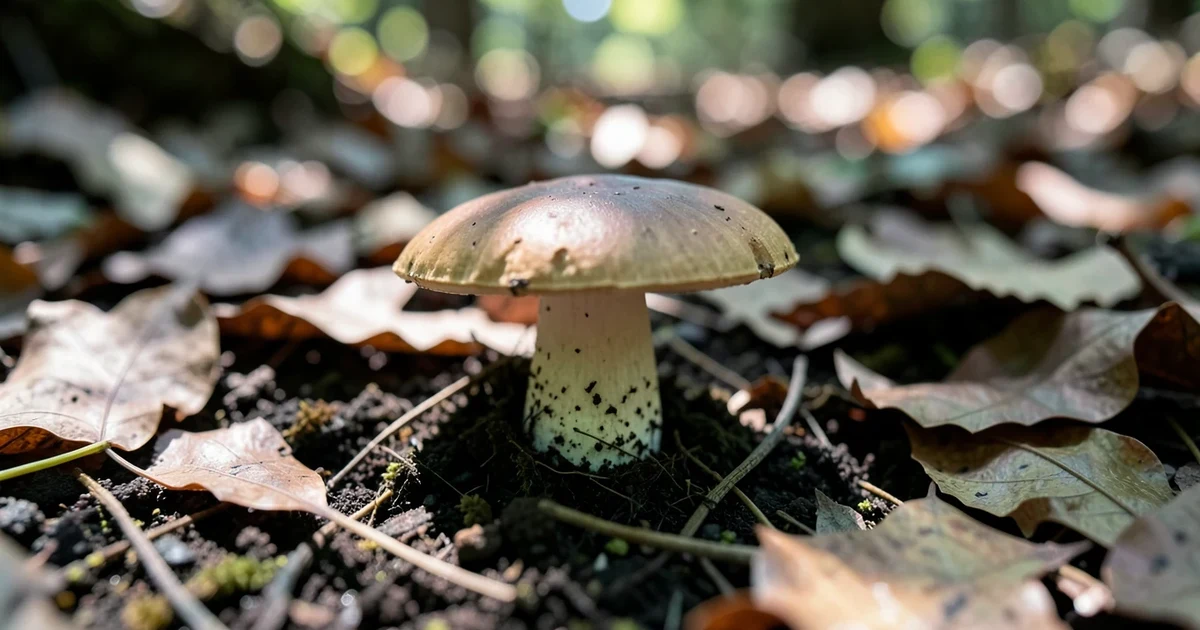
Photo identification of mushrooms fails in a specific and predictable way: the features that separate a good edible from a lethal species are frequently not photographable.
That is not a limitation of the software. It is a fact about the organism.
What a photograph cannot contain
Spore print colour. Not visible on the living mushroom at all. It separates genera that look identical from outside, and it is the character that distinguishes honey fungus from deadly galerina — white against rusty brown. It requires a few hours on paper. How to take a spore print.
The stem base. The volva — the cup that identifies the genus responsible for most fatal poisonings — is usually buried. It is not in a photograph of a standing mushroom, and it is not there after the mushroom has been pulled rather than dug.
The inside. Whether a puffball is uniform white or contains the outline of a developing Amanita. Whether a morel is hollow. Whether flesh changes colour when cut. All require a knife.
Whether a gill can be peeled. The false-gill test that separates a chanterelle from the jack-o'-lantern is tactile.
Texture and smell. Aniseed, almonds, radish, phenol. Diagnostic in several groups.
Scale. A mushroom photographed without a reference object could be 2 cm or 20.
Substrate. Whether it is on wood or on soil, and which trees are nearby. This is a hard identifying feature and it is usually cropped out.
That list is most of what identification consists of, which is the whole problem.
Where apps do reasonably
Distinctive, widely-photographed species with no close lookalikes: fly agaric, chicken of the woods, giant puffball, shaggy ink cap, turkey tail. Things with a shape or colour nothing else has.
Where they fail
Precisely the pairs where the cost of an error is highest.
- Death cap against field mushroom and paddy straw
- Deadly galerina against honey fungus and Psilocybe
- Jack-o'-lantern against chanterelle
- False morel against morel
- Young Amanita against puffball
- Green-spored parasol against edible parasols
Published evaluations of the popular apps have reported error rates that would be entirely unacceptable for a decision about eating, and several have specifically flagged that the apps offer confident answers on dangerous lookalikes.
Every major app's own terms disclaim use for determining edibility. That disclaimer is the accurate part of the marketing.
If you are going to photograph one anyway
Do it properly, because a good set of photographs plus a spore print genuinely can be identified by someone competent.
- In place, from the side, showing cap and stem, with the substrate visible.
- The underside — gills, pores, teeth or ridges, and how they attach to the stem.
- Dug up, with soil brushed off, so the base is visible. Dug, not pulled.
- Cut lengthwise, showing the flesh and whether it is hollow.
- The habitat — what it is growing on, and the nearby trees.
- A spore print, photographed on white and dark paper.
- Something for scale in at least one shot.
Then add, in text: the location, the substrate, the nearby tree species, the smell, and whether the flesh changed colour when cut.
That is what a local mycological society will ask for, and they are the people to ask. Most regions have one, many run identification sessions, and many maintain relationships with poison control centres for exactly this reason.
The position worth holding
Photographic identification is fine for curiosity and for narrowing a possibility down before doing the actual work. It is not a basis for eating anything.
The features that matter are the ones you get by digging the mushroom up, cutting it open, smelling it, and leaving it on paper overnight — the sequence in the parts of a mushroom you have to check.
And the single habit that prevents the worst outcome does not involve a photograph at all: dig, look for a ring, look for a cup, check whether the gills stay white. The Amanita check.
Species referenced
Read this before anything else
- Never eat a wild mushroom identified by a website or an app.That includes this one. These tools narrow possibilities; they cannot see your mushroom, its base, its smell or its habitat, and the difference between a meal and a liver transplant is sometimes a feature buried in the soil.
- Get it confirmed in person by an experienced local forager or a mycological society. Most regions have one, most run free identification sessions, and they will look at the actual specimen.
- Dig, do not pull. The cup at the base of a death cap is often underground. Pulling the mushroom leaves the most important feature in the soil.
- If someone has eaten a wild mushroom and feels unwell, call poison control now — in the US, 1-800-222-1222. Do not wait for symptoms to worsen. Amatoxin poisoning has a false recovery phase, and delayed treatment is what makes it fatal. Save any uneaten pieces for identification.
Keep reading
- The Parts of a Mushroom You Have to CheckSix features carry nearly all identification, and two of them are commonly destroyed by the way people pick. Here is what each one is and why it matters.
- Mushrooms in Bark Mulch and Garden BedsMulch is wood, and wood-decaying fungi eat wood. Most are harmless, one is not, and two of them are strange enough to be worth recognising.
- How to Take a Spore Print — and Why It Matters So MuchA spore print costs nothing, takes a few hours, and separates several deadly mushrooms from the edible species they resemble. Here is how, and what each colour rules out.