

How to Take a Spore Print — and Why It Matters So Much
By IdentifyThese Editorial · · 3 min read · updated August 2026
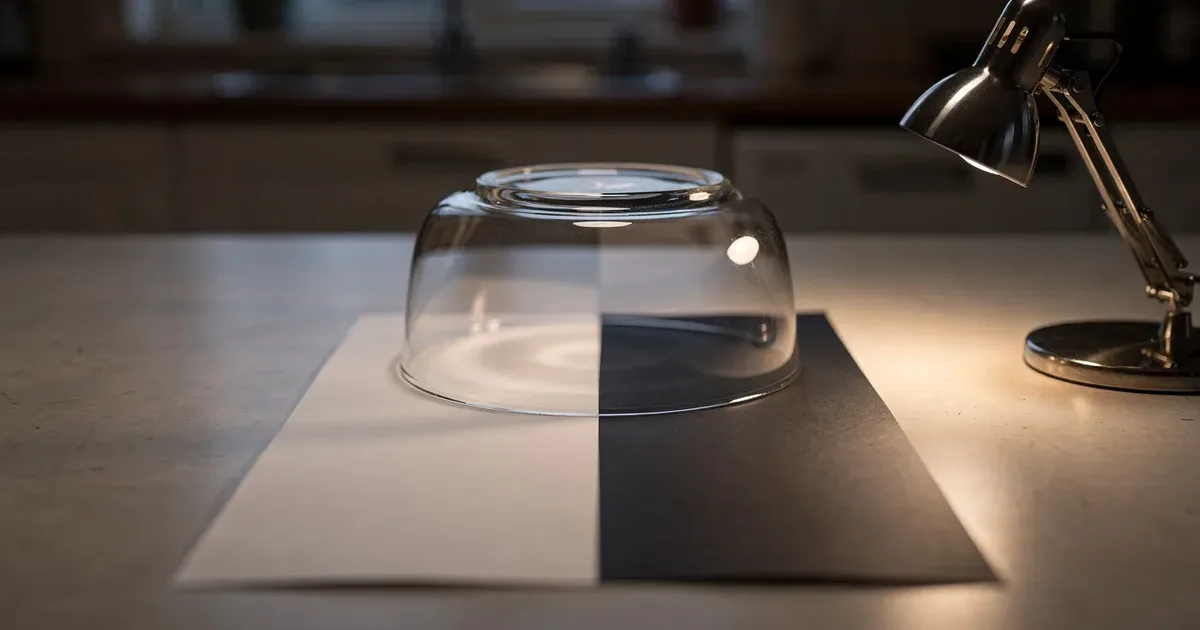
The spore print is the highest-value thing an amateur can do, and almost nobody does it. It costs nothing, requires no equipment, and it settles two of the confusions that kill people.
How to do it
- Cut the cap from the stem with a knife, as close to the cap as you can.
- Place it gills down on a sheet of paper. Use paper that is half white and half black — a white print is invisible on white paper and a black one is invisible on black.
- Cover it with a bowl, glass or cup. This stops draughts blowing the spores away, which is the usual reason a print fails.
- Leave it several hours, or overnight.
- Lift the cap straight up and look at the deposit. Judge the colour where it is thickest.
If nothing appears, the mushroom is either too young to be dropping spores or too old to have any left. Try another specimen.
What the colours mean
| Print colour | What it points to |
|---|---|
| White or cream | Amanita, Russula, Lactarius, Pleurotus, Armillaria, Cantharellus |
| Pink | Volvariella, Pluteus, Entoloma |
| Brown | Agaricus, Bolete family |
| Rusty brown | Cortinarius, Galerina, Gymnopilus |
| Black or purple-black | Coprinus, Psathyrella, Panaeolus |
| Green | Chlorophyllum molybdites — a very common cause of poisoning in lawns |
The two prints that save lives
White versus rusty brown, on wood. Honey fungus and the deadly Galerina both grow in clusters on dead wood, both are brownish, both have a ring, and both appear in autumn. Honey fungus is widely eaten. Galerina contains the same amatoxins as the death cap.
Honey fungus prints white. Galerina prints rusty brown. That is the whole difference, and it has killed people who did not check.
White versus brown, in grass. Field mushrooms and destroying angels can both be white mushrooms in grass. Field mushroom gills go pink then chocolate brown and the print is brown. Destroying angel gills stay white forever and the print is white.
Gills that stay white on a white mushroom in grass should stop you every time.
What a print does not do
It gives you a genus-level clue, not a species. A white print is shared by chanterelles, oyster mushrooms, russulas and the death cap — an enormous range of consequences.
So the print narrows; it does not conclude. Combine it with:
- What is under the cap — gills, ridges, pores or teeth
- The stem base, dug up rather than pulled, checked for a cup
- A ring on the stem
- The substrate — wood, soil, grass or dung
The habit worth building
Take a print of everything you find, even things you are not remotely considering eating. It costs nothing but a bowl and a night, and after a season of doing it you will have an intuition for which genus you are looking at that no amount of photograph-matching produces.
And when the print does not match what you expected, that is the print doing its job.
Reading a print that came out badly
Prints fail in a small number of ways, and each has a fix:
| What happened | Cause | Fix |
|---|---|---|
| Nothing at all | Cap too young, or too old and spent | Try another specimen at a different stage |
| Very faint | Not enough time, or dry air | Leave overnight, and cover to hold humidity |
| Smeared | Cap moved, or condensation ran | Weight the bowl, keep it somewhere still |
| Colour ambiguous | Judged on the thin edge | Judge where the deposit is thickest |
| Looks white on white paper | Wrong paper | Always use half white, half dark |
A cap that is genuinely too old will have dropped most of its spores already, often leaving a visible dusting on whatever is beneath it in the field — which is itself a usable print if you notice it before picking.
Keep the prints
A print on paper keeps indefinitely if it stays dry. Writing the date, the substrate and where it was found on the same sheet turns a season of walks into a reference collection that is worth more than any book, because it is local to you.
Use it alongside the identification key rather than instead of it.
Species referenced
Read this before anything else
- Never eat a wild mushroom identified by a website or an app.That includes this one. These tools narrow possibilities; they cannot see your mushroom, its base, its smell or its habitat, and the difference between a meal and a liver transplant is sometimes a feature buried in the soil.
- Get it confirmed in person by an experienced local forager or a mycological society. Most regions have one, most run free identification sessions, and they will look at the actual specimen.
- Dig, do not pull. The cup at the base of a death cap is often underground. Pulling the mushroom leaves the most important feature in the soil.
- If someone has eaten a wild mushroom and feels unwell, call poison control now — in the US, 1-800-222-1222. Do not wait for symptoms to worsen. Amatoxin poisoning has a false recovery phase, and delayed treatment is what makes it fatal. Save any uneaten pieces for identification.
Keep reading
- The White Mushrooms in Your Lawn: What They Usually AreWhite is the colour the deadly Amanitas share with several harmless lawn species. What separates them, and the one feature that is almost always underground.
- Honey Fungus or Deadly Galerina? The Spore Print DecidesBoth are small brown clustered mushrooms on wood. One is edible cooked; the other contains the same toxins as a death cap. The spore print separates them.
- The Parts of a Mushroom You Have to CheckSix features carry nearly all identification, and two of them are commonly destroyed by the way people pick. Here is what each one is and why it matters.