

Mushrooms in Bark Mulch and Garden Beds
By IdentifyThese Editorial · · 3 min read
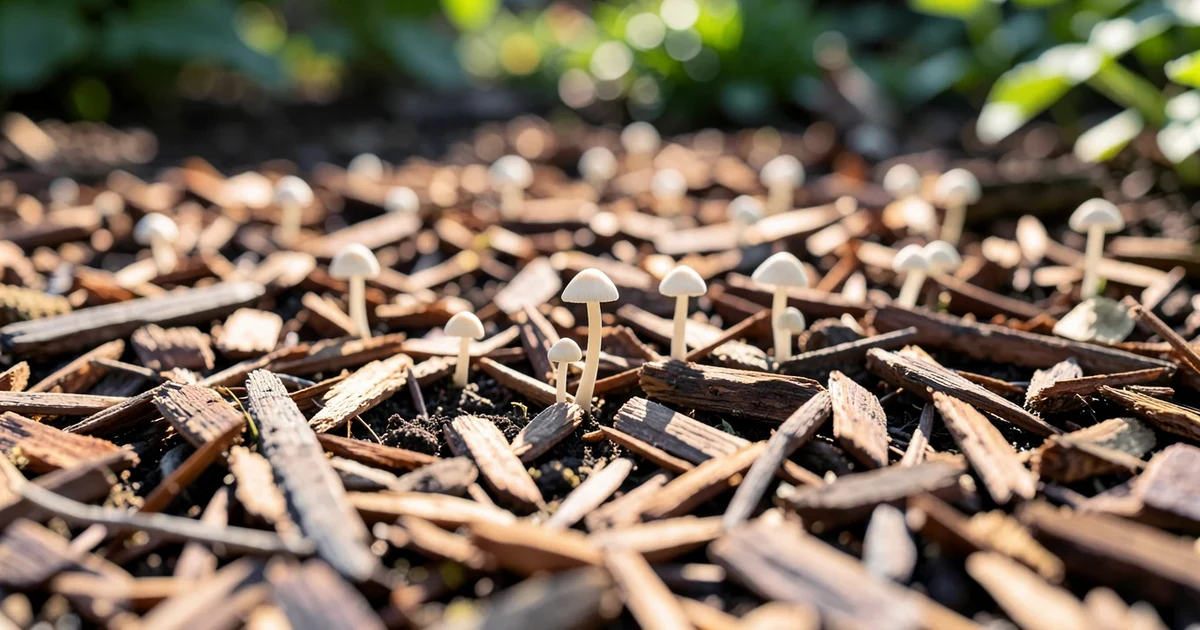
Mulching a bed with bark or wood chips is putting down a food supply for wood-decaying fungi. They arrive, they fruit, and it is the system working rather than failing.
The mulch is being broken down into soil, which is what mulch is for.
The common ones
Bird's nest fungi — tiny cups, 5–10 mm, containing several egg-like packets of spores. The cup is shaped so a raindrop striking it splashes the packets out, sometimes over a metre. Harmless and worth getting down on hands and knees to see properly.
Dog vomit slime mold (Fuligo septica) — not a fungus at all. Bright yellow, appearing overnight as a spreading foamy mass, then drying to a brown crust. It is a plasmodial slime mold, it moves slowly, and it is entirely harmless. It is also one of the most-photographed things in any garden.
Stinkhorns — emerging from an egg-like structure, growing at a remarkable rate, and smelling strongly of decay to attract flies that disperse the spores. Alarming, brief and harmless. Several species are conspicuously phallic, which produces a certain volume of correspondence.
Inky caps — including shaggy ink caps, dissolving into black liquid from the cap margin upward as they mature. Fast-growing, common in mulch and disturbed ground.
Artillery fungus (Sphaerobolus) — small and easy to miss, and the one that causes actual property damage. It fires spore packets up to six metres toward light, and they stick to house siding and cars as small tar-like black dots that are extremely difficult to remove. Light-coloured siding near a mulched bed is where the complaints come from.
Yellow houseplant mushroom (Leucocoprinus birnbaumii) — bright yellow, small, in mulch and in houseplant pots. Not edible, and it feeds on the compost rather than the plant.
The one that matters
Deadly galerina grows on rotting wood — including bark and wood-chip mulch.
It is small, tawny brown, with a fragile ring, and it contains the same amatoxins as a death cap. It is not rare, and mulched landscape beds are one of the places it turns up.
That combination — a deadly mushroom, small enough to be overlooked, on the substrate people put down in gardens where children play — is the reason mulch mushrooms are worth a look rather than a shrug. The identification and its lookalike are in honey fungus or deadly galerina.
What to do about them
In an ornamental bed — nothing. They are decomposing the mulch, which improves the soil.
Where children or pets play — walk the bed after rain in late summer and autumn and pick what is there. Bag it rather than composting it in place.
If you want fewer:
- Rake the mulch periodically to dry the surface. Fungi need it damp.
- Use a coarser mulch — larger chips have less surface area and hold less moisture.
- Reduce mulch depth to 5–8 cm. Deeper stays wetter and is not better for the plants either.
- Water in the morning rather than the evening.
- Consider a non-wood mulch in play areas: gravel, rubber, or a living groundcover.
Fungicides do not work on mulch fungi in any practical sense. The mycelium is distributed through the whole bed.
If a child or a dog eats one
Call Poison Control — 1-800-222-1222 in the US — and collect a specimen properly: dug up with the base intact, wrapped in paper rather than plastic, refrigerated. The reasons are set out in a child ate a mushroom, and the crucial point is not to wait for symptoms, because with the dangerous species the absence of symptoms is expected during the hours when treatment matters most.
The wider pattern
Mushrooms in a lawn, in mulch, or in a ring are all the same phenomenon: something is decomposing buried organic matter, and the fruiting bodies are what appears when conditions are right.
That is also why mushrooms appear suddenly in numbers after rain and then vanish — the mycelium was already there, distributed through the substrate, and the mushroom is a few days of reproductive effort. Removing them changes nothing about the organism, which is the same conclusion fairy rings arrives at from the other direction.
Species referenced
Read this before anything else
- Never eat a wild mushroom identified by a website or an app.That includes this one. These tools narrow possibilities; they cannot see your mushroom, its base, its smell or its habitat, and the difference between a meal and a liver transplant is sometimes a feature buried in the soil.
- Get it confirmed in person by an experienced local forager or a mycological society. Most regions have one, most run free identification sessions, and they will look at the actual specimen.
- Dig, do not pull. The cup at the base of a death cap is often underground. Pulling the mushroom leaves the most important feature in the soil.
- If someone has eaten a wild mushroom and feels unwell, call poison control now — in the US, 1-800-222-1222. Do not wait for symptoms to worsen. Amatoxin poisoning has a false recovery phase, and delayed treatment is what makes it fatal. Save any uneaten pieces for identification.
Keep reading
- Fairy Rings, and What They Are Telling YouA ring of mushrooms is the edge of a single organism expanding outward from a starting point. The dark green grass is the interesting part.
- A Child Ate a Mushroom From the GardenCall Poison Control now, and collect the mushroom before it is trampled. Most garden mushrooms are harmless — and identification is what establishes that.
- Mushrooms in the Lawn: What They Mean and Whether to Remove ThemThey mean buried wood and a working soil, not a sick lawn. Why mowing spreads them, what actually reduces them, and when they are worth removing anyway.