

Mushrooms Growing on My Tree: What That Means
By IdentifyThese Editorial · Reviewed · 4 min read
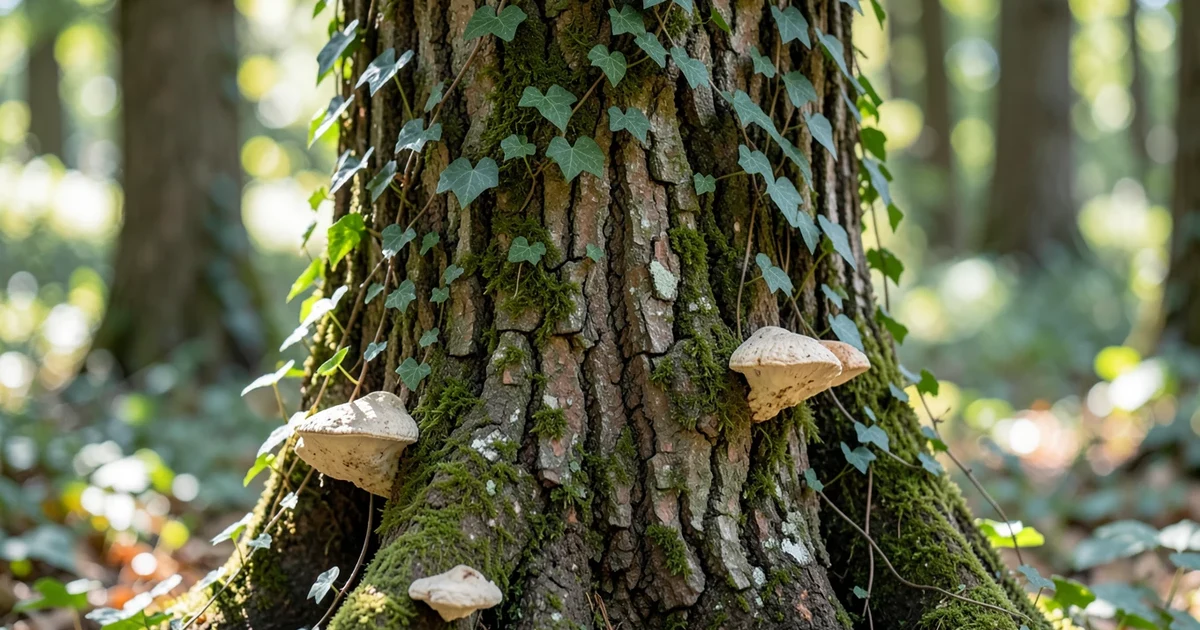
A mushroom on a living tree is the visible end of something that has been going on inside the wood for years.
The mycelium is the organism. The fruiting body is what it puts out to release spores, and it appears only once the colony is well established — often long after the decay began.
So the useful question is not whether to remove the mushroom. It is what the decay is doing and where.
Where it is fruiting
Position is the most informative single fact, because it indicates which part of the tree is affected.
| Where | What it suggests |
|---|---|
| At the base or on buttress roots | Root and butt rot — the most serious, because it affects anchorage |
| On the lower trunk | Butt rot extending upward |
| On the trunk, higher up | Trunk decay, often entering through an old wound or pruning cut |
| On a branch | Localised branch decay; usually the least serious |
| On a wound or old pruning cut | The entry point, which tells you how it got in |
| From soil near the trunk | Could be a root decay fungus, or a harmless mycorrhizal partner |
Fungi fruiting at the base of a large tree over a target — a house, a road, a play area — is the combination that warrants a professional assessment rather than a search.
The important distinction
Saprophytes feed on dead wood. On a dead stump or a fallen log they are decomposing something already dead, which is what they are for. Finding turkey tail on a stump is not a problem.
Parasites attack living tissue. Honey fungus is the significant one, killing living trees and spreading through soil by black shoestring-like rhizomorphs — found under the bark of an infected trunk, and diagnostic for the genus.
Mycorrhizal fungi are in partnership with the tree's roots and are beneficial. They fruit from soil near the tree rather than on the wood, and their presence is a sign of a healthy root system.
Which is worth stating clearly: mushrooms coming up from the lawn near a tree are usually mycorrhizal partners or decomposers of buried debris, not a sign that the tree is being attacked. Mushrooms coming out of the trunk are a different matter.
What the common ones indicate
- Honey fungus — clustered, honey-coloured, with a ring, white spore print, and rhizomorphs under the bark. A serious pathogen that kills and spreads. Its small brown lookalike on the same wood contains death cap toxins — honey fungus or deadly galerina.
- Turkey tail and other thin bracket polypores — saprophytic, on dead wood, and not an indicator of danger to a living tree.
- Oyster mushrooms — mostly saprophytic on dead or dying hardwood, occasionally weakly parasitic on a stressed tree. Oyster mushroom lookalikes covers the identification.
- Large perennial brackets — hoof-shaped, woody, adding a layer each year. These indicate substantial, long-established internal decay and are the ones an arborist takes most seriously.
- Chicken of the woods — bright orange and yellow shelves, causing brown rot in the heartwood.
What removing the mushroom achieves
Nothing structural. The decay is inside the wood and continues regardless.
There are two reasons to remove one anyway: reducing spore release to nearby trees, marginally, and keeping it away from children and pets. Neither affects the tree.
Do not seal, paint or treat the wound. Wound paints have been shown not to help and can trap moisture against the decay.
When to call an arborist
- Fruiting bodies at the base of a large tree
- Any fungus on a tree within falling distance of a building, road or play area
- Visible cavities, cracks, or bulging bark
- Sudden leaf loss, dieback in the crown, or a lean that has changed
- Soil lifting on one side of the trunk
A qualified arborist can assess how much sound wood remains — by sounding, resistance drilling, or tomography — and that is what determines whether a tree is dangerous. Presence of decay alone does not; many trees live for decades with substantial internal decay, because the strength of a hollow cylinder is concentrated in its outer wall.
Not to eat
Fungi growing on trees include excellent edibles and several things that will make you very ill, and some of the best-known edible ones have dangerous small brown neighbours on the same log.
If the interest is culinary rather than arboricultural, the substrate and the spore print do the work — which is where gills, pores or teeth and a print on paper come in.
Species referenced
Read this before anything else
- Never eat a wild mushroom identified by a website or an app.That includes this one. These tools narrow possibilities; they cannot see your mushroom, its base, its smell or its habitat, and the difference between a meal and a liver transplant is sometimes a feature buried in the soil.
- Get it confirmed in person by an experienced local forager or a mycological society. Most regions have one, most run free identification sessions, and they will look at the actual specimen.
- Dig, do not pull. The cup at the base of a death cap is often underground. Pulling the mushroom leaves the most important feature in the soil.
- If someone has eaten a wild mushroom and feels unwell, call poison control now — in the US, 1-800-222-1222. Do not wait for symptoms to worsen. Amatoxin poisoning has a false recovery phase, and delayed treatment is what makes it fatal. Save any uneaten pieces for identification.
Keep reading
- Oyster Mushrooms and the Three Things That Look Like ThemDecurrent gills, an off-centre stem or none, and growth in shelving clusters on wood. Two lookalikes are poisonous and one is merely disappointing.
- Honey Fungus or Deadly Galerina? The Spore Print DecidesBoth are small brown clustered mushrooms on wood. One is edible cooked; the other contains the same toxins as a death cap. The spore print separates them.
- Mushrooms in Bark Mulch and Garden BedsMulch is wood, and wood-decaying fungi eat wood. Most are harmless, one is not, and two of them are strange enough to be worth recognising.