
Gills, Pores or Teeth? The First Question
By IdentifyThese Editorial · Reviewed · 3 min read
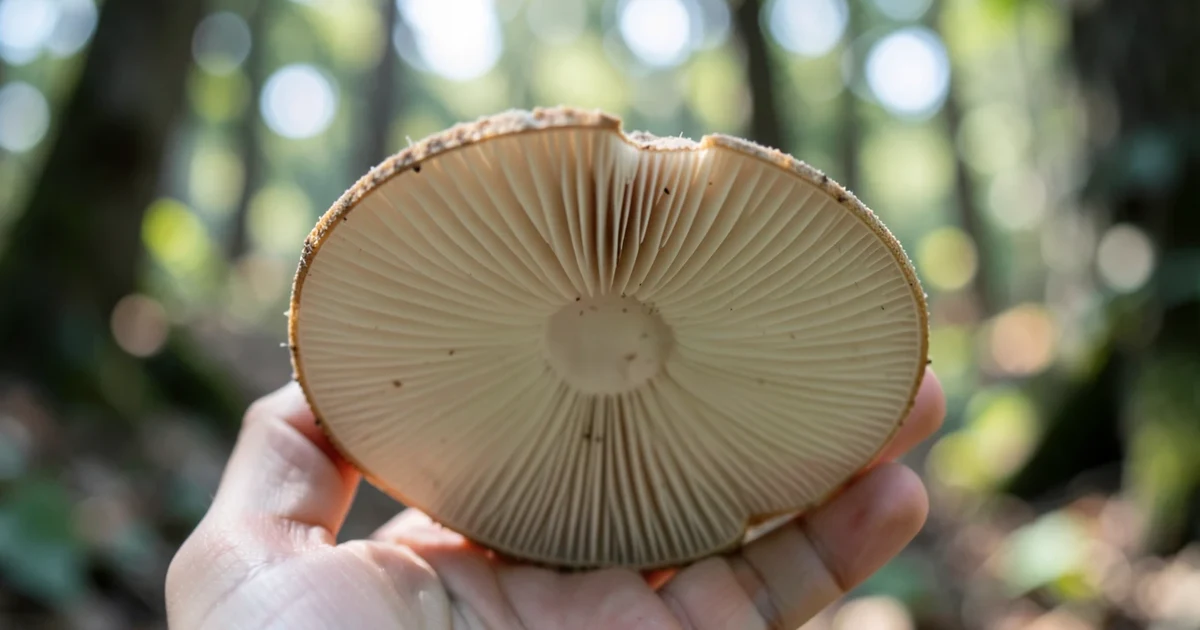
Turn the mushroom over. What is underneath is the first branch of every key, because the spore-bearing surface reflects deep divisions between groups.
It also tracks risk. The species responsible for nearly all fatal poisonings are gilled.
The four surfaces
Gills — thin blades radiating from the stem. The largest group and the one containing everything dangerous.
Pores — a spongy layer of tiny tubes, viewed end-on as a mass of small holes. Boletes and polypores.
Teeth — downward-hanging spines. Hedgehog fungi and Hericium.
Ridges or nothing — blunt forking wrinkles, or a smooth surface. Chanterelles have ridges; puffballs have no external surface at all because the spores form inside.
Gills
The important group, and the one where the detail matters.
Attachment is the character to check first:
- Free — the gills stop short of the stem and do not touch it. Amanitas and Agaricus.
- Attached — they meet the stem squarely.
- Notched — attached but with a notch just before the stem.
- Decurrent — they run down the stem rather than stopping at it. Chanterelles, oyster mushrooms, and their lookalikes.
Colour, and whether it changes. Young gills are frequently pale in species whose mature gills are dark. Gills that stay white as the mushroom matures mean white spores, and white-spored, white-gilled mushrooms with a ring and a cup at the base are the deadly Amanita signature — the Amanita check is the habit that catches it.
Spacing and whether they fork.
True or false. Try to separate one blade from the cap flesh with a fingernail. A true gill is a distinct structure and will come away. A false gill is a blunt fold continuous with the flesh and will not. This single test separates chanterelles from the jack-o'-lantern, which has true gills, is genuinely poisonous, and is otherwise convincing.
Pores
A bolete has a spongy layer that can often be peeled away from the cap flesh in one piece.
In North America and Europe, no pored bolete is known to be deadly. Several are unpleasant, some cause serious gastric illness, and a few stain vividly blue when cut — which is not itself a warning sign, contrary to the folklore.
Polypores are the tough, woody, shelf-like fungi on trunks. Their pore layer is fine and their flesh is leathery rather than fleshy. Almost none is edible in the ordinary sense, and almost none is dangerous.
Teeth
A small group and a distinctive one.
The hedgehog fungus (Hydnum) has soft spines under a pale cap, is a well-regarded edible, and has no dangerous lookalike — which is unusual enough to be worth stating.
Hericium — lion's mane, bear's head — grows on wood as a cascade of spines with no cap at all.
Ridges, and nothing
Ridges — blunt, forking, running down the stem, continuous with the flesh. Chanterelles.
Smooth — the surface of a stinkhorn, an earthstar, or the inside of a cup fungus.
Nothing visible — puffballs, earthballs and truffles produce spores internally. The safety question for a puffball is not the surface but the inside: it must be pure white and uniform throughout when cut in half, with no outline of a developing cap and stem, and no darkening.
A young Amanita in its egg stage looks exactly like a puffball from outside, which is why cutting is not optional.
Pitted and ridged, hollow — morels. The whole fruiting body is a mass of pits, and it is hollow from the tip of the cap to the bottom of the stem.
What it tells you about risk
Very roughly, and as a statistical pattern rather than a rule:
| Surface | Deadly species known? |
|---|---|
| Gills | Yes — all the deadly ones |
| Pores (boletes) | None in North America or Europe |
| Teeth | None |
| Ridges | None, but a gilled lookalike is poisonous |
| Internal (puffballs) | Only via mistaking a young Amanita for one |
This is a reason to be more careful with gilled mushrooms, not a licence to be careless with the rest. Serious illness is possible in every category.
Then take a spore print
The colour of the spores separates genera that look identical from outside, and it cannot be seen on the living mushroom. It costs a few hours and a sheet of paper — how to take a spore print.
Species referenced
Read this before anything else
- Never eat a wild mushroom identified by a website or an app.That includes this one. These tools narrow possibilities; they cannot see your mushroom, its base, its smell or its habitat, and the difference between a meal and a liver transplant is sometimes a feature buried in the soil.
- Get it confirmed in person by an experienced local forager or a mycological society. Most regions have one, most run free identification sessions, and they will look at the actual specimen.
- Dig, do not pull. The cup at the base of a death cap is often underground. Pulling the mushroom leaves the most important feature in the soil.
- If someone has eaten a wild mushroom and feels unwell, call poison control now — in the US, 1-800-222-1222. Do not wait for symptoms to worsen. Amatoxin poisoning has a false recovery phase, and delayed treatment is what makes it fatal. Save any uneaten pieces for identification.
Keep reading
- The Amanita Check: Dig It Up, Every TimeMost fatal mushroom poisonings are one genus. Two features identify it, one is usually underground, and pulling the mushroom rather than digging destroys the evidence.
- How to Take a Spore Print — and Why It Matters So MuchA spore print costs nothing, takes a few hours, and separates several deadly mushrooms from the edible species they resemble. Here is how, and what each colour rules out.
- Mushroom Poisoning: Why the Delay Matters More Than the SymptomsHow long before symptoms start is the most informative single fact. Under six hours is usually the milder group; after six hours is the dangerous one.