

Identifying a Snake From Its Shed Skin
By IdentifyThese Editorial · Reviewed · 3 min read
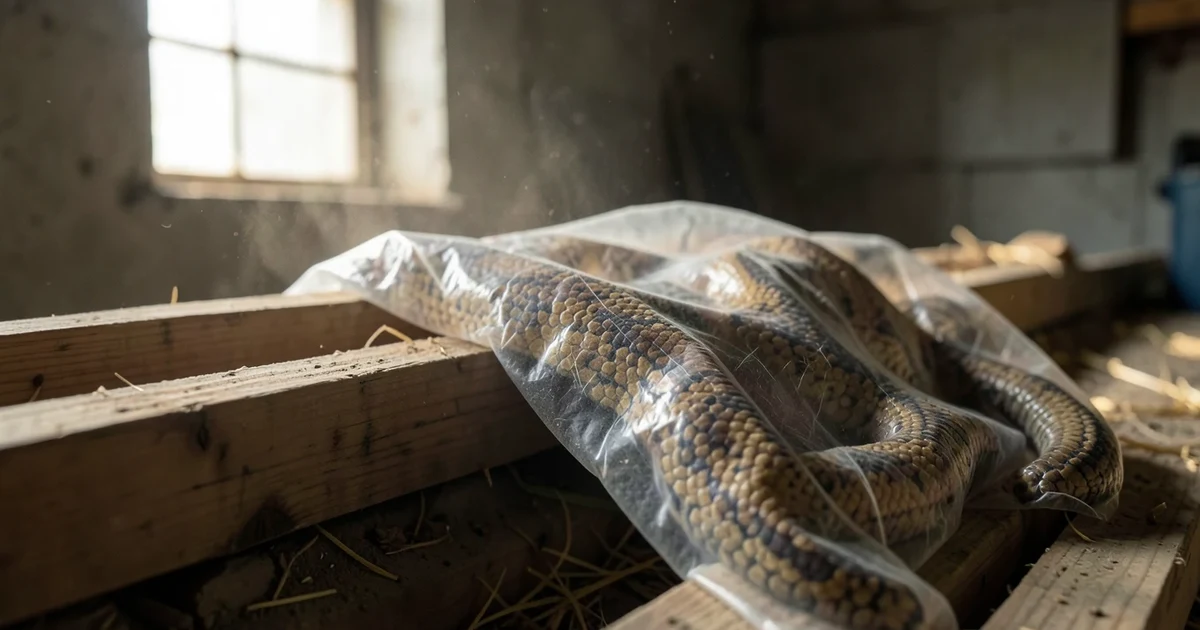
A shed is better evidence than most photographs. It sits still, it does not flee, and it preserves exactly the small scale-level characters that field guides key on and that a blurry phone picture loses.
It also cannot bite you, which makes it the one situation where handling is the sensible approach.
Get it usable first
A dry shed is brittle and will crumble. Dampen it — a light mist, or five minutes between two wet paper towels — and it relaxes enough to unroll without tearing.
Sheds usually come off inside-out, like a pulled-off sock. Turn it the right way round so the scales read correctly. And note the length, with the caveat that a shed stretches during the process: it runs roughly 10–20% longer than the animal.
Three features that do most of the work
Keeled or smooth. Run a fingertip along the back scales. A keel is a raised ridge down the centre of each scale, and it gives the skin a matte, textured feel; smooth scales feel glassy and look shinier. This splits the common groups immediately.
- Keeled: ratsnakes, water snakes, garter snakes, most pit vipers
- Smooth: kingsnakes, milk snakes, racers, coral snakes, green snakes
The anal plate. Find the vent — where the tail begins and the belly scales change character. The scale immediately in front of it is either a single plate or divided into two by a diagonal seam. It is a stable character within species and one of the fastest to check.
- Single: pit vipers, kingsnakes and milk snakes, hognose
- Divided: ratsnakes, water snakes, garter snakes, racers
Subcaudal scales. Past the vent, the underside scales are either in a single row or paired in two columns. In North America this is close to a venomous/harmless test on its own.
| Pit vipers | Most harmless colubrids | |
|---|---|---|
| Subcaudals | Single row | Paired, in two columns |
| Anal plate | Single | Usually divided |
| Belly scales | Wide, one per row | Wide, one per row |
The single-row subcaudal is the strongest signal on a North American shed. Coral snakes are the exception — they are elapids, with paired subcaudals and a smooth, small-scaled skin.
Counting scale rows
Field guide keys use the number of scale rows at mid-body, counted diagonally across the back from one belly scale edge to the other. It is fiddly and it is decisive: eastern ratsnake and northern water snake overlap in size, colour and habitat but not in row count.
Do it on a damp, flattened shed, count twice, and expect to get a different answer the first time.
What tells you it was a pit viper
Besides the single subcaudal row, look at the head end:
- A loreal pit between the eye and the nostril leaves a distinct extra opening in the shed, in addition to the eye scale and nostril. Three openings on each side rather than two.
- The eye scale is often a vertical ellipse rather than a circle, though this deforms easily and is the least reliable of the three.
- A rattle obviously settles it, but the rattle is not shed with the skin — the shed ends at the base of it.
The pit is the one to trust. It is worth knowing that the pit is also the feature people are told to look for on a live animal, which is bad advice on a live animal for reasons covered in how to tell if a snake is venomous — you have to be far too close. On a shed, it is free.
What the location tells you
Snakes shed somewhere sheltered, humid and undisturbed, because the process takes days and leaves them vulnerable and briefly near-blind. A shed in your garage, under decking or behind stored boxes is not a passing animal — it is a place something has been using.
That is worth acting on, and what to act on is in do snakes come back to the same yard: cover, warmth, prey. A shed in a woodpile and a rodent problem are usually the same finding described twice.
Keeping it
If you want a reference, mist it, lay it flat between sheets of paper under a weight for a few days, then store it dry. It will keep for years and it is considerably easier to compare a new find against an old shed than against a book.
Species referenced
Before anything else
- Back away and leave it alone. A snake that can see you leaving has no reason to bite. Most bites in the United States happen to people who picked up, cornered, or tried to kill a snake.
- Never handle a snake to identify it. Every identification on this site can be made from a photo or from several feet away.
- If someone is bitten, call emergency services now. Keep the limb still and below the heart, remove rings and watches, and go to hospital. Do not cut, suck, apply ice, or use a tourniquet — all of these make outcomes worse.
- Do not try to catch the snake for identification. A photo from a distance is enough, and hospitals treat symptoms rather than species.
In the US, the Poison Help line is 1-800-222-1222. This site is a reference, not medical advice.
Keep reading
- How to Tell If a Snake Is Venomous — And Why the Usual Advice Is WrongTriangular heads and slit pupils are the standard advice and both are unreliable. Here is what actually distinguishes venomous US snakes, and why location beats appearance.
- Do Snakes Come Back to the Same Yard?Snakes return to places that reliably offer cover, warmth and prey. Which means the question worth asking is what your yard is providing, not how to repel them.
- A Snake Bit My Dog. What Now?Go to a vet immediately, do not wait for symptoms, and do not attempt first aid. Here is why each of those matters, and what the clinic will actually do.