

Why There Are Suddenly Spiders Everywhere in Autumn
By IdentifyThese Editorial · · 3 min read
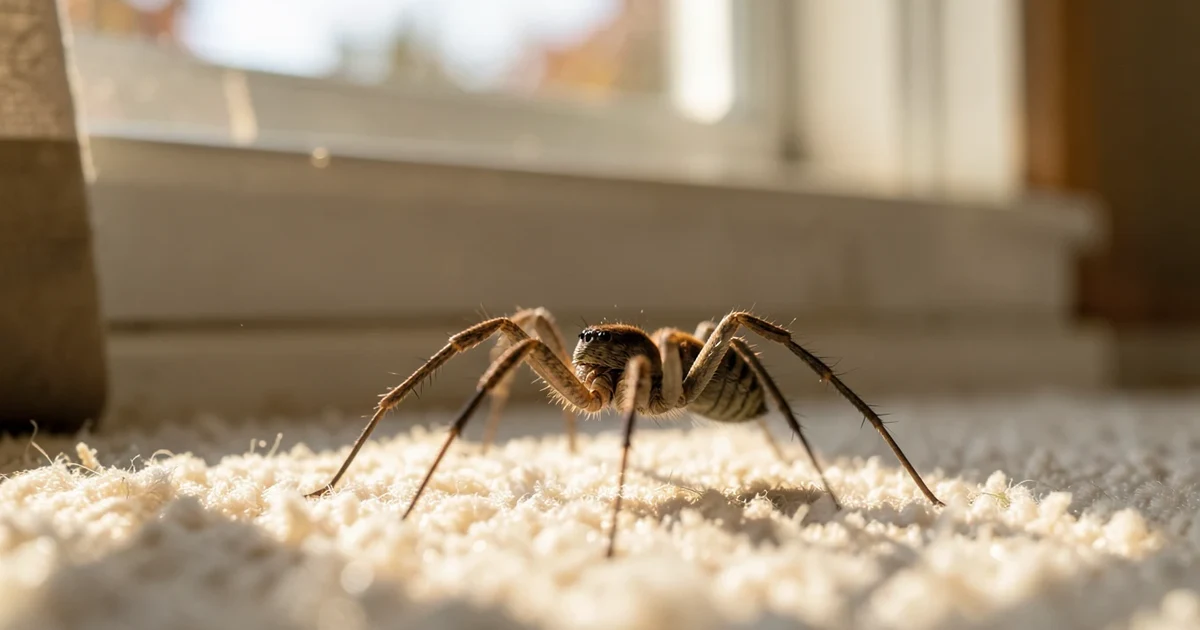
Every September the same thing happens and the same explanation gets given: spiders are coming in from the garden to escape the cold.
They are not. The spiders you are seeing have been in the house the whole time.
What is actually happening
The common house spiders — Tegenaria, Eratigena, Parasteatoda — are synanthropic. They live alongside people and are essentially indoor animals in much of their range. They were in your loft, behind the wardrobe, under the bath, in the garage, all summer.
What changes is the calendar. They mature in late summer, and adult males abandon their webs and walk in search of females.
So the animal you meet crossing the living room floor at 9pm in September is a mature male on a search. He is not lost, not cold, and not new to the building.
Three consequences follow:
- They are large, because they are adults.
- They are moving in the open, because searching is the whole activity.
- They are mostly male, which is why the ones people find are the big long-legged ones rather than the fatter-bodied females sitting in webs.
The season runs roughly late August to early October, peaking sharply, and then it stops.
Why the bath
The most common single question of the season, and there are two answers, both correct.
Males wandering at night fall into baths and sinks and cannot climb out — the glaze offers no purchase and the sides are too steep. They did not come up the plughole; the trap holds water and a spider cannot pass it.
They are also seeking water. Central heating dries a house considerably and a bathroom is the humid room.
A towel draped over the edge gives them a route out overnight, if you would rather not deal with it directly.
The outdoor ones
A separate autumn phenomenon, and a more attractive one.
Orb weavers — garden spiders, cross orbweavers, marbled orbweavers — hatched in spring, spent the summer growing, and reach full size in late summer. Their webs are suddenly conspicuous and the spiders are large.
Then they lay eggs and die with the first frosts. The generation you are admiring in September is finishing, and the egg sac is what overwinters. Nothing is invading; a cohort has simply become visible.
What does not keep them out
- Conkers. Tested; no effect. The claim is old and persistent and has never been supported.
- Peppermint oil sprays. Marketed heavily. The evidence is thin at best, and effects observed under lab conditions do not translate to a room.
- Ultrasonic devices. No effect on spiders, and none on most of what they claim to repel.
What does
Reduce what they eat and reduce the ways in.
- Outdoor lighting draws insects, and insects draw spiders. Warm-toned or motion-activated lighting near doors makes a real difference.
- Seal gaps around doors, windows, vents and service entries.
- Vacuum webs and egg sacs regularly, particularly in corners and window frames.
- Reduce clutter in garages, sheds and lofts.
None of it will empty a house, and emptying a house is not a sensible target. Spiders are the main predator of the insects you also do not want.
The ones worth recognising
Most of what turns up indoors in autumn is a house spider, a cellar spider or a wandering male of something harmless. Two are worth being able to identify on sight — the widows, which have a distinctive shape and a marking underneath, and the recluses, which are absent from most of the continent.
Black widow or common house spider covers the first, and it turns on looking at the underside rather than at colour. For the second, the useful step is checking the range before the spider — do brown recluses live where you do.
Cellar spiders, the long-legged ones in the corners of ceilings, are the subject of the most widely repeated falsehood in the whole subject, and the daddy long-legs myth works through which three animals the name refers to and why the claim fails for all of them.
Species referenced
If you think you were bitten
- Most suspected spider bites are not spider bites. Studies of patients presenting with a “spider bite” repeatedly find that the large majority are bacterial skin infections — frequently MRSA — which need antibiotics rather than reassurance. A spreading, painful, pus-filled sore is far more likely to be an infection than a spider.
- Wash it, ice it, and watch it. Clean the area with soap and water, apply a cold pack, and keep an eye on it.
- Get medical care if the wound spreads or darkens, if you develop cramping, sweating, fever or severe abdominal pain, or if you are confident it was a widow or a recluse.
- Bring the spider only if it is already dead and to hand. Do not go looking for it. Doctors treat symptoms, not species.
In the US, the Poison Help line is 1-800-222-1222. This site is a reference, not medical advice.
Keep reading
- The Daddy Long-Legs Myth, and the Three Animals It Refers ToThe claim that daddy long-legs have the world's most powerful venom but fangs too short to bite is wrong twice over — and it is applied to three completely different animals.
- How Long Do Brown Recluse Bite Symptoms Take?Most bites cause a red mark and nothing more. The minority that develop a lesion follow a recognisable timeline, and the first few hours look unremarkable.
- House Spider, Giant House Spider, or Something Else?Four unrelated spiders share the name 'house spider'. They build different webs, sit in different places, and only one of them is worth a second look.