

Dating Glass by the Seam and the Base
By IdentifyThese Editorial · Reviewed · 3 min read
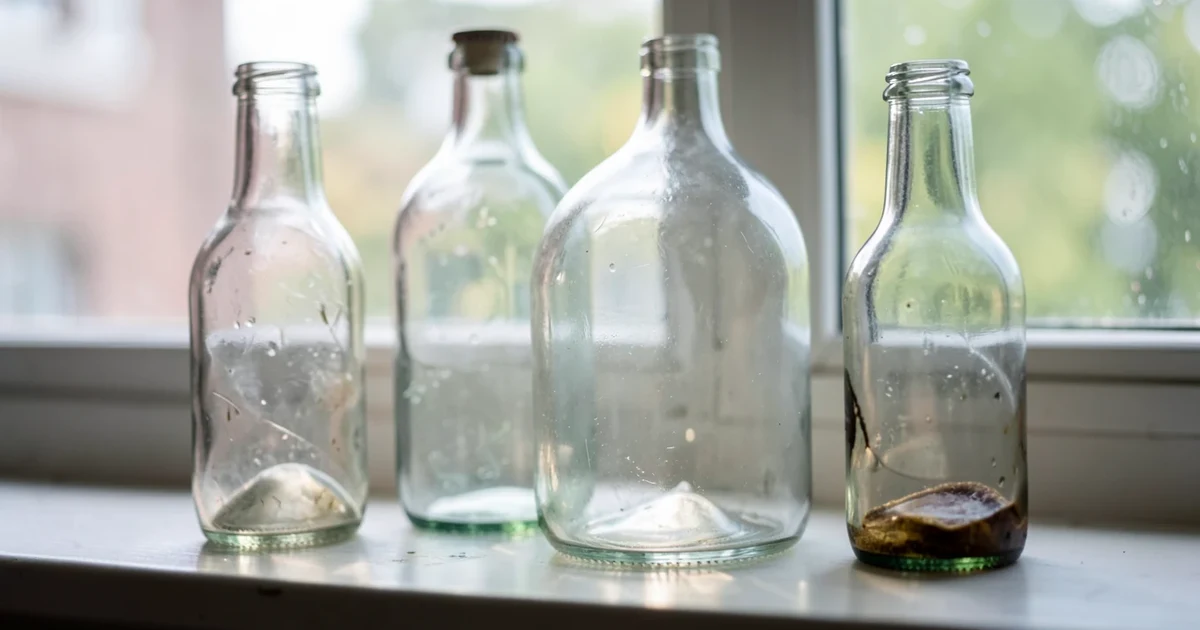
Glass is the most systematically datable material in the whole subject, because the seam records the manufacturing method and the methods have known dates.
Follow the seam
Run a finger up the side of a bottle from the base toward the lip and note where the seam stops.
No seam at all — free-blown. Generally pre-1860, and often much earlier.
Seam stops at the shoulder — a dip mold, with the neck formed separately. Pre-1860.
Seam stops partway up the neck, below the lip — the body was molded and the lip was applied or tooled by hand. Roughly 1860 to 1915. This is the commonest nineteenth-century arrangement.
Seam runs all the way over the top of the lip — a fully automatic bottle machine. From 1905, and dominant from about 1920.
That last one is the most useful single check in the field. A seam over the lip on a bottle claimed as Civil War era ends the discussion.
Look at the base
A pontil scar — a rough, sharp, irregular circular scar — is where the punty rod that held the bottle during finishing was snapped away. Pre-1860 in most contexts.
Variations tell you more: a plain broken pontil is earliest, a sand pontil leaves grit, and an improved or graphite pontil leaves a smoother ring and is later.
An Owens machine scar — an off-centre circle with a feathered edge — indicates the Owens automatic machine, roughly 1905 to 1950.
A valve or ejection mark — a small circle, usually centred — indicates a later press-and-blow machine.
A smooth base with a maker's mark — twentieth century. Maker's marks are documented and many can be dated to a range of years.
Colour, and what it means
Purple glass in old bottles is genuine and specific: manganese was used as a decolouriser roughly 1880 to 1920, and it turns purple with long sun exposure. So a naturally purple bottle sits in that window.
Irradiated purple is modern — bottles deliberately exposed to radiation to darken them for sale. The colour is a deep, even, unnatural shade rather than the soft lavender of sun-purpled glass.
Aqua is the natural colour of glass with iron impurities and was normal before deliberate decolourising. Deep cobalt, amber and green were deliberate.
Embossing
Raised lettering was molded in, and it dates and identifies.
- Product names, cities and proprietors can be traced in directories.
- "Federal law forbids sale or reuse of this bottle" dates precisely to 1935 to 1964.
- "Duraglas" indicates 1940 onward.
- Patent dates give a hard floor.
Pressed glass and cut glass
A different question, and constantly confused.
Pressed glass was molded, has seams, and its pattern edges are rounded — you can run a finger over them comfortably.
Cut glass was ground on a wheel, has no seams, and its facet edges are sharp enough to feel. It also rings when tapped, where pressed glass usually thuds.
The distinction matters for value: cut glass is generally worth substantially more, and pressed glass is sold as cut constantly. Detail in pressed glass.
Where this leaves you
Glass is unusual in this field in giving a dating chronology that is close to mechanical. Most of the rest of the subject rests on construction evidence that gives a period rather than a decade — which is what the five checks do for furniture.
The value caution applies here as much as anywhere: most old bottles were made in millions and are worth very little, and colour, embossing and rarity do all the work.
A note on weight and ring
Two quick sensory checks worth adding to the visual ones.
Weight. Early hand-blown glass is often lighter and less even than machine glass of the same size, and the thickness varies noticeably around the body.
Ring. Lead crystal rings clearly when flicked; soda-lime glass thuds. That distinguishes cut lead crystal from molded soda glass imitating it, and it takes a fingernail.
Categories referenced
Keep reading
- Reading an Object's History From Its WearWear records how an object was used. It is the hardest thing to fake convincingly and the most informative thing on most pieces.
- The Marks That Date an Object ExactlyMost marks give a rough period. Four kinds give a precise year, and they are worth learning because they end the argument.
- Dating Ceramics by the Foot and the GlazeTurn the piece over. The unglazed foot rim records how it was made and fired, and that changes by period in ways a decorated surface does not.