

Reading an Object's History From Its Wear
By IdentifyThese Editorial · Reviewed · 3 min read
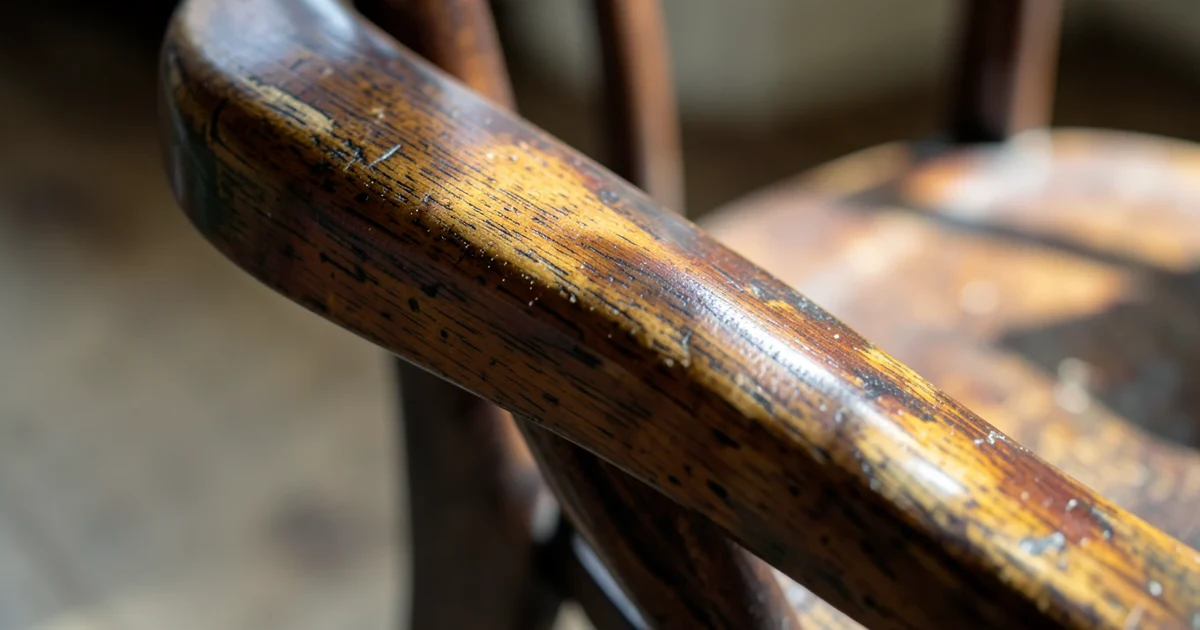
An object that has been used for a century carries a record of how. Wear is the hardest evidence to fake and the most informative thing on most pieces, and reading it is a skill worth more than memorising marks.
Wear is never even
This is the whole principle. Objects wear where they are touched, and they are not touched evenly.
- Chair arms wear at the front where hands rest, and the wear is polished rather than scratched.
- Table tops wear in the middle and around the edge where people lean, not uniformly.
- Drawer runners wear on the underside and the sides, and a drawer that has been opened ten thousand times drops slightly.
- Feet wear according to the floor — stone abrades, carpet does not, and a piece moved between houses shows more than one pattern.
- Carving wears on the high points and stays crisp in the recesses.
- Around a keyhole, from a key scraping against the escutcheon.
Wear that appears where nothing touches is decoration rather than history.
Patina and what it is
Patina is the accumulated change to a surface — oxidation, absorbed dirt and oils, light exposure, successive waxings. It is not dirt and it is not damage.
On furniture, patina shows as depth: the finish looks like it goes down into the wood rather than sitting on it, and the colour varies subtly across the surface.
On metal, it is the oxide layer, and on bronze in particular it is a substantial part of the value.
On silver it is the tarnish in the recesses of decoration, which is why over-polishing flattens a design.
What honest wear tells you
That the object was used for what it appears to be. A writing slope with ink stains in the well and wear on the lid edge was used as a writing slope. One with pristine internals has not been.
Roughly how long. Wear accumulates slowly and the depth is informative — worn through a finish into the wood is decades, not years.
Where it lived. Sun bleaching on one side of a piece tells you it stood by a window. Salt damage suggests a coastal house. Woodworm exit holes tell you it was somewhere damp.
Whether the parts belong together. This is the most practical use. On a married piece the wear patterns will not agree — a top with heavy wear on a base with none, or two halves whose colour differs on the hidden surfaces.
What honest wear is not
Damage. Chips, breaks, splits, replaced parts, woodworm that is still active. These reduce value and are not patina, and the distinction matters when someone tells you damage is character.
Repair. Old sympathetic repair is generally acceptable and often adds interest. Modern repair with modern materials usually does not.
Faking it
Artificial ageing is common and it fails in consistent ways.
- Evenness. Applied across a whole surface rather than concentrated where hands go.
- Sharpness. Fresh distressing has crisp edges; real wear is rounded and polished.
- Wrong places. Dents on a surface nothing would strike, wear on an underside.
- Colour without depth. Stain applied over new wood sits on the surface. Patina looks like it came from within.
- No wear inside. Fakers work on the front — the interior of a drawer, the back of a case and the underside are usually untouched, which is where to look. That is the general lesson in how reproductions give themselves away.
The practical use
When you are looking at something and cannot decide, put the marks and the style aside and ask a simpler question: does the way this has worn make sense for the way it would have been used?
A convincing answer is hard to arrange deliberately, and an unconvincing one is usually obvious once the question is asked.
And when the answer is that the wear is honest, the corollary follows — leave it alone. Cleaning off the evidence is the most common way people reduce what an object is worth.
Categories referenced
Keep reading
- What Not to CleanPolishing silver, stripping furniture and scrubbing coins all remove value permanently. The safe rule is stabilise, do not restore.
- How Reproductions Give Themselves AwayWear in the wrong places, uniformity where there should be variation, and materials that did not exist yet. Fakers concentrate on the front.
- The Marks That Date an Object ExactlyMost marks give a rough period. Four kinds give a precise year, and they are worth learning because they end the argument.