

Whose Nest Is This?
By IdentifyThese Editorial · Reviewed · 3 min read
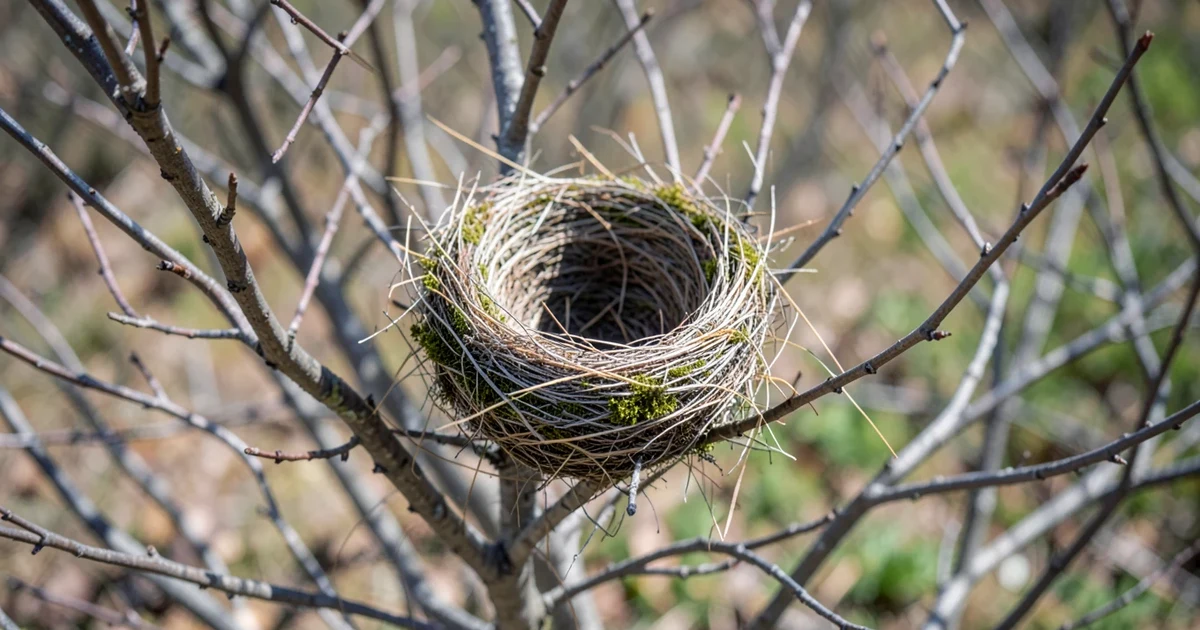
Before anything else: if there are eggs or young in it, leave it alone. In the United States active nests of native birds are protected under the Migratory Bird Treaty Act, and that includes the nest itself while it is in use. House sparrows, European starlings and rock pigeons are not covered.
Nest identification is done on structure, materials and placement.
By shape
Open cup — the commonest form. Robins, sparrows, finches, cardinals, most songbirds.
Cup lined with mud — American robin. A deep cup of grass and twigs with a smooth mud cup inside, in a shrub, a tree fork or on a ledge. The mud lining is diagnostic.
Cup made entirely of mud pellets — barn swallow, plastered to a beam, a rafter or under a bridge. Cliff swallows build an enclosed gourd shape from the same material.
Flimsy platform of twigs, so thin you can see the eggs through it — mourning dove. It looks unfinished and frequently is.
Domed with a side entrance — Carolina wren, in anything from a plant pot to a coat pocket left in a shed. Also ovenbird, on the ground in woodland.
Hanging pouch woven from plant fibre, suspended from a branch tip — Baltimore oriole. Unmistakable and one of the finest structures any bird makes.
Cavity, unlined or lightly lined — woodpeckers excavate their own; chickadees, titmice, nuthatches and bluebirds use old ones and nest boxes.
Large stick platform high in a tree or on a pole — hawks, herons, ospreys, eagles.
By material
| Material | Builder |
|---|---|
| Mud lining inside a grass cup | American robin |
| Mud pellets throughout | Barn swallow, cliff swallow |
| Woven plant fibre, hanging | Baltimore oriole |
| Lichen and spider silk, tiny | Ruby-throated hummingbird |
| Moss, dome-shaped | Carolina wren |
| Hair and fine grass lining | Chipping sparrow |
| Snake skin worked into it | Great crested flycatcher |
| Sticks, minimal lining | Mourning dove, corvids, raptors |
The hummingbird nest is worth knowing: about the size of a walnut half, bound with spider silk so it stretches as the young grow, and camouflaged with lichen on the outside. It looks like a knot on a branch.
By placement
- In a shrub or low tree fork — robin, cardinal, mockingbird
- On a ledge, beam or light fitting — robin, phoebe, barn swallow
- In a cavity or nest box — chickadee, titmouse, bluebird, wren, house sparrow
- On the ground — ovenbird, killdeer, meadowlark, waterfowl
- Hanging from a branch tip — oriole, vireo
- High in a conifer — many finches and warblers
- On a stump or in dense ivy — Carolina wren, house finch
Killdeer barely build at all: a scrape in gravel, sometimes with a few stones, frequently on a car park or a flat roof. That is why they turn up in such unlikely places.
The eggs
Less diagnostic than people expect. Many small songbirds lay pale eggs with brown speckling that cannot be told apart in the field. Two exceptions worth knowing:
- Robin — unmarked blue-green, the colour named after it.
- House finch — pale blue with fine black speckling at the wide end.
If there is a noticeably larger, speckled egg among smaller ones, that is a brown-headed cowbird, which lays in other species' nests and leaves them to raise the young. Removing it is illegal — cowbirds are native and protected.
When you can take it down
Once the nest is finished with and empty, and the species is not likely to reuse it. Many birds do reuse — phoebes, barn swallows and bluebirds return to the same site for years.
Old nests carry mites, so clean out a nest box between broods and at the end of the season with hot water and a stiff brush.
If a nest is somewhere genuinely unworkable — a barbecue, a door frame in daily use — the honest answer is that you wait. Most songbirds go from egg to fledged in under a month, and a fledgling on the ground is the sign that it is over.
Species referenced
Keep reading
- There's a Baby Bird on the GroundFeathered and hopping is a fledgling and its parents are nearby — leave it. Naked or downy is a nestling, and that one goes back in the nest.
- Identifying Birds by SoundMost birds are heard rather than seen. Learn rhythm and quality before pitch, start with five species, and use the mnemonics — they work.
- Feeding Birds in Winter: What ChangesFat matters more than seed once it is cold, water matters more than either, and the birds at the feeder are a different set from the summer ones.