

Is It Even Mould? Four Things That Aren't
By IdentifyThese Editorial · · 3 min read · updated August 2026
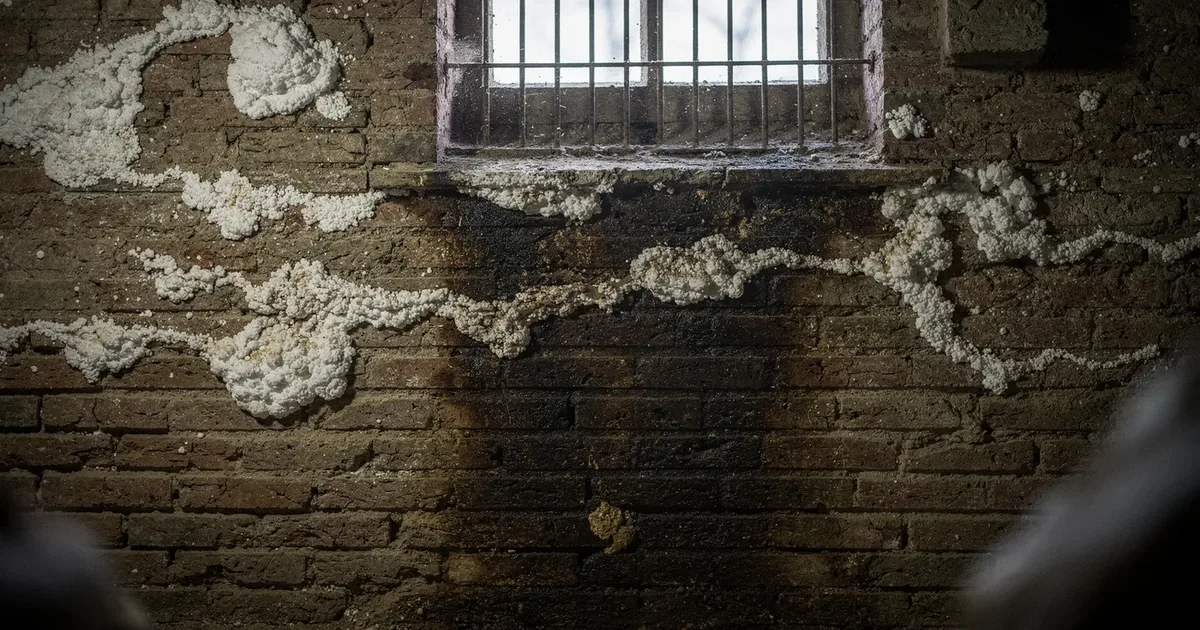
A large share of mould reports are not mould. Recognising the impostors saves an unnecessary remediation, and each of them has a test that takes seconds.
1. White crust on basement walls — efflorescence
What it looks like: A white or off-white crust on brick, block or concrete, sometimes fluffy and needle-like, sometimes a flat powdery bloom.
The test: Drop water on it. Efflorescence dissolves. Mould does not — water tends to bead on it.
It is mineral salt, carried out of the masonry by water moving through it and left behind when the water evaporates. It is not alive, it will not spread to your lungs, and killing it is not a concept that applies.
What it does tell you is worth knowing: water is moving through that wall. The deposit is harmless but the moisture behind it will eventually support real mould on any wood, carpet or stored cardboard nearby. Efflorescence is a symptom pointing at drainage, grading or a damp-proofing failure.
2. Pink or orange slime in the shower — Serratia
What it looks like: A pink, salmon or orange film in shower corners, around drains, in toilet bowls and along the bottom of shower curtains.
The test: It is slimy and smears rather than fuzzy and brushing away as powder. It appears in wet zones with soap residue, not on walls.
This is Serratia marcescens, a bacterium that feeds on the fatty residues left by soap, shampoo and conditioner. Being a bacterium rather than a fungus, mould-specific products are beside the point.
It is harmless to healthy people on intact skin. It can cause infections through open wounds and is taken seriously in hospitals, which is where its reputation comes from.
The fix is not a stronger cleaner. It is removing the food source: rinse surfaces after use, squeegee or wipe them dry, and it largely stops coming back.
3. Black lines on the ceiling — ghosting
What it looks like: Fine dark lines on a ceiling or wall, often remarkably straight and regularly spaced, or dark fans radiating from air vents.
The test: Look at the pattern. Mould grows in irregular rounded patches. Ghosting follows straight lines that trace the framing behind the plasterboard, or the airflow from a vent. There is also no musty smell and no texture — it is flat.
The cause is soot and fine dust particles from candles, cooking or a fireplace, depositing where the surface is coldest. The studs and joists conduct heat differently from the insulated cavities between them, so those strips run cooler and collect deposits.
It is a cosmetic and insulation issue. Worth fixing for the cold spots, not for your health.
4. White fuzz on plant soil — a harmless saprophyte
What it looks like: White fuzzy growth across the surface of potting compost, sometimes with visible threads.
This one genuinely is a fungus, but it is a saprophyte feeding on organic matter in the compost, not a pathogen and not a threat to you or usually to the plant.
What it indicates is that the compost is staying wet too long, which is worth addressing for the plant's sake — persistently wet compost leads to root rot, which is a real problem. Scrape off the fuzz, let the top of the mix dry between waterings, and improve drainage.
When it is mould
Real mould, as opposed to these four:
- Has texture. Fuzzy, velvety, powdery or slimy — three-dimensional growth rather than a flat stain or crust.
- Does not dissolve in water.
- Grows in irregular, rounded, spreading patches, not straight lines.
- Smells musty. That characteristic damp smell comes from compounds fungi release as they grow, and it is a genuine indicator.
- Comes back after cleaning if the moisture source is still there.
If it ticks those boxes, work out what it likely is — and then go and find the water, because that is the part that actually matters.
Types referenced
The species matters less than you think
- Public health guidance is to remove all indoor mould regardless of type. The CDC and EPA do not recommend routine species testing for ordinary households, because the response does not change: find the water, stop it, remove the growth.
- “Toxic black mould” is a marketing phrase, not a category. Stachybotrys is real and does need soaked material to grow, so finding it tells you something useful about your building. But the health effects that are well established — allergy, asthma aggravation, irritation — are not specific to it.
- Mould without water does not persist. Cleaning growth while leaving the moisture source is why it comes back. The leak, the condensation or the ventilation is the actual problem.
Call a professional for areas larger than about 10 square feet, for anything in HVAC ductwork, after sewage or flood water, or if anyone in the household is immunocompromised or has a lung condition.
Keep reading
- Toxic Black Mould: What the Evidence Actually SaysStachybotrys is real, produces mycotoxins, and needs soaked material to grow. What it is not is a separate category of danger requiring a different response.
- Removing Mould: What Works, and Why Bleach Usually Isn't ItCleaning the growth without fixing the moisture is why mould comes back. What to use on which surface, what to throw away, and where the DIY limit sits.
- Black Widow or Common House Spider? Look UnderneathWidows and house spiders build the same messy web in the same dark corner. The red hourglass underneath is the whole test — plus three backup checks including the egg sac.