

Mold in the Attic: Almost Always Ventilation
By IdentifyThese Editorial · Reviewed · 4 min read
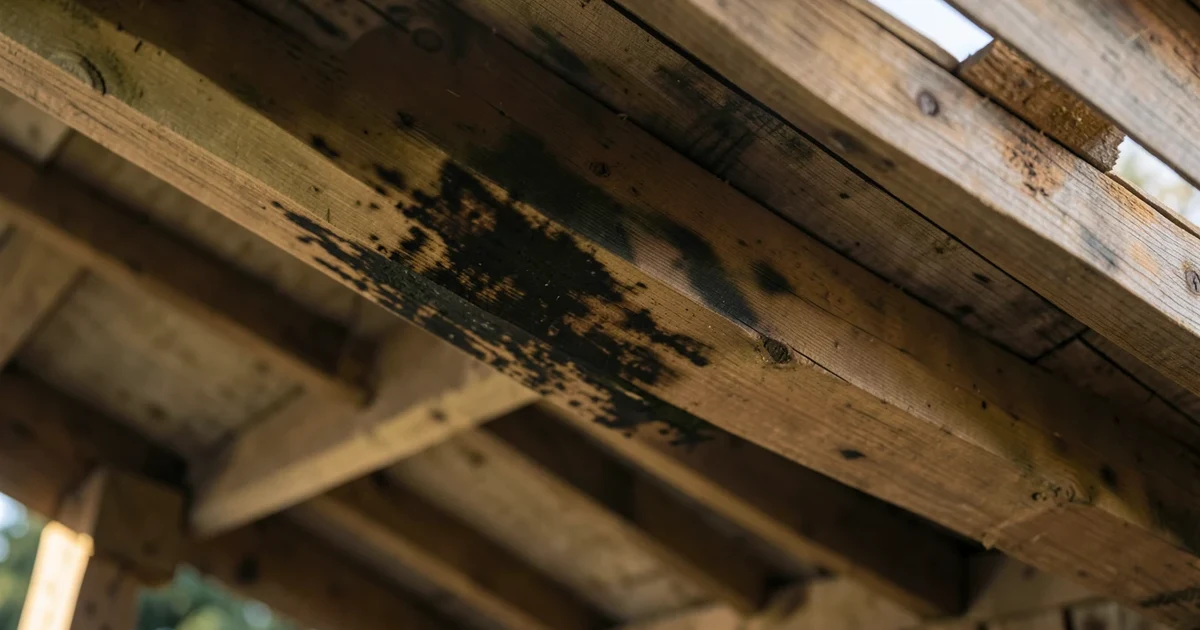
An attic is cold by design. The roof sheathing in winter sits close to outdoor temperature, and any warm moist air that reaches it condenses on the underside.
So attic mold is a question about where that air is coming from, and the growth pattern usually answers it.
Read the pattern
| Where the growth is | What it points at |
|---|---|
| A defined patch above a bathroom | The extractor fan venting into the loft, or a leaking duct |
| Around a ceiling light or loft hatch | Air leakage through the gap |
| North-facing slope only | General ventilation — that slope is coldest and dries last |
| Along the eaves | Soffit vents blocked by insulation |
| At the ridge | Ridge vent blocked, absent, or paired with no intake |
| A defined stain with a run mark below | A leak, not condensation |
| Around a chimney or vent penetration | Failed flashing |
The distinction between condensation and a leak is the first one to make, and it is easy: a leak produces a stain with a direction — water ran somewhere. Condensation produces even growth across a surface with no run marks, worst where it is coldest.
The four common causes
1. Bathroom and kitchen fans terminating in the loft. Extremely common, particularly in houses where a fan was retrofitted. The duct ends a foot above the ceiling and discharges warm, saturated air straight into the roof space every day.
Every fan must terminate outside — through the roof, a gable or a soffit — with an insulated duct and a backdraught damper. This is the single most common finding and the single most effective fix.
2. Air leakage. Recessed lights, loft hatches, pipe and cable penetrations, the gap at the top of a stud wall. Warm house air leaks up continuously, and the mold appears at each leakage point.
Air sealing before adding insulation. Insulation over a leaky ceiling slows heat loss and does nothing about the moisture.
3. Blocked ventilation. Insulation pushed into the eaves is the classic error — someone tops up the loft insulation and stuffs the soffit vents. The roof space stops breathing.
Baffles at the eaves keep the airway open. Ventilation needs both intake low at the soffits and exhaust high at the ridge; either alone does not move air.
4. Leaks. Slipped tiles, failed flashing, nail pops, a blocked valley. Repair the roof.
Look at the whole roof space
Go up with a torch on a cold morning, when condensation is visible.
- Frost or water droplets on the underside of the sheathing tells you the loft is running humid before mold appears.
- Damp or compressed insulation marks where water has been landing.
- Rusty nail points show repeated condensation.
- Dark staining on the sheathing between rafters is the growth itself.
Check the eaves from outside too: if you cannot see daylight through the soffit vents from inside, they are blocked.
Cleaning it
Fix the cause first. Cleaning an attic whose fan still vents into it is a scheduled repeat.
For the growth itself:
- Small areas — wipe with detergent solution or a dilute hydrogen peroxide, wearing an N95 and eye protection. Attic work adds fibreglass and dust to the spore load, so the respirator matters more here than elsewhere.
- Larger areas — professional remediation, usually soda blasting or dry ice blasting, which removes growth from timber without soaking it. Sanding is impractical over a whole roof.
- Encapsulation — a sealing paint applied after cleaning. It is a legitimate finishing step and not a substitute for removal; a surface painted over live growth still has live growth.
Staining often remains after successful treatment. Discoloured but dead is fine, and it is why after-photos in this trade are less informative than they look.
When it is structural
If a screwdriver pushes easily into a rafter or the sheathing, or the timber has cracked into cubes and smells strongly mushroomy, that is wood decay rather than surface mold — and it needs a surveyor, not a cleaner. The distinction between something growing on wood and something consuming it is covered alongside the furniture case in mold on wood furniture.
The winter check worth doing
On a cold morning, put your head into the loft and look at the underside of the roof. Dry timber and moving air means the system works. Droplets, frost or a damp smell means moist air is getting up there, and you have a season to find out how before it becomes growth.
The same reasoning applies at every cold surface in a house — the window reveal is where most people meet it first, and condensation around windows sets out the moisture budget that drives both.
Types referenced
The species matters less than you think
- Public health guidance is to remove all indoor mold regardless of type. The CDC and EPA do not recommend routine species testing for ordinary households, because the response does not change: find the water, stop it, remove the growth.
- “Toxic black mold” is a marketing phrase, not a category. Stachybotrys is real and does need soaked material to grow, so finding it tells you something useful about your building. But the health effects that are well established — allergy, asthma aggravation, irritation — are not specific to it.
- Mold without water does not persist. Cleaning growth while leaving the moisture source is why it comes back. The leak, the condensation or the ventilation is the actual problem.
Call a professional for areas larger than about 10 square feet, for anything in HVAC ductwork, after sewage or flood water, or if anyone in the household is immunocompromised or has a lung condition.
Keep reading
- Black Mold Around Windows: It Is CondensationMold on a window reveal is the coldest surface in the room collecting the room's moisture. Cleaning it treats the symptom; three changes treat the cause.
- Mold on Wood FurnitureSurface mold on a finished piece wipes off. Mold on bare wood has gone into the grain, and the difference decides whether the piece is recoverable.
- Removing Mold: What Works, and Why Bleach Usually Isn't ItCleaning the growth without fixing the moisture is why mold comes back. What to use on which surface, what to throw away, and where the DIY limit sits.