

Mold in a Crawlspace, and Why the House Smells
By IdentifyThese Editorial · Reviewed · 4 min read
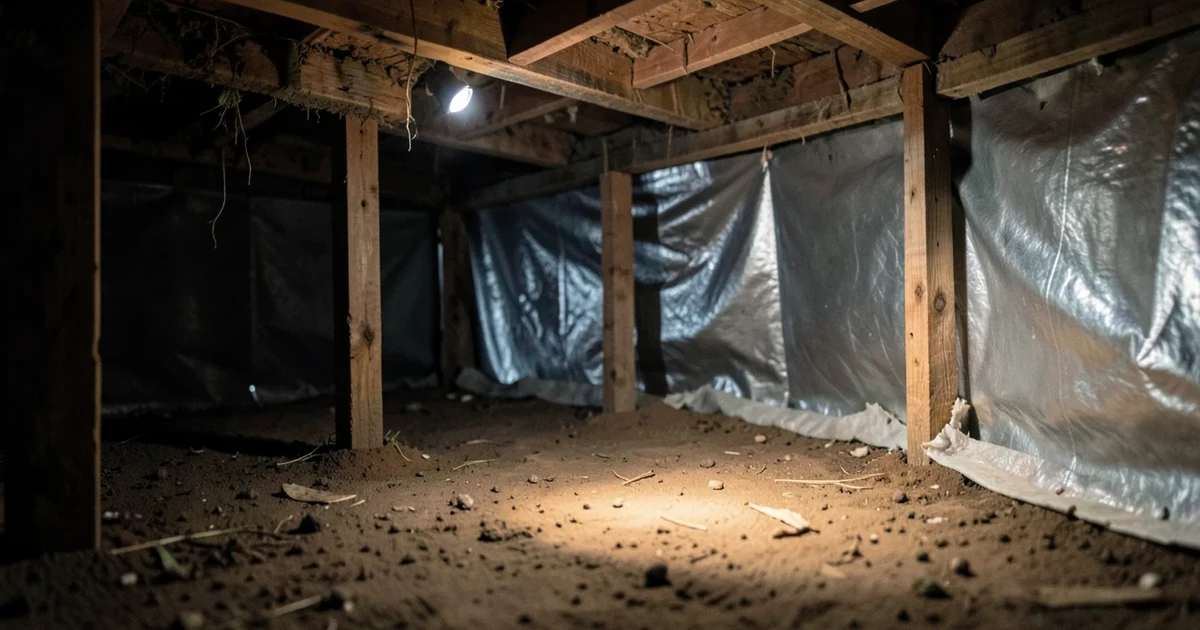
A crawlspace is not sealed off from the house. Air moves upward through a building — warm air rises, leaves at the top, and draws replacement air in at the bottom. That replacement air comes through the crawlspace.
Estimates for how much of a ground floor's air originates below it run high, and the exact figure matters less than the direction. Whatever is in the crawlspace is in the house.
Why they grow mold
Vents, in a humid climate. This is the counterintuitive one. Crawlspace vents were required by code for decades on the reasoning that ventilation dries things out.
In summer, warm humid outdoor air enters a crawlspace that is cool because it is against the ground. The air cools, its relative humidity rises, and it condenses on the coolest surfaces — the joists and the underside of the floor. Venting adds moisture rather than removing it.
Modern practice in humid climates is a sealed, encapsulated crawlspace with a conditioned or dehumidified interior. Building codes in the US have permitted this for years.
No vapour barrier, or a torn one. Bare earth releases a large amount of water vapour continuously. A sealed, taped, well-lapped barrier over the entire floor is the single highest-value intervention in most crawlspaces.
Grading and drainage. Ground sloping toward the house, downpipes discharging at the foundation, no gutters. Water arrives and stays.
Plumbing leaks. A slow leak in a crawlspace can run for years unnoticed.
Ducts. Uninsulated air conditioning ducts sweat heavily in a humid crawlspace, and a leaking supply duct dumps cold air onto surfaces that then condense.
What to look for
Go under with a torch, a mask and something to lie on.
- White or grey fuzzy growth on joists and the floor underside
- Dark staining on timber
- A vapour barrier that is torn, absent, or not lapped and taped
- Standing water or damp soil
- Rusty ducts, sweating pipes, insulation fallen or hanging
- Insulation that is dark, wet or compressed — the batts fall out when they get wet, which is itself a sign
- Wood that a screwdriver enters easily
That last one is the important check. Surface mold is a cleaning problem; wood decay is a structural one, and it is what an unattended crawlspace eventually produces.
The fix, in order
Doing these out of order wastes the money.
- Water first. Fix grading, extend downpipes well clear, repair leaks, add a sump if there is standing water. Nothing else works while water is arriving.
- Vapour barrier. 6-mil minimum, 10–20 mil for a proper encapsulation. Cover the entire floor, lap seams generously and tape them, run it up the walls and seal it there.
- Seal the vents and air-seal the rim joist, if encapsulating.
- Dehumidify. A crawlspace-rated unit with a condensate drain, set around 50–55%.
- Insulate the walls rather than the floor above, in an encapsulated space.
- Then remediate the growth — cleaning first and sealing later means cleaning twice.
Removing the growth
Small areas: detergent solution, an N95, eye protection, and physical removal. Bring the material out rather than leaving it in place.
Larger areas: professional treatment, usually soda or dry ice blasting, which strips growth from timber without soaking it. Follow with a sealing coating if desired — noting that encapsulant over live growth is decoration, not remediation.
Do not use bleach on timber here. It is mostly water, it wets the wood you are trying to dry, and it does not penetrate. The same argument applies to grout and silicone in a bathroom — removing shower mold without bleach sets out why.
What it costs to ignore
- Musty smell throughout the ground floor, which is the complaint that usually brings people down here in the first place — a musty smell with no visible mold lists it among the top few sources
- Cupping and buckling hardwood floors above
- Higher heating and cooling bills, from wet insulation and conditioned air lost to leaky ducts
- Wood decay in joists and sill plates, which is the expensive endpoint
- Rodents and insects, which want the same conditions
The attic parallel
An attic and a crawlspace fail for mirror-image reasons: the attic gets moisture from the house below and needs ventilation to the outside; the crawlspace gets moisture from the ground and the outdoor air and needs to be sealed from both.
Applying attic logic to a crawlspace — more vents — is a common and expensive mistake. Attic mold covers the other half, where the ventilation advice runs the other way.
Types referenced
The species matters less than you think
- Public health guidance is to remove all indoor mold regardless of type. The CDC and EPA do not recommend routine species testing for ordinary households, because the response does not change: find the water, stop it, remove the growth.
- “Toxic black mold” is a marketing phrase, not a category. Stachybotrys is real and does need soaked material to grow, so finding it tells you something useful about your building. But the health effects that are well established — allergy, asthma aggravation, irritation — are not specific to it.
- Mold without water does not persist. Cleaning growth while leaving the moisture source is why it comes back. The leak, the condensation or the ventilation is the actual problem.
Call a professional for areas larger than about 10 square feet, for anything in HVAC ductwork, after sewage or flood water, or if anyone in the household is immunocompromised or has a lung condition.
Keep reading
- Mold in the Attic: Almost Always VentilationAttic mold is warm moist air from the house meeting cold roof sheathing. The pattern of growth points at exactly where it is getting in.
- A Musty Smell With No Visible MoldThe smell is real and it means active growth somewhere. Here is the search order, and the six places hidden mold is usually found.
- Mold After a Flood: The First 48 Hours Decide ItMold establishes on wet building materials within one to two days. What you do in that window determines whether this is drying out or rebuilding.