
Can You Get Poisoned by Touching a Mushroom?
By IdentifyThese Editorial · · 3 min read
No. Handling a mushroom, including a death cap, does not poison you. The toxins responsible for serious mushroom poisoning have to be swallowed and absorbed through the gut.
This is worth saying plainly, because the over-caution does real harm: it discourages the one action that identifies dangerous species, which is picking the whole thing up and looking at the base.
Why the myth persists
Three things feed it.
The consequences of eating one are so severe that people reasonably assume the danger must be easily transmitted. The word "toxic" gets used the same way for contact irritants and ingested poisons, though they work completely differently. And advice given to children — do not touch, do not pick — sensibly errs toward the absolute, and then gets repeated by adults as though it were a statement of pharmacology.
Amatoxins, the compounds in death caps and destroying angels, are not absorbed through intact skin in any meaningful quantity. Neither is muscarine, nor ibotenic acid, nor the gyromitrin in false morels.
The genuine exceptions
Two things are worth knowing, and neither is poisoning in the sense people mean.
Spore allergy is real. Handling large quantities, particularly puffballs releasing clouds of spores, can cause respiratory irritation and in rare cases a genuine hypersensitivity reaction. This is an allergic response to inhaled spores, not a toxin.
A very small number of species cause skin irritation on prolonged handling, mostly in people already sensitive. It is a rash, not systemic poisoning.
Contact versus ingestion, by toxin
| Toxin group | Found in | Absorbed through skin? | What actually causes harm |
|---|---|---|---|
| Amatoxins | Death cap, destroying angels, deadly Galerina | No | Eating even a small piece |
| Muscarine | Inocybe, Clitocybe | No | Eating |
| Ibotenic acid / muscimol | Fly agaric, panther cap | No | Eating |
| Gyromitrin | False morels | Negligible | Eating; also inhaling cooking vapour |
| Spores | Puffballs and others in quantity | Not a toxin | Inhaling large amounts — an allergic response |
The false morel is the only one with an inhalation route worth naming, and it involves standing over a pan of them cooking rather than picking one up.
What actually matters
Wash your hands afterwards, as you would after any gardening. Do not put your fingers in your mouth while you work. Do not eat lunch mid-forage without washing.
That is the whole precaution, and it is aimed at the small residue you might transfer to food, not at absorption through skin.
Why this matters for identification
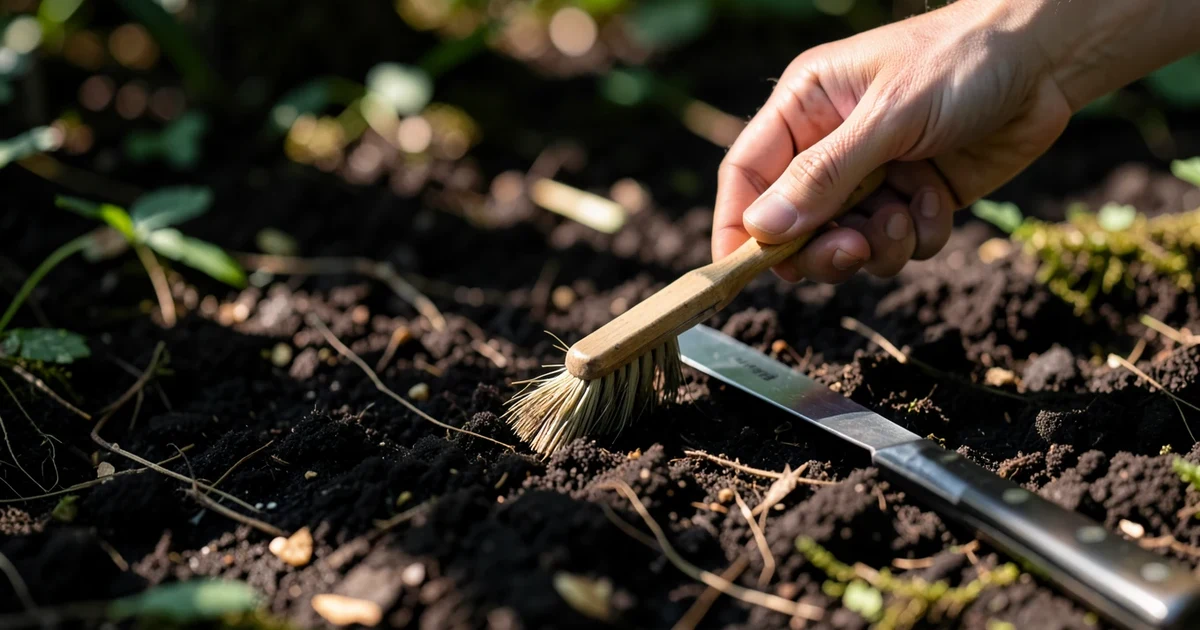
The single most diagnostic feature on the deadly Amanitas — the volva at the base of the stem — sits below the soil line. Cutting the stem at ground level, or refusing to touch the mushroom at all, removes it from the specimen entirely.
Digging the whole thing up and brushing the base clean is the habit that catches the most dangerous mistakes, and being frightened of contact prevents it. The three features to find first.
Children and dogs
The rule for both is about eating, not touching.
Teach children not to eat wild mushrooms, and that picking one to show an adult is fine and useful. A blanket do-not-touch rule sounds safer and produces children who cannot show you what they found.
For dogs the same logic applies in reverse: contact is irrelevant, ingestion is urgent, and a dog that has eaten one needs a vet before symptoms rather than after. What to do.
What still holds
Nothing here changes the central rule. Never eat a wild mushroom identified from a website or an app, including this one. The gap between handling being harmless and eating being safe is the whole subject.
Read this before anything else
- Never eat a wild mushroom identified by a website or an app.That includes this one. These tools narrow possibilities; they cannot see your mushroom, its base, its smell or its habitat, and the difference between a meal and a liver transplant is sometimes a feature buried in the soil.
- Get it confirmed in person by an experienced local forager or a mycological society. Most regions have one, most run free identification sessions, and they will look at the actual specimen.
- Dig, do not pull. The cup at the base of a death cap is often underground. Pulling the mushroom leaves the most important feature in the soil.
- If someone has eaten a wild mushroom and feels unwell, call poison control now — in the US, 1-800-222-1222. Do not wait for symptoms to worsen. Amatoxin poisoning has a false recovery phase, and delayed treatment is what makes it fatal. Save any uneaten pieces for identification.
Keep reading
- The Amanita Check: Dig It Up, Every TimeMost fatal mushroom poisonings are one genus. Two features identify it, one is usually underground, and pulling the mushroom rather than digging destroys the evidence.
- The White Mushrooms in Your Lawn: What They Usually AreWhite is the colour the deadly Amanitas share with several harmless lawn species. What separates them, and the one feature that is almost always underground.
- The Parts of a Mushroom You Have to CheckSix features carry nearly all identification, and two of them are commonly destroyed by the way people pick. Here is what each one is and why it matters.