

Shelf Fungi: Turkey Tail and the Ones It Is Not
By IdentifyThese Editorial · Reviewed · 3 min read
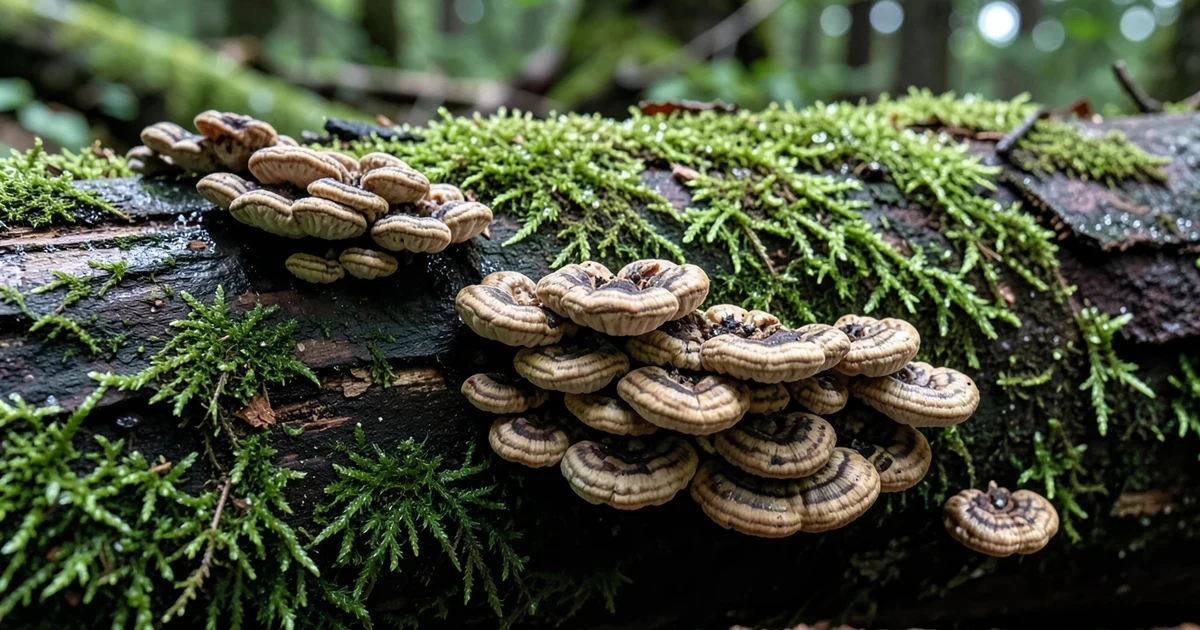
Turkey tail is one of the most abundant fungi in temperate woodland and one of the most misidentified, because several unrelated brackets look similar from above.
Every one of them is separated by turning it over.
Turkey tail
Trametes versicolor.
- Thin and flexible — a few millimetres thick, and it bends without snapping when fresh.
- Concentric bands of contrasting colour across the upper surface: browns, greys, blues, greens, ochres, often with a pale outer margin. The banding is sharply defined.
- Upper surface finely fuzzy or velvety to the touch.
- Underside white to cream, covered in very fine pores — three or more per millimetre, so they need a hand lens to resolve individually.
- Grows in overlapping rosettes and tiers on dead hardwood.
The pore surface and the flexibility together are what identify it.
The three lookalikes
False turkey tail (Stereum ostrea and relatives) — banded and similar from above, but the underside is smooth, with no pores at all. That is the whole difference and it is decisive. Some Stereum species bleed red when cut fresh, which is worth knowing.
Hairy bracket (Trametes hirsuta) — thicker, with a coarsely hairy upper surface, less colour contrast in the banding, and generally whitish to grey. A pore surface, so it is a genuine Trametes, just not turkey tail.
Violet-toothed polypore (Trichaptum biforme) — similar above, but the underside is purple when fresh and breaks up into teeth rather than remaining as pores. On dead hardwood, extremely common.
The comparison
| Underside | Thickness | Upper surface | |
|---|---|---|---|
| Turkey tail | Fine white pores | Thin, flexible | Fuzzy, sharply banded |
| False turkey tail | Smooth, no pores | Thin | Banded, sometimes smoother |
| Hairy bracket | Pores | Thicker, stiffer | Coarsely hairy, muted |
| Violet-toothed polypore | Teeth, purple when fresh | Thin | Banded |
Turning it over answers it in every case, which is the same first question that runs through the whole subject — gills, pores or teeth.
The other common brackets
Artist's conk (Ganoderma applanatum) — a large perennial bracket, woody, hoof or shelf-shaped, adding a layer each year. The white pore surface bruises brown instantly when scratched, which is where the name comes from — it can be drawn on. Its presence on a living tree indicates long-established internal decay, which is the arboricultural point in mushrooms growing on my tree.
Chicken of the woods (Laetiporus) — bright orange and yellow, thick and fleshy, in large overlapping shelves. A well-known edible with real caveats: it causes reactions in a minority of people, and specimens from eucalyptus, conifers and yew should be avoided.
Birch polypore (Fomitopsis betulina) — smooth, pale, kidney-shaped, on birch only. Historically used as a strop for razors and found in the possessions of the Alpine iceman.
Tinder fungus (Fomes fomentarius) — hoof-shaped, grey, hard, perennial. Used for carrying fire for thousands of years.
Is turkey tail edible
Not in any ordinary sense. It is far too tough to eat, and it is used as a tea or an extract rather than as food.
It has a substantial research literature — polysaccharide-K, derived from it, has been used as an adjunct cancer therapy in Japan for decades and has been through clinical trials. That is a pharmaceutical preparation rather than a woodland tea, and the gap between the two is where most of the supplement marketing lives.
Which is a reason to be careful with claims rather than a reason to dismiss the fungus. The identification, at least, is straightforward.
Collecting it
- Take only from dead wood.
- Cut rather than tear, leaving the mycelium in the log.
- Check the underside on every single piece — mixed collections of turkey tail and Stereum are the normal result of collecting from a log by eye.
- Dry thoroughly before storing.
The rest of the log is worth a look too. Fallen hardwood carries oyster mushrooms, and it also carries small brown mushrooms with a ring that contain death cap toxins — oyster mushroom lookalikes covers the pairing.
Species referenced
Read this before anything else
- Never eat a wild mushroom identified by a website or an app.That includes this one. These tools narrow possibilities; they cannot see your mushroom, its base, its smell or its habitat, and the difference between a meal and a liver transplant is sometimes a feature buried in the soil.
- Get it confirmed in person by an experienced local forager or a mycological society. Most regions have one, most run free identification sessions, and they will look at the actual specimen.
- Dig, do not pull. The cup at the base of a death cap is often underground. Pulling the mushroom leaves the most important feature in the soil.
- If someone has eaten a wild mushroom and feels unwell, call poison control now — in the US, 1-800-222-1222. Do not wait for symptoms to worsen. Amatoxin poisoning has a false recovery phase, and delayed treatment is what makes it fatal. Save any uneaten pieces for identification.
Keep reading
- Mushrooms Growing on My Tree: What That MeansA fruiting body on a living trunk means the fungus has been inside the wood for years. The position on the tree tells you which part is affected.
- Gills, Pores or Teeth? The First QuestionWhat is under the cap splits the fungi into groups before anything else. It also decides how much trouble a mistake can cause.
- Oyster Mushrooms and the Three Things That Look Like ThemDecurrent gills, an off-centre stem or none, and growth in shelving clusters on wood. Two lookalikes are poisonous and one is merely disappointing.