
Sticky Leaves: What Honeydew Means and Who Is Making It
By IdentifyThese Editorial · Reviewed · 3 min read
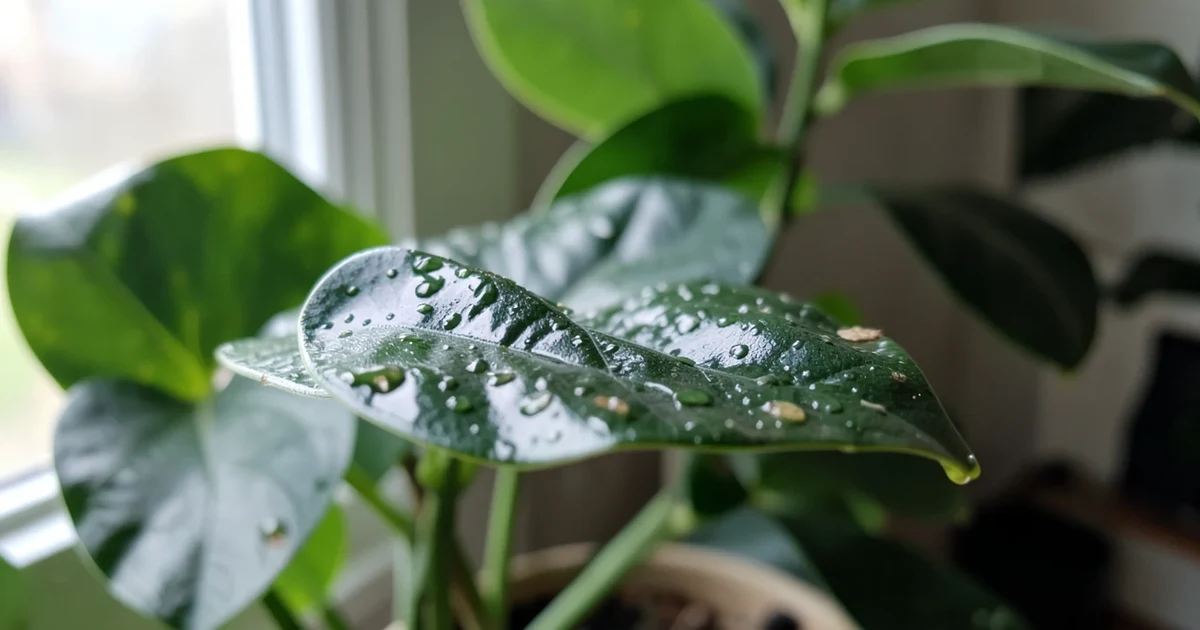
Sticky leaves are not a plant condition. Plants do not secrete anything sticky onto their own foliage.
What you are touching is honeydew: sugar water excreted by insects feeding on sap. Sap is carbohydrate-rich and protein-poor, so a sap-feeder has to process a great deal of it to get enough nitrogen, and the surplus sugar passes straight through.
Which gives you a useful piece of information immediately — it fell from above.
Follow it upward
Honeydew drips. Whatever is producing it sits above the stickiest surface, and it is almost never on the sticky leaf itself.
Check, in this order:
- The undersides of leaves directly above the sticky area.
- Stems and leaf axils, especially where a leaf joins the stem.
- New growth and flower buds, which is where aphids concentrate.
- The underside of the leaf you are standing under, if it is an outdoor tree.
Which insect
| Insect | Where | What it looks like |
|---|---|---|
| Aphids | New growth, buds, leaf undersides | Soft pear-shaped clusters, green, black, grey or pink; two small tubes at the rear |
| Scale | Stems and midribs | Immobile brown or white bumps that scrape off with a fingernail |
| Mealybugs | Leaf axils, crowns, roots | White cottony masses; the fluff is wax, not fungus |
| Whiteflies | Leaf undersides | Tiny white moth-like insects that fly up in a cloud when disturbed |
| Psyllids and leafhoppers | Leaves, stems | Small, jumping; often the cause on outdoor trees |
Scale is the one most often missed, because an immobile brown bump on a stem does not read as an animal. Scrape one off — if it lifts away leaving a slightly damp patch and the underside is soft, it was alive.
Mealybug fluff is regularly mistaken for a fungus and treated with fungicide. Pull a piece apart: there is an insect inside.
The black film that follows
Left long enough, sooty mold grows on the honeydew. It is a black crust across the leaf and anything below it — paving, cars, garden furniture.
The mold is not attacking the plant; it is living on the sugar. It does shade the leaf, which matters when it is thick. Remove the insects and it stops being replenished, then weathers or wipes off with soapy water. It is covered alongside the other causes of dark marks in black spots and black leaves.
Outdoor trees, and why your car is sticky
A car parked under a lime, maple, birch or oak in early summer gets coated. That is aphid honeydew from the canopy, and there is nothing practical to do about a mature tree.
It is seasonal and it ends when the aphid population crashes — usually within a few weeks, as ladybirds, lacewings and parasitic wasps catch up. Spraying a large tree is neither feasible nor useful, and systemic insecticides applied to flowering trees carry a real cost to pollinators.
Park somewhere else for a fortnight.
Treating it on a plant you can reach
In rough order of what to try:
- Wash it off. A firm spray of water removes most aphids and a good share of whiteflies. Repeat every few days. This alone resolves a lot of houseplant cases.
- Wipe scale and mealybugs. Alcohol on a cotton bud kills on contact. Tedious, effective, and the only thing that reliably reaches leaf axils.
- Insecticidal soap or horticultural oil. Contact killers — coverage is everything, especially leaf undersides. Do not apply in direct sun or above about 30 °C, which burns foliage.
- Repeat. Every one of these misses eggs and crawlers. A single application is why infestations come back.
- Isolate the plant if it is indoors. Mealybugs and scale move between touching plants.
Outdoors, wait before doing any of it. Aphid populations are usually collapsing under predation by the time you notice them, and a broad-spectrum spray removes the predators faster than the aphids — the specific mechanism when not to spray describes.
When sticky is not honeydew
A few plants have genuinely sticky glandular hairs — petunias, tobacco, some salvias, sundews obviously. That stickiness is on the plant's own surface, evenly distributed, and present from the moment the leaf opens. Honeydew is patchy, glossy, and always worse below something.
Problems referenced
Check these two things first
- Push a finger into the soil, two knuckles deep. Wet soil plus a wilting plant means too much water, not too little — and it is the commonest reason a plant is dying. Dry soil plus crisp leaves means the opposite. The leaves look nearly identical either way, so the soil is what tells you.
- Turn a damaged leaf over. Half of all diagnoses live on the underside: fuzz means downy mildew, fine webbing means spider mites, clusters of insects mean aphids. Nothing on the top of a leaf is as informative.
Most garden problems are cosmetic and resolve without treatment. Reach for a spray last, not first.
Keep reading
- Black Spots and Black Leaves: Six Different ProblemsBlack on a leaf can be fungal, bacterial, an insect by-product, cold damage or sunburn. The halo, the shape and whether it rubs off separate them.
- Something Is Eating My Leaves. What, and When?The shape of the damage identifies the culprit better than catching it. Holes, edge notches, windowpaning and slime trails each point somewhere different.
- Wilting Even Though You Watered ItA plant wilting in wet soil has a supply problem, not a water problem. Root rot, vascular wilt and stem borers each leave a different mark.