

Black Spots and Black Leaves: Six Different Problems
By IdentifyThese Editorial · · 3 min read
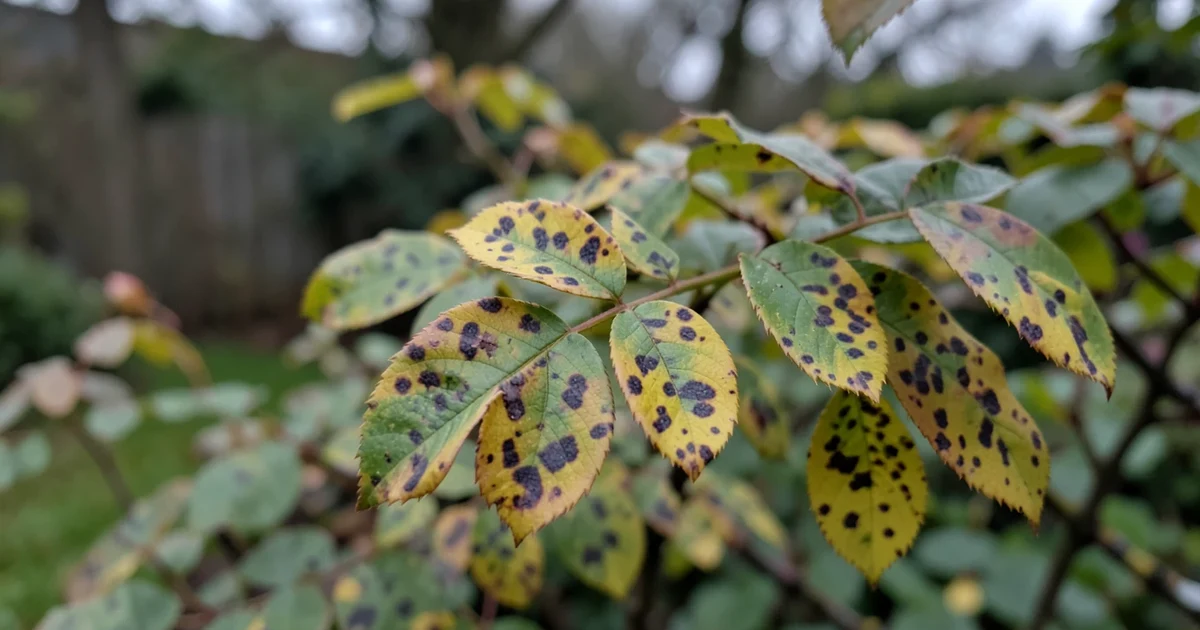
Black on a leaf is not one condition. Six things produce it, and they are separated by three questions: does it rub off, does it have a halo, and is the leaf sticky.
Does it rub off?
Yes — sooty mold. A black film across the upper surface, sometimes over the whole plant and whatever is beneath it. It is a fungus growing on honeydew, and honeydew comes out of sap-feeding insects. Look above the affected leaves for aphids, scale, mealybugs or whiteflies.
The mold itself does no direct damage beyond shading the leaf. Deal with the insects and it weathers off; wipe it with soapy water for appearance. Spraying fungicide at it treats the wrong organism.
Sticky leaves with no black yet is the same problem caught earlier.
No — keep going.
Does it have a halo?
A yellow halo around a dark spot points at bacteria or a bacterial-mimicking fungus.
- Bacterial leaf spot — small, angular spots bounded by the veins, water-soaked and greasy-looking when fresh, with a yellow halo. Spreads in wet weather and by splashing.
- Anthracnose — sunken dark lesions, often on stems and fruit as well as leaves, frequently with a tan centre.
The angular versus round distinction is the useful one here, and it is the same character that separates downy from powdery mildew: pathogens confined by leaf veins make angular patches, and fungi that spread through tissue make round ones.
Round spots with concentric rings — early blight or septoria on tomatoes and potatoes. The tomato leaf spot guide separates the three that matter, because the response differs and getting it wrong wastes a season.
Rose black spot
Distinct enough to treat separately, and the most-searched of the lot.
- Round black spots with fringed, feathery margins — not clean edges.
- Yellowing spreads outward from the spot until the whole leaf drops.
- Starts on lower leaves and moves up.
- Roses only. It will not move to anything else in the garden.
It needs seven hours of leaf wetness to infect, which is the whole basis of managing it: water at the base, water in the morning, and space plants for airflow. Fallen leaves carry it through winter, so raking is not tidiness but control.
Some cultivars are highly resistant and some — many older hybrid teas — are hopeless in a humid climate. Variety choice does more than any spray programme.
The black that is not an organism
Cold and frost damage. Blackened tissue appearing overnight after a cold snap, worst on exposed new growth and on the windward side. It does not spread afterwards. Basil goes black at 5 °C without frost at all.
Sunburn. Bleached first, then brown or black, in patches on the leaves facing the light, on a plant recently moved to brighter conditions. Not on shaded leaves.
Edema. Small raised corky bumps on the underside, later turning brown-black, on plants that took up more water than they could transpire — cool humid conditions with wet soil. Common on succulents, geraniums and brassicas. It is a watering pattern, not a disease.
Chemical damage. Sprays applied in heat, at too high a concentration, or on a plant already stressed. Oil and soap sprays in sun are the usual cause, and the damage follows the spray pattern rather than any biological logic.
The order to check
- Rub it. Comes off → sooty mold → find the insects above.
- Look for a halo and angular edges → bacterial.
- Look for concentric rings → blight or septoria.
- Look at the margin — fringed on a rose → rose black spot.
- Consider the weather in the last week → frost, sun, chemical.
- Only then consider a fungicide, and only if it is a disease with a season left to save.
Most black-spotted leaves on an established plant in late summer need nothing. Removing badly affected leaves, cleaning up fallen material and improving airflow does more than a bottle, which is the case when not to spray sets out.
Problems referenced
Check these two things first
- Push a finger into the soil, two knuckles deep. Wet soil plus a wilting plant means too much water, not too little — and it is the commonest reason a plant is dying. Dry soil plus crisp leaves means the opposite. The leaves look nearly identical either way, so the soil is what tells you.
- Turn a damaged leaf over. Half of all diagnoses live on the underside: fuzz means downy mildew, fine webbing means spider mites, clusters of insects mean aphids. Nothing on the top of a leaf is as informative.
Most garden problems are cosmetic and resolve without treatment. Reach for a spray last, not first.
Keep reading
- Powdery Mildew or Downy Mildew? They Are Not RelatedPowdery mildew sits on top of the leaf and wipes off. Downy mildew grows underneath and is bounded by the veins. One is a nuisance; the other kills crops.
- Why Are My Plant's Leaves Turning Yellow? Start With WhereYellow leaves have at least seven common causes. Which leaves yellowed — oldest or newest — and whether the veins stayed green narrows it to one or two immediately.
- Which Tomato Leaf Spot Is It? Rings, Dots and GreaseFour diseases spot tomato leaves and they need different responses. Concentric rings, tiny black dots and a greasy texture separate them — one of them needs acting on today.