

Which Tomato Leaf Spot Is It? Rings, Dots and Grease
By IdentifyThese Editorial · Reviewed · 4 min read
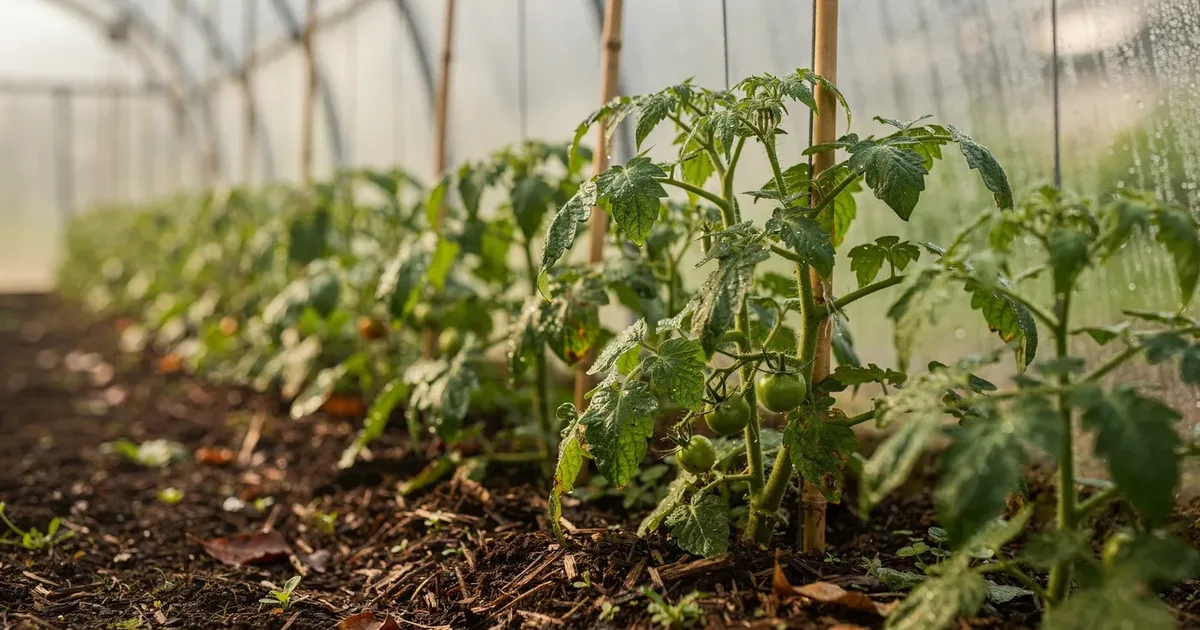
Four different things spot tomato leaves, and while three of them can be managed at your leisure, one needs dealing with the same day. The differences are visible without magnification once you know what to look at.
The one to rule out first: late blight
Before anything else, check whether the lesions look wet.
Late blight lesions are large, irregular and appear greasy or water-soaked, even on a dry afternoon. They are grey-green at first, turning brown-black, and in humid weather a fine white fuzz forms on the underside at the edge of the lesion. Fruit develops firm, greasy brown patches.
Two other things mark it out:
- It does not start at the bottom. It appears anywhere on the plant, including the top.
- It moves in days. A plant can go from a few lesions to collapse inside a week.
If that is what you have, act today: pull the plants, bag them, and bin them. The spores travel on wind for miles and will reach your neighbours' gardens. This is the one tomato disease where speed genuinely matters.
Everything below is a much slower problem.
Early blight: a few spots, with rings
Look for concentric rings inside each spot — a tiny archery target, or the growth rings of a tree.
Early blight makes relatively few spots, each maybe the size of a pencil eraser, on the lowest, oldest leaves first. Yellow spreads out around each spot, the leaf goes fully yellow, and it drops. Then the disease moves up a level and does it again.
It overwinters in the soil and gets onto the plant by splashing up in rain or from a hose. Which is why the most effective single response is not a fungicide but mulch — a thick layer between soil and foliage removes the delivery mechanism.
Septoria: many spots, with pale centres
Septoria produces dozens of small spots rather than a few large ones, up to about a quarter inch, with dark borders and pale grey or tan centres. Look closely — a hand lens helps — and there are minute black dots in the centre of each. Those are the fruiting bodies.
No concentric rings. That is the separation from early blight, and it is reliable.
Septoria also never infects the fruit. It ruins the crop indirectly by stripping the plant of leaves.
The two diseases very often appear on the same plant, and the management is identical, so distinguishing them matters more for satisfaction than for treatment.
Bacterial spot: greasy and angular
Bacterial spots are small, dark, and look wet, especially in the morning. Their edges are often angular rather than round, because bacteria travel through the leaf's plumbing and are stopped by the veins. There is frequently a yellow halo around each. In dry weather the centres fall out, leaving small holes.
The critical practical point: bacterial diseases spread on hands, tools and clothing moving among wet plants. Staying out of the tomato bed until the foliage has dried does more than any spray.
Side by side
| Early blight | Septoria | Late blight | Bacterial spot | |
|---|---|---|---|---|
| Spot size | Large, few | Small, many | Very large blotches | Small, many |
| Rings inside | Yes — target pattern | No | No | No |
| Spot centres | Dark brown | Pale grey with black dots | Grey-green, greasy | Dark, greasy |
| Edges | Round | Round | Irregular | Angular, vein-bounded |
| Texture | Dry, papery | Dry | Wet, greasy | Wet, greasy |
| Starts | Lowest leaves | Lowest leaves | Anywhere | Anywhere |
| Speed | Weeks | Weeks | Days | Fast in wet weather |
| Fruit affected | Yes, at stem end | No | Yes, greasy patches | Yes, raised scabs |
What to do about the slow three
The response is much the same for early blight, septoria and bacterial spot, and most of it is not spraying:
- Remove affected lower leaves and bin them. Do not compost, and do not take more than about a third of the foliage at once.
- Mulch thickly. Most infection arrives by soil splash.
- Water at the base, in the morning. Wet foliage overnight is what these diseases need.
- Stay out of the bed when plants are wet, particularly for bacterial spot.
- Improve airflow — prune the bottom twelve inches, and space plants further apart next year.
- Fungicide only if it is climbing fast. Copper or chlorothalonil protect healthy new growth; they do not cure existing spots. Observe the pre-harvest interval on the label.
Next season
Rotation is the real answer. Move tomatoes and potatoes to a different bed for two to three years, clear every scrap of debris in autumn, and pull volunteer seedlings. These fungi survive winter in the soil and on the remains of last year's crop, and a plant grown where an infected one stood is starting the season already losing.
Problems referenced
Check these two things first
- Push a finger into the soil, two knuckles deep. Wet soil plus a wilting plant means too much water, not too little — and it is the commonest reason a plant is dying. Dry soil plus crisp leaves means the opposite. The leaves look nearly identical either way, so the soil is what tells you.
- Turn a damaged leaf over. Half of all diagnoses live on the underside: fuzz means downy mildew, fine webbing means spider mites, clusters of insects mean aphids. Nothing on the top of a leaf is as informative.
Most garden problems are cosmetic and resolve without treatment. Reach for a spray last, not first.
Keep reading
- Black Spots and Black Leaves: Six Different ProblemsBlack on a leaf can be fungal, bacterial, an insect by-product, cold damage or sunburn. The halo, the shape and whether it rubs off separate them.
- Overwatering or Underwatering? The Leaves Won't Tell YouBoth make a plant droop and yellow, and the treatments are opposites. The soil, the leaf texture and the recovery time separate them in under a minute.
- Crispy Brown Leaf Tips, and What They Are NotBrown tips are almost always humidity, salt build-up or tap water chemistry. They are almost never disease, and the pattern of browning says which.