
Powdery Mildew or Downy Mildew? They Are Not Related
By IdentifyThese Editorial · Reviewed · 3 min read
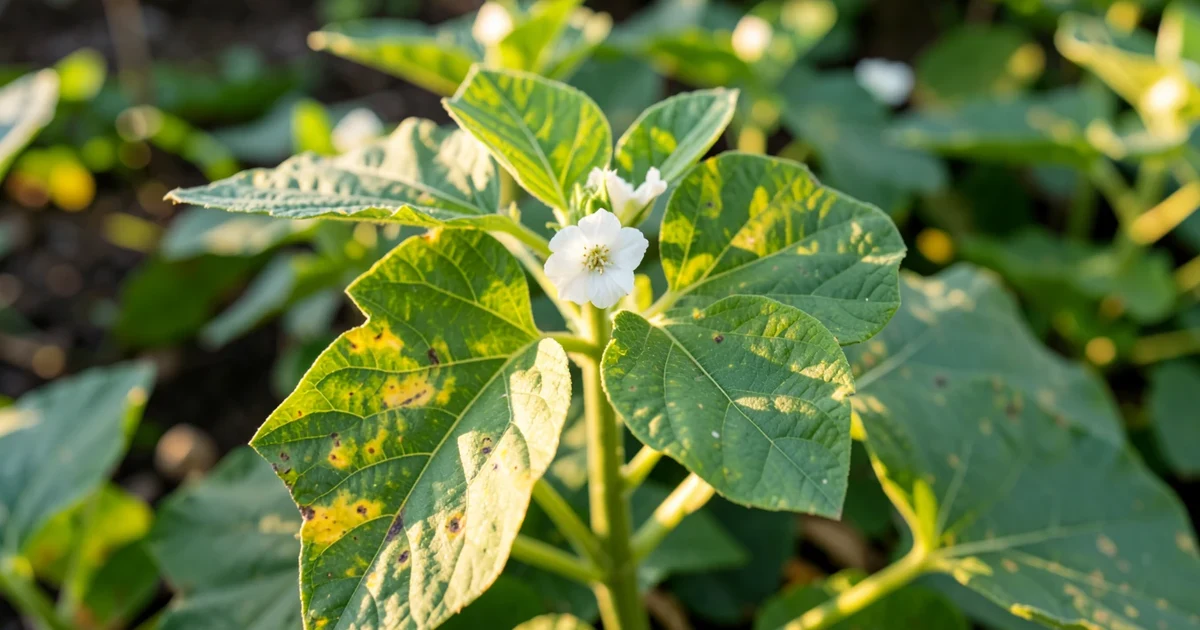
They share a name and nothing else. Powdery mildew is a fungus; downy mildew is an oomycete, closer to algae than to fungi. They infect differently, respond to different weather, and one of them matters far more than the other.
The one-second test
Rub the white growth with a finger.
- It smears and comes off — powdery mildew. It grows on the surface.
- It does not — the discolouration is inside the leaf. Turn the leaf over.
Then look at the underside. Downy mildew produces its growth there — a fuzzy grey, purple or near-black layer — while the upper surface shows yellow patches.
The full comparison
| Powdery mildew | Downy mildew | |
|---|---|---|
| Where it grows | Upper surface, sometimes both | Underside only |
| Appearance | White talcum-powder dusting | Grey, purple or black fuzz below; yellow above |
| Wipes off | Yes | No |
| Patch shape | Round, spreading, ignores veins | Angular — bounded by leaf veins |
| Weather | Warm, dry days with humid nights | Cool and genuinely wet; needs free water |
| Speed | Slow, over weeks | Fast, days |
| Severity | Often cosmetic | Frequently fatal to the planting |
The angular patch is the character to learn. Downy mildew cannot cross the larger veins, so its yellow patches are bounded by them and look like a stained-glass pattern. Powdery mildew spreads in circles and pays no attention to veins.
Powdery mildew
Counterintuitively, it does not need wet leaves. It thrives in warm dry days with humid nights, which is why it turns up in late summer on squash, cucumbers, roses, phlox, lilac and monarda — often just as the plants are finishing anyway.
Each host has its own specialised species. The powdery mildew on your roses will not move to your squash.
What helps: spacing for airflow, morning watering at the base rather than overhead, resistant varieties, and removing the worst leaves. What does not: treating a plant three weeks from the end of its season, which is most of the powdery mildew people spray.
Milk sprays and potassium bicarbonate have modest evidence behind them as preventatives. Neither cures established infection.
Downy mildew
This one is worth acting on quickly.
It requires free water on the leaf for several hours and cool temperatures, so it arrives with a wet spell. Once established it moves fast, and on basil and cucurbits it can end a planting in two weeks.
Cucurbit downy mildew is particularly worth knowing about because it does not overwinter in most of North America — it blows north each season from southern overwintering sites. There are public forecast networks that track the front as it moves, and knowing it is a week away is far more useful than any spray applied afterwards.
Basil downy mildew arrived in the US in 2007 and is now widespread. The first sign is yellowing that looks like a nitrogen problem; turn the leaf over and the underside is grey-black. Resistant varieties now exist and are the only reliable answer for a home garden.
What it is not
- Spider mite damage produces fine stippling and webbing, not a coating. Check the underside with a lens.
- Grey mold (botrytis) is a fuzzy grey growth, but on dying tissue — spent flowers, damaged fruit — rather than on healthy leaf surface.
- Sooty mold is black, sits on top, wipes off, and grows on insect honeydew rather than on the plant. If it is black and sticky underneath, look for aphids or scale above.
- Hard water residue on leaves after overhead watering looks like powdery mildew and is distributed by droplet pattern rather than in expanding circles.
Deciding whether to do anything
If it is powdery mildew, late in the season, on a plant that has already produced — do nothing. This is the single most common unnecessary spray in a home garden, and when not to spray makes the case at more length.
If it is downy mildew on basil or cucurbits, the useful actions are removing infected material, improving airflow, and planting resistant varieties next season. The infection in front of you is largely already decided.
And if the spots are on tomatoes, neither of these is the likely answer — see which tomato leaf spot is it.
Problems referenced
Check these two things first
- Push a finger into the soil, two knuckles deep. Wet soil plus a wilting plant means too much water, not too little — and it is the commonest reason a plant is dying. Dry soil plus crisp leaves means the opposite. The leaves look nearly identical either way, so the soil is what tells you.
- Turn a damaged leaf over. Half of all diagnoses live on the underside: fuzz means downy mildew, fine webbing means spider mites, clusters of insects mean aphids. Nothing on the top of a leaf is as informative.
Most garden problems are cosmetic and resolve without treatment. Reach for a spray last, not first.
Keep reading
- Something Is Eating My Leaves. What, and When?The shape of the damage identifies the culprit better than catching it. Holes, edge notches, windowpaning and slime trails each point somewhere different.
- When Not to Spray: Most Plant Problems Fix ThemselvesFungicides do nothing against pests, nutrients or watering faults — and most garden damage is cosmetic. A short guide to when treatment helps and when it just costs money.
- Crispy Brown Leaf Tips, and What They Are NotBrown tips are almost always humidity, salt build-up or tap water chemistry. They are almost never disease, and the pattern of browning says which.