
Crispy Brown Leaf Tips, and What They Are Not
By IdentifyThese Editorial · · 3 min read
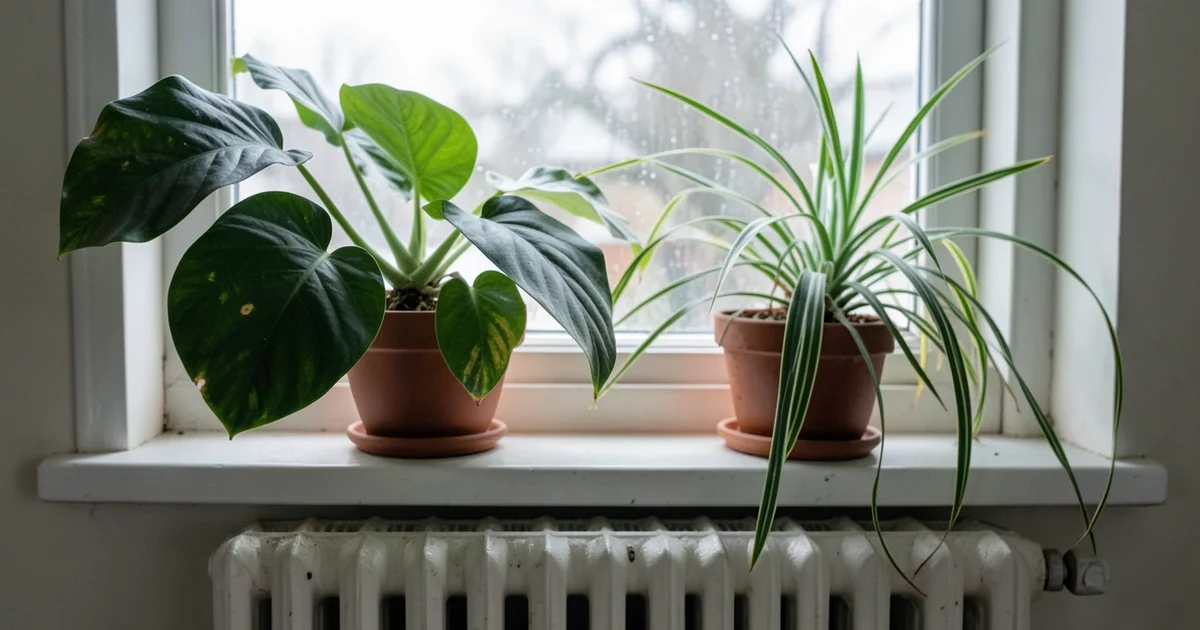
Brown tips are a symptom of the leaf's plumbing, not of an infection. The tip is the furthest point from the roots and the last to be supplied, so anything that interrupts supply or concentrates salts shows up there first.
That is why the same symptom has half a dozen unrelated causes and why fungicide does nothing for any of them.
Read the pattern
| Pattern | Cause |
|---|---|
| Tip only, thin dark line between brown and green | Low humidity |
| Tip and margins, working inward | Salt or fertiliser build-up |
| Tips on new growth, older leaves fine | Water chemistry — fluoride, chlorine |
| Tips plus yellowing lower leaves plus soggy soil | Root rot |
| Tips plus overall dullness plus dry soil | Underwatering |
| One side of the plant only | Draught, or a radiator, or a cold window |
Low humidity
The most common cause in a heated house in winter, and the one people least want to hear because the fix is inconvenient.
Household air in winter runs 20–30% relative humidity. Calatheas, marantas, ferns, and most aroids evolved at 60–80%. The leaf loses water from the tip faster than the plant can replace it and the tissue dies.
What works: grouping plants together, a pebble tray with the pot sitting above the waterline, or a humidifier. What does not work: misting. It raises humidity for about ten minutes and, on some plants, encourages bacterial leaf spot.
Salt build-up
Fertiliser salts and minerals from hard water accumulate in the soil and concentrate at the leaf margins.
Signs: a white or yellowish crust on the soil surface or around the drainage hole, brown that starts at the tip and creeps along the edges, and a plant that has been in the same soil and on the same feeding schedule for a long time.
The fix is flushing — water slowly with three or four pot-volumes of water, letting it drain fully each time, and do it in a sink rather than a saucer. Then feed at half strength and less often.
The most common version of this is a plant on a fixed feeding schedule that has stopped growing. A dormant plant uses almost nothing and the rest accumulates.
Water chemistry
Some plants are genuinely sensitive to fluoride and chlorine at tap concentrations. Spider plants, dracaenas, cordylines, peace lilies and prayer plants are the usual sufferers.
The tell is that browning appears on new leaves as they mature while older leaves stay clean.
Leaving water out overnight lets chlorine dissipate but does nothing for fluoride, which is the more common culprit. Rainwater or distilled water is the actual fix if you have a sensitive plant.
Root problems
Both too much and too little water produce brown tips, which is why the symptom alone is not diagnostic.
- Underwatering — the whole plant looks dull, the pot is light, soil has pulled from the sides.
- Root rot from overwatering — soil stays wet, the pot is heavy, lower leaves yellow, and there may be a sour smell. The roots have stopped working, so the plant is drought-stressed while drowning.
Overwatering or underwatering goes through the checks that actually separate them, none of which involve looking at the leaves.
Physical causes
- Draughts — a door, an air vent, a radiator under a windowsill. The damage is on one side.
- Cold glass — leaves touching a window in winter brown where they touch.
- Sunburn on a plant moved to brighter light, which browns patches rather than tips.
Trimming
Cosmetic only, but there is a right way. Cut with clean scissors following the leaf's natural taper, and leave a hairline of brown. Cutting into green tissue wounds the leaf and it browns again along the new edge, which is why re-trimmed leaves get progressively shorter and uglier.
A leaf that is mostly brown is not recoverable and is worth removing entirely so the plant stops supporting it.
The thing to check first
Turn the plant around and look at where the browning sits relative to the room. Half the cases here resolve at that point without touching the plant, and the rest come down to the soil — which is where yellowing leaves also ends up.
Problems referenced
Check these two things first
- Push a finger into the soil, two knuckles deep. Wet soil plus a wilting plant means too much water, not too little — and it is the commonest reason a plant is dying. Dry soil plus crisp leaves means the opposite. The leaves look nearly identical either way, so the soil is what tells you.
- Turn a damaged leaf over. Half of all diagnoses live on the underside: fuzz means downy mildew, fine webbing means spider mites, clusters of insects mean aphids. Nothing on the top of a leaf is as informative.
Most garden problems are cosmetic and resolve without treatment. Reach for a spray last, not first.
Keep reading
- Why Are My Plant's Leaves Turning Yellow? Start With WhereYellow leaves have at least seven common causes. Which leaves yellowed — oldest or newest — and whether the veins stayed green narrows it to one or two immediately.
- Leaves Curling Up or Curling Down? The Direction Tells You WhyCurling upward and inward is usually water stress or heat. Curling downward and outward points at overwatering, root damage or herbicide. Direction narrows it fast.
- Which Tomato Leaf Spot Is It? Rings, Dots and GreaseFour diseases spot tomato leaves and they need different responses. Concentric rings, tiny black dots and a greasy texture separate them — one of them needs acting on today.