

Jumping Spiders: How to Recognise the Ones Watching You Back
By IdentifyThese Editorial · Reviewed · 3 min read
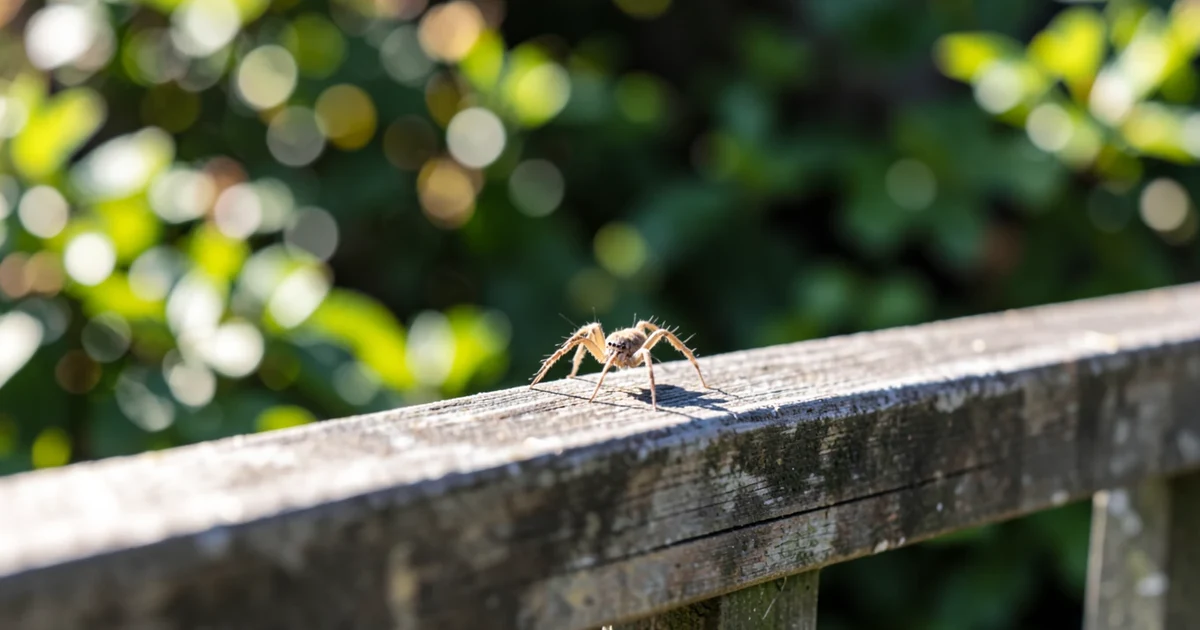
If a small spider on a windowsill turns to face you as you lean in, it is a jumping spider. Nothing else in the group does that, because nothing else can see well enough to bother.
The eyes
Eight eyes, arranged around a broad square face, and two of them are enormous and point directly forward.
Those two are the reason for everything else about the animal. They provide resolution comparable in some respects to a small mammal's, in a body a few millimetres long, and they work by a genuinely unusual mechanism — a layered retina that the spider moves internally to scan and focus. Look closely at a jumping spider's face and the "pupils" appear to shift colour as the retina swings behind the lens.
The smaller side eyes handle motion detection across a wide field. Something moves, the spider swings round, and the big eyes take over.
What follows from being able to see
Jumping spiders do not build webs to catch prey. They stalk, judge the distance, and jump — trailing a silk dragline as a safety rope, which they can be seen paying out and climbing back up.
The jump is hydraulic rather than muscular: they force haemolymph into the legs to extend them suddenly. There is no jumping muscle.
They also court visually, with waving and drumming displays that are elaborate enough to have their own literature. The peacock spiders of Australia are the extreme case, and the North American species do a subdued version of the same thing.
Recognising one
| Feature | Jumping spider |
|---|---|
| Eyes | Two very large forward-facing, six smaller around a square face |
| Body | Compact, stout, hairy |
| Legs | Short and thick, front pair often held slightly raised |
| Movement | Short darting runs, pauses, sudden turns to face |
| Web | A silk retreat only — no capture web |
| Size | Mostly 4–15 mm |
The behaviour is as diagnostic as the anatomy. A spider that moves in stops and starts, turns to track you, and appears to be assessing something is a salticid.
The common ones in North America
Bold jumping spider (Phidippus audax) — black, hairy, with a white or orange triangular mark on the abdomen and, unmistakably, iridescent green or blue chelicerae. Large for a jumping spider at up to 15 mm. Common on fences, walls and vegetation.
Zebra jumping spider (Salticus scenicus) — small, black and white striped, on sunny walls, windowsills and stone. Widespread in North America and Europe and the one most people meet indoors.
Regal jumping spider (Phidippus regius) — the largest in North America, southeastern, with females often grey and males black with bold white markings.
Tan jumping spider (Platycryptus undatus) — flattened, mottled grey-brown, sits under bark and on tree trunks, and is remarkably tolerant of being approached.
Not jumping spiders
Crab spiders — held-out front legs and a sideways scuttle, sitting motionless in flowers to ambush. The goldenrod crab spider can change between white and yellow over a few days to match the flower it is on. Eight small eyes, no large pair.
Lynx spiders — spiny legs, tapered abdomen, on vegetation. The green lynx is bright green and hunts actively but has the eye arrangement of a lynx, not a salticid.
Wolf spiders — also have two large eyes, but they are in a three-row arrangement with four small eyes below, and the animal is much larger and hairier. The comparison is in wolf spider or nursery web spider.
In the house
They come indoors, wander over walls and windows, and leave. They do not establish, do not build webs and are not a sign of anything.
They are also the group most likely to change how someone feels about spiders, largely because they look back. A jumping spider on a windowsill in spring is worth two minutes of watching before you move it.
If you would rather it were outside, the glass-and-card method works, though a jumping spider will usually simply walk onto a hand — see the spider in the bath for the general approach, and note that a salticid is the one that will not run from it.
Species referenced
If you think you were bitten
- Most suspected spider bites are not spider bites. Studies of patients presenting with a “spider bite” repeatedly find that the large majority are bacterial skin infections — frequently MRSA — which need antibiotics rather than reassurance. A spreading, painful, pus-filled sore is far more likely to be an infection than a spider.
- Wash it, ice it, and watch it. Clean the area with soap and water, apply a cold pack, and keep an eye on it.
- Get medical care if the wound spreads or darkens, if you develop cramping, sweating, fever or severe abdominal pain, or if you are confident it was a widow or a recluse.
- Bring the spider only if it is already dead and to hand. Do not go looking for it. Doctors treat symptoms, not species.
In the US, the Poison Help line is 1-800-222-1222. This site is a reference, not medical advice.
Keep reading
- Wolf Spider or Nursery Web Spider? Watch What She CarriesA wolf spider carries her egg sac attached to her spinnerets and her young on her back. A nursery web spider carries hers in her jaws. Eye arrangement confirms it.
- Why There Are Suddenly Spiders Everywhere in AutumnThey are not coming in from the cold. The spiders in your house in September have been there all year, and they are moving because they are looking for mates.
- Black Widow or Common House Spider? Look UnderneathWidows and house spiders build the same messy web in the same dark corner. The red hourglass underneath is the whole test — plus three backup checks including the egg sac.