

What Is in That White Ball? Spider Egg Sacs
By IdentifyThese Editorial · Reviewed · 4 min read
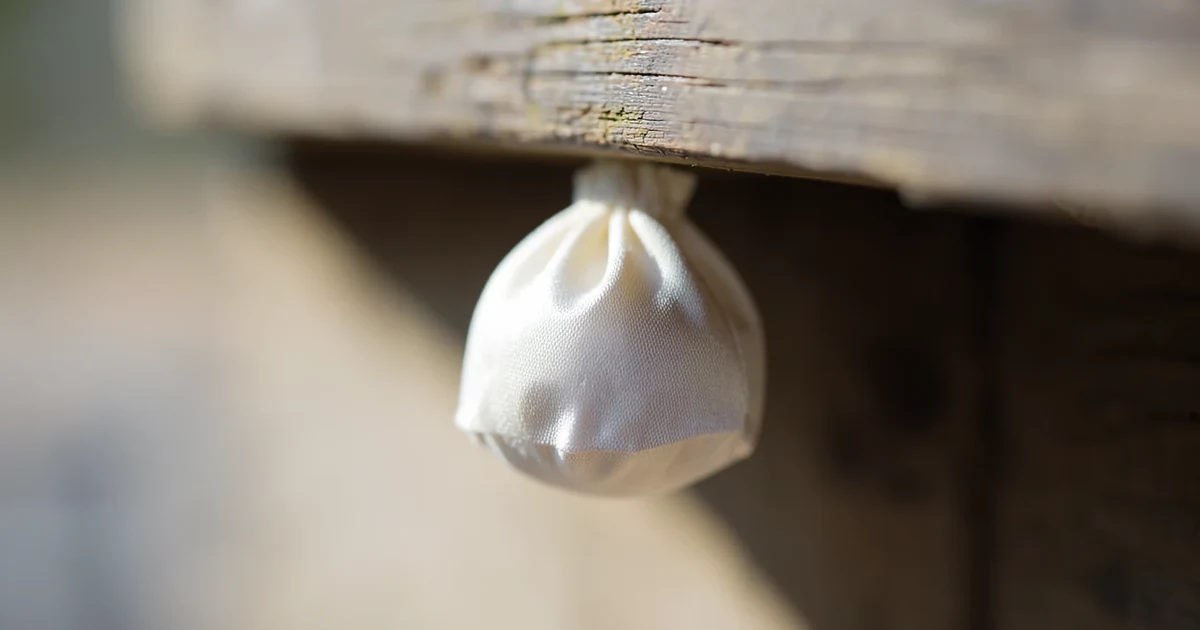
An egg sac is often easier to identify than the spider, because it is stationary, it stays for weeks, and the construction differs sharply between families.
It is also the only thing you will find in some cases — the female may be dead or hidden — and it tells you what is living where you found it.
The one worth recognising
Brown widow — the sac is covered in silk spikes or tufts, like a small sea urchin, tan to grey, 8–12 mm. Nothing else in North America makes anything like it.
Brown widows are spreading through the southern United States and southern California, and the sac is a more reliable identification than the spider, whose colouring is variable enough to be unhelpful.
Black widow — smooth, pale cream to grey, pear-shaped or spherical, 8–12 mm, with a papery surface. Suspended in an untidy tangle web, usually in a dark void — under a pot rim, in a meter box, under outdoor furniture. Often several in one web.
Finding either means widows are established there rather than passing through, and the places to check are listed in are there black widows where you live.
The common harmless ones
| Sac | Looks like | Where |
|---|---|---|
| Common house spider | Pale brown, papery, teardrop-shaped, often several | Tangle web in a corner |
| Cellar spider | A loose bundle of eggs with minimal silk, carried in the jaws | Held by the mother, ceiling corners |
| Wolf spider | Smooth grey-white ball attached to the spinnerets and dragged | On the mother, ground level |
| Nursery web spider | Carried under the body in the jaws, later in a silk tent | Vegetation |
| Orb weaver | Large, fluffy, often golden or brown, papery | Attached to vegetation or under an eave |
| Yellow sac spider | Small flat white pouch | Wall-ceiling junctions, behind pictures |
| Jumping spider | Small flat silk retreat with eggs inside | Under bark, in crevices |
The cellar spider one is striking if you see it — a female with a visible cluster of eggs held in her chelicerae, essentially unwrapped. She carries them until they hatch.
The wolf spider carries hers attached to her spinnerets, and after hatching the young ride on her abdomen, which is worth knowing before you find a spider that appears to be covered in moving specks — see wolf spider or nursery web spider.
When it will hatch
Timing varies by species and temperature. Broadly:
- Sacs laid in late spring or summer hatch in two to four weeks.
- Sacs laid in autumn usually overwinter and hatch in spring.
- Indoors, with central heating, autumn sacs may hatch out of season.
Spiderlings often stay in a cluster near the sac for a few days after emerging, then disperse — many by ballooning, releasing silk threads and lifting off on air currents. That is where the gossamer on autumn grass comes from.
Removing one
Indoors, if you would rather not have a few hundred spiderlings:
- Vacuum it. Simplest, and it takes the sac and its contents in one go. Empty the vacuum outside afterwards.
- Scrape it into a container and put it outside, if you would rather it survived.
- Do not crush it in place. Sacs are tough and crushing tends to release the contents rather than destroy them.
Outdoors, leaving them is generally the better choice. Orb weaver sacs under eaves produce the spiders that spend next summer eating flies around your house.
What is not an egg sac
- A cocooned prey item. Spiders wrap prey in silk and store it in the web. It is usually a different shape — elongated rather than spherical — and often has legs or wings showing.
- A moth or butterfly cocoon, which is denser and usually attached differently.
- A silk retreat with no eggs in it, which is where the spider sleeps. Jumping spiders and yellow sac spiders both build them, and they are flat rather than rounded.
- Mealybugs and woolly aphids on plants, which are white and fluffy and are insects.
- Spider mite webbing, which is fine, sheet-like and covers leaf surfaces rather than forming a discrete ball.
The one to check first
If you are in the southern United States and find a spiky tan sac, look for the spider before removing it — brown widows are frequently in numbers, and the sac tells you they are breeding rather than visiting. Elsewhere, the overwhelming majority of egg sacs found in and around a house belong to house spiders and orb weavers, and neither is worth acting on.
Species referenced
If you think you were bitten
- Most suspected spider bites are not spider bites. Studies of patients presenting with a “spider bite” repeatedly find that the large majority are bacterial skin infections — frequently MRSA — which need antibiotics rather than reassurance. A spreading, painful, pus-filled sore is far more likely to be an infection than a spider.
- Wash it, ice it, and watch it. Clean the area with soap and water, apply a cold pack, and keep an eye on it.
- Get medical care if the wound spreads or darkens, if you develop cramping, sweating, fever or severe abdominal pain, or if you are confident it was a widow or a recluse.
- Bring the spider only if it is already dead and to hand. Do not go looking for it. Doctors treat symptoms, not species.
In the US, the Poison Help line is 1-800-222-1222. This site is a reference, not medical advice.
Keep reading
- Identifying a Spider by Its WebWeb architecture is fixed by family, so the web identifies the group even when the spider is hidden. Four shapes cover almost everything you will find.
- Are There Black Widows Where You Live?Four widow species cover most of the United States between them, and the brown widow is still spreading. The range is far wider than the recluse's.
- Black Widow or Common House Spider? Look UnderneathWidows and house spiders build the same messy web in the same dark corner. The red hourglass underneath is the whole test — plus three backup checks including the egg sac.