

Identifying a Spider by Its Web
By IdentifyThese Editorial · Reviewed · 4 min read
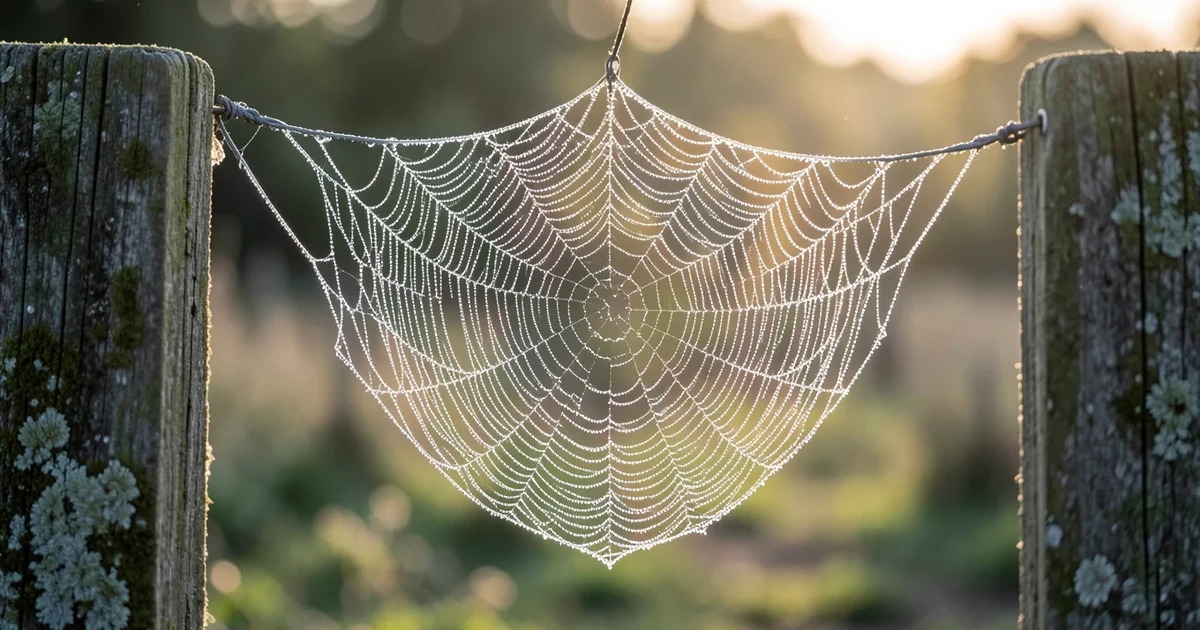
The web stays put while you look at it, which is more than can be said for the spider. And because web architecture is fixed at the family level rather than varying with the individual, it identifies the group reliably.
Four shapes cover nearly everything.
Orb — the wheel
Radiating spokes crossed by a spiral, hung vertically in an open gap where flying insects travel. Rebuilt frequently, often nightly.
Who — orb weavers: garden spiders, cross orbweavers, marbled orbweavers, spiny-backed orbweavers, golden silk orbweavers, joro spiders.
Significance — none. No orb weaver in North America is medically significant. The large spider in the middle of an impressive web across a garden path in September is harmless.
The character to look for is the empty hub at the centre. The spiral does not continue into the middle — there is a free zone where the spider sits or where a signal thread runs to a retreat. That distinguishes a genuine spiral from a set of concentric rings, which is what people often remember seeing.
Funnel — the sheet with a tube
A flat horizontal sheet, often over grass or in a corner, with a tube retreat leading back into a gap. The spider waits in the tube and runs out along the sheet.
Who — grass spiders, house spiders, the hobo spider.
Significance — none in North America. The Australian funnel-webs, which are genuinely dangerous, are unrelated and are not in this hemisphere. The hobo spider's reputation did not survive review.
Sheet webs over lawns, conspicuous with dew on an autumn morning, are grass spiders and there will be a great many of them.
Tangle — the untidy three-dimensional mess
No plane, no pattern, threads running in every direction, usually in a corner or a void, often with a dense retreat at one edge.
Who — cobweb spiders: the common house spider, false widows, and the widows.
Significance — this is the one to look at. Widows build tangle webs, and the web is often the first indication.
Two things distinguish a widow's from a house spider's: the silk is noticeably strong, enough to be audible when broken, and the retreat is a dense funnel of thick silk. Then look for the spider's underside, since the marking is there rather than on top — black widow or common house spider.
Sheet — the hammock
A dome or bowl of fine silk slung beneath a scaffold of support threads, sometimes with a second looser layer below. The spider hangs underneath and pulls prey through.
Who — sheet weavers and bowl-and-doily spiders. Recluses also build a small, scruffy, irregular sheet in undisturbed dark places.
Significance — the sheet weavers are harmless. A recluse's sheet is small, messy and hidden — in a box, behind stored material, in a wall void — and looks like nothing designed. It is not the neat hammock of a bowl-and-doily spider strung in vegetation.
The summary
| Web | Family | Worth a second look? |
|---|---|---|
| Neat wheel with an empty hub | Orb weavers | No |
| Flat sheet with a tube retreat | Funnel weavers | No |
| Untidy 3D tangle, dense retreat | Cobweb spiders — including widows | Yes |
| Slung hammock, sometimes two layers | Sheet weavers — and recluses | Yes, if small and scruffy in the dark |
The useful summary: neither medically significant group builds a patterned web. A neat, geometric, impressive web means an animal that is not a concern. An untidy mess in a dark corner is the one to look at properly.
Webs that are not capture webs
- Jumping spiders and wolf spiders build silk retreats and no capture web at all. A small silk pouch in a ceiling corner is a yellow sac spider or a jumping spider rather than evidence of a web-builder.
- Egg sacs are silk and are not webs. A spiky tan one is a brown widow, which is worth knowing.
- Draglines — the single line a jumping spider trails behind itself.
- Gossamer — the sheets of silk across grass on autumn mornings, produced by small spiders ballooning on air currents.
Where the web is, is information too
Orb webs go where flying insects travel: gaps between plants, doorways, across paths, over water.
Tangle webs go into voids: under furniture, in corners, under a pot rim, in a meter box — which is exactly the list of places widows are found, and why knowing whether widows are in your area is worth pairing with knowing what their web looks like.
Species referenced
If you think you were bitten
- Most suspected spider bites are not spider bites. Studies of patients presenting with a “spider bite” repeatedly find that the large majority are bacterial skin infections — frequently MRSA — which need antibiotics rather than reassurance. A spreading, painful, pus-filled sore is far more likely to be an infection than a spider.
- Wash it, ice it, and watch it. Clean the area with soap and water, apply a cold pack, and keep an eye on it.
- Get medical care if the wound spreads or darkens, if you develop cramping, sweating, fever or severe abdominal pain, or if you are confident it was a widow or a recluse.
- Bring the spider only if it is already dead and to hand. Do not go looking for it. Doctors treat symptoms, not species.
In the US, the Poison Help line is 1-800-222-1222. This site is a reference, not medical advice.
Keep reading
- Are There Black Widows Where You Live?Four widow species cover most of the United States between them, and the brown widow is still spreading. The range is far wider than the recluse's.
- Jumping Spiders: How to Recognise the Ones Watching You BackTwo enormous forward-facing eyes and a habit of turning to look at you. Jumping spiders have the best vision of any spider and are entirely harmless.
- Spider Bite or Skin Infection? How Doctors Actually TellMost wounds presented as spider bites are not spider bites. What separates the two, why the distinction matters urgently, and the questions a clinician will ask.